

Stop Heat Killing Your Car Scents: 4–6 Week Hangers for UK Drivers
Choose heat-stable formats and skip anything liquid sitting exposed on the dashboard. Solid ceramic, polymer blocks, and sealed slow-release hangers hold their scent profile far longer in a hot cabin than gels, paper, or open vent-clip oils, which evaporate fast and risk leaking onto trim. Keep any liquid product out of direct sun and off soft-touch plastics, and lean toward a slow-release hanger placed away from the windshield line for the most consistent result.
TL;DR:
- Solid ceramic, polymer blocks, and sealed slow-release hangers are the most heat-resistant car scent formats, outperforming gels, paper, and vent clips in hot conditions.
- Fragrance notes like citrus and mint tend to fade faster in heat, while woody, amber, and green scents age more gracefully and last longer.
- Keeping any liquid or open product away from direct sun, soft plastics, and dashboard surfaces prevents interior damage and prolongs scent life.
- Placement of scent products affects longevity, with rearview mirror hangers and under-seat spots generally lasting longer in high temperatures.
- Testing for heat durability should include a spot test on hidden trim, placement away from direct sunlight, and a scent check after a day in full sun.
Table of Contents
- How Heat and Sunlight Change Car Fragrances
- Which Air-Freshener Formats Resist Heat Best
- Safety and Material Compatibility: Avoid Stains, Fogging, and Damage
- Placement and Usage Tips to Extend Scent Life in Heat
- Choosing Scent and Intensity for Hot Conditions
- Why Slow-Release Hangers Suit Heat-Prone Driving
- How I Check Whether a Car Scent Actually Holds Up in Heat
- Getting Started With Voidescent’s Heat-Ready Scent Hangers
- Sources
- FAQ
How Heat and Sunlight Change Car Fragrances
A parked car in direct sun works like a small greenhouse. Cabin temperatures climb well past the outside air, and that heat does two things to a fragrance at once: it speeds up evaporation, and it speeds up chemical breakdown from UV exposure. Lighter, brighter notes (citrus, mint, some florals) tend to “burn off” first because their molecules are smaller and evaporate more readily, leaving heavier base notes to dominate after a few hot days.
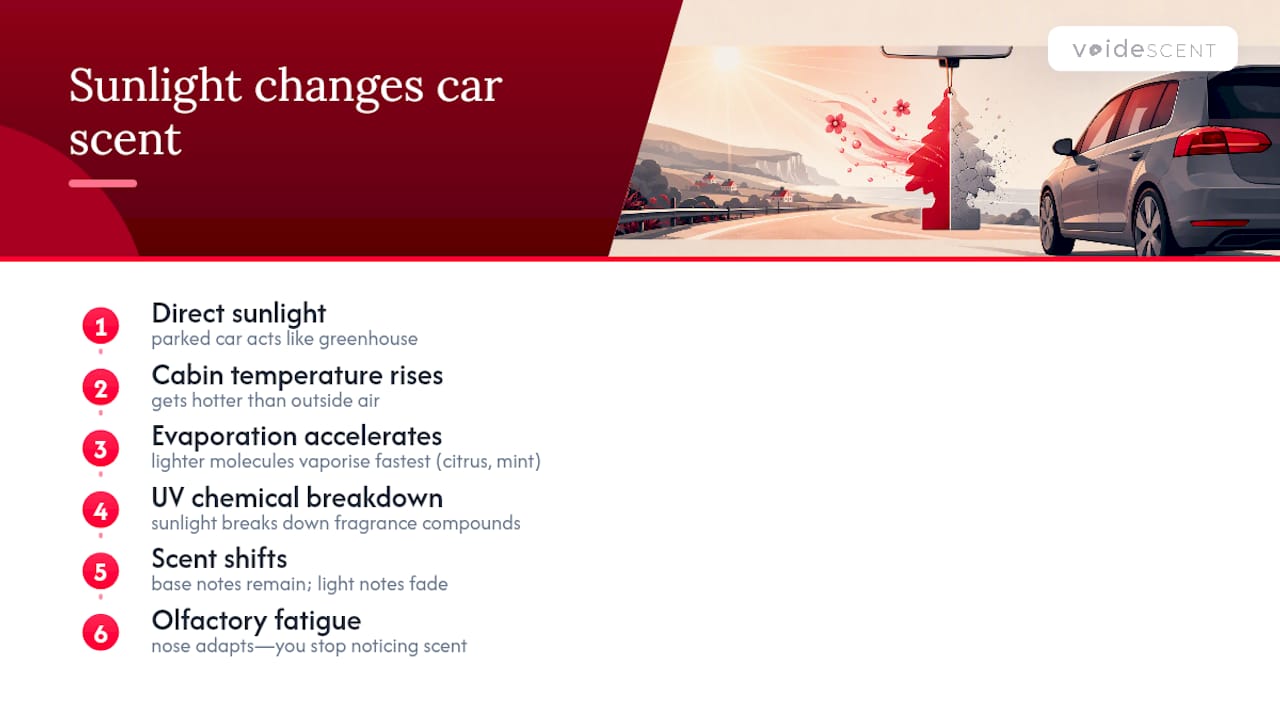
Car interiors trap heat and off-gas volatile organic compounds faster as temperatures rise, which is part of why fragrance chemistry behaves differently in a hot cabin than it does in open air, according to IQAir’s research on cabin air quality. That is also why fragrance oils built with high-flashpoint carriers hold up better under sustained heat.
There is a perception trap here too. Your nose adapts to a scent within minutes through olfactory fatigue, so a car can smell “gone” to you long before the product is actually empty. A friend getting into your car for the first time will usually notice scent you have stopped registering entirely.
Which Air-Freshener Formats Resist Heat Best
Format matters more than brand when it comes to surviving a hot dashboard. Testing on air freshener types consistently shows that solid and slow-release formats outperform anything liquid once temperatures climb.
- Solid ceramic or stone diffusers: melt-proof, leak-proof, and the most stable under sustained heat.
- Solid polymer or wax blocks: nearly as stable, with slower, more even release.
- Fragrance oils in sealed, slow-release hangers: strong performance if the oil carrier and seal are heat-rated.
- Gel canisters: can soften or separate in extreme heat, changing scent throw.
- Paper or cardboard hangers: cheapest, but they dry out fastest and shift scent character quickly.
- Vent clips and liquid diffusers: strongest initial scent, but testing by BHG found they wear out faster once the HVAC system runs heavily.
Match the format to how you actually park. Street parking in full sun all day calls for something solid or fully sealed. A garaged car with occasional highway use has more flexibility.
Safety and Material Compatibility: Avoid Stains, Fogging, and Damage
Heat does not just shorten scent life. It raises the odds that a fragrance product damages the interior around it. Concentrated fragrance oils and aggressive solvent carriers can etch dashboard plastic or cloud a soft-touch coating if they make contact while hot, and liquid diffusers or glass bottles are the most common source of that kind of accident, per material compatibility guidance from a fragrance oil manufacturer.
Follow a few rules before anything goes into a hot cabin:
- Never set a bottle or open container directly on the dashboard, even briefly.
- Keep liquid products away from soft-touch plastics, leather, and touchscreens.
- Store bottles upright and fully sealed when the car is parked for the day.
- Spot-test any new fragrance oil on a hidden trim panel before regular use.
- Check packaging for IFRA compliance and fragrance concentration guidance.
Manufacturers commonly run oven-based panel tests to check for staining and fogging before releasing a product for automotive use, a standard practice for fragrance oils in vehicles.
Pro Tip: Do a 24-hour spot test on a scrap of interior trim or an inconspicuous panel edge before hanging any new oil-based product near soft-touch surfaces. If you see no discoloration or tackiness after a full day of sun, you are clear to use it normally.
Placement and Usage Tips to Extend Scent Life in Heat
Where you hang or set a scent product changes how long it lasts almost as much as the format does.
- Rearview mirror hangers work well for oils and ceramics, as long as they stay clear of the windshield’s direct sun line.
- Under-seat placement suits gel canisters and shields them from UV exposure entirely.
- Door pockets work for backup products but expose them to more temperature swings.
- Avoid vent clips if you run your A/C or heater constantly. Car and Driver’s testing found vent-mounted options can last around 30 days under light use but degrade much faster with heavy blower use.
- Use a sunshade on hot days and pull any liquid product out of the car if it will sit parked in full sun for more than a few days, a step confirmed to extend scent life in independent testing.
Choosing Scent and Intensity for Hot Conditions
Heat rewards patience. Woody, amber, and green scent families tend to age more gracefully than sugary or fruity ones because their molecular structure resists breakdown better, a pattern Car and Driver’s reviewers noted across multiple product tests. Sweet top notes fade fast in heat and can leave an unbalanced, artificial smell behind.
New products often smell strongest in the first day or two. Crack a window or let the car air out before your first drive with a fresh scent, rather than sealing the cabin shut immediately. If you rotate scents seasonally, oil-based products generally hold a steadier, longer perceived scent life than water-based sprays, which lean on quick bursts rather than gradual release.
Why Slow-Release Hangers Suit Heat-Prone Driving
Voidescent’s scent hangers are built around slow-release botanical fragrance oils designed to hold a consistent, evolving aroma for four to six weeks rather than spiking hard and fading fast. That release curve matters most exactly when heat is working against you. Hang them away from direct windshield sun, keep the seal intact when the oil is refreshed, and avoid letting the wick or reservoir touch dashboard plastic. Full placement guidance is available for readers who want the exact spot to hang one.
How I Check Whether a Car Scent Actually Holds Up in Heat
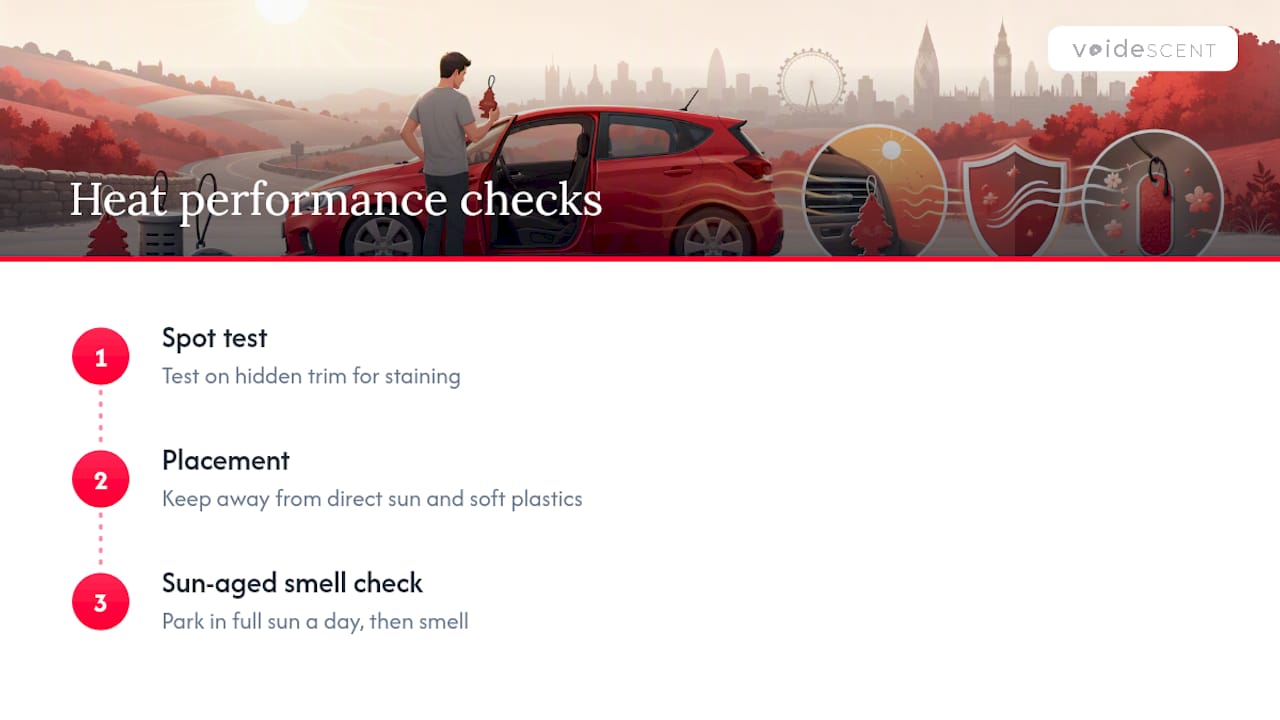
Evaluating a car fragrance for heat performance comes down to three checks, and you can run all three yourself. First, a spot test on hidden trim to rule out staining. Second, placement away from direct sun and soft plastics. Third, a smell check after the car has sat in full sun for a day, since that is when weak formats fall apart fastest.
What surprises most people is that the products failing hardest in heat are usually the ones that smelled strongest on day one. A fragrance that hits you immediately is often burning off its lightest, most volatile molecules first, which is exactly the scent profile that heat destroys fastest. Slower, subtler release tends to mean a longer, steadier life in a hot cabin, not a weaker one.
— Azanone
Getting Started With Voidescent’s Heat-Ready Scent Hangers
Slow-release scent hangers solve the problem of fast fading, harsh chemical bursts, and interior risk from exposed liquids. Three options fit most cabins and climates.
Heavens leans into lighter, airy botanical notes and works best hung away from direct sun exposure on the rearview mirror. Descent carries a deeper, woody base that tends to hold up especially well through sustained cabin heat. Nebula blends both registers and suits drivers who want an evolving scent profile across its full four to six week cycle.
Every product ships with a satisfaction guarantee, so testing one in your own car and climate carries no real risk. Pick the option that matches your scent preference and place your order directly on the product page.
Sources
- Chemicals indoors: what’s in car air? | IQAir
- The 5 Best Car Air Fresheners, Tested by BHG
- Car Air Care: Heat/UV & Material Compatibility - Fragrance Oils Manufacturer
- Which Type of Car Air Freshener You Should Buy | Car and Driver
FAQ
What Is the Best Car Air Freshener for Hot Weather?
Solid ceramic diffusers, polymer blocks, and sealed slow-release hangers with heat-stable oil carriers perform best because they resist melting, leaking, and rapid evaporation.
Why Does My Car Smell Bad When the Heat Is On?
Running the heater or A/C heavily speeds up dispersal from vent clips and diffusers, which shortens their lifespan and can let stale cabin odors resurface once the fragrance fades faster than expected.
What Is the Best-Smelling Car Scent for Summer?
Woody, amber, and green scent families tend to age more evenly in heat than sugary or fruity ones, which can turn sharp or artificial-smelling once their lighter top notes burn off.
How Do I Keep My Car Smelling Nice All the Time?
Choose a heat-stable, slow-release format, keep it out of direct sun and off soft-touch plastics, and rotate or replace it before it fully fades rather than after the cabin already smells stale.