

6 Fast Ways to Reactivate a Car Air Freshener
Yes, you can usually bring a faded car air freshener back to life instead of buying a new one. Felt, cardboard, and wood hangers respond well to a few drops of essential oil. Spray bottles just need a fresh refill mix. Gels are trickier, but a dying gel still earns a second life tucked into a glovebox or drawer. The one rule that matters: go light on the oil and test for stains before you commit.
TL;DR:
- Porous materials like felt, cardboard, and wood respond well to adding a few drops of essential oil, which can revive scent for one to two weeks with proper application.
- Gel fresheners are difficult to rehydrate and often better repurposed into smaller enclosed spaces rather than attempting water or household oil reactivation.
- Spray bottles should be refilled with a mixture of alcohol, water, and essential oil, and the nozzle cleaned beforehand to prevent clogging and ensure consistent scent release.
- Placement away from direct airflow, heat, and sunlight prolongs fragrance life, making strategic hanging and storage key to maintaining scent longevity.
- Avoid using harsh chemicals like acetone and always test before reactivating to prevent damage or staining, especially with porous materials.
Table of Contents
- How Do You Reactivate a Car Air Freshener?
- Quick Hacks: 6 Fast Ways to Refresh Scent Right Now
- Step-by-Step: Reactivating by Freshener Type
- Where You Hang It Determines How Long It Lasts
- What to Avoid When Reactivating a Freshener
- When DIY Refreshing Makes Sense (and When It Doesn’t)
- A Longer-Lasting Option When You’re Done Topping Up
- Sources
- FAQ
How Do You Reactivate a Car Air Freshener?
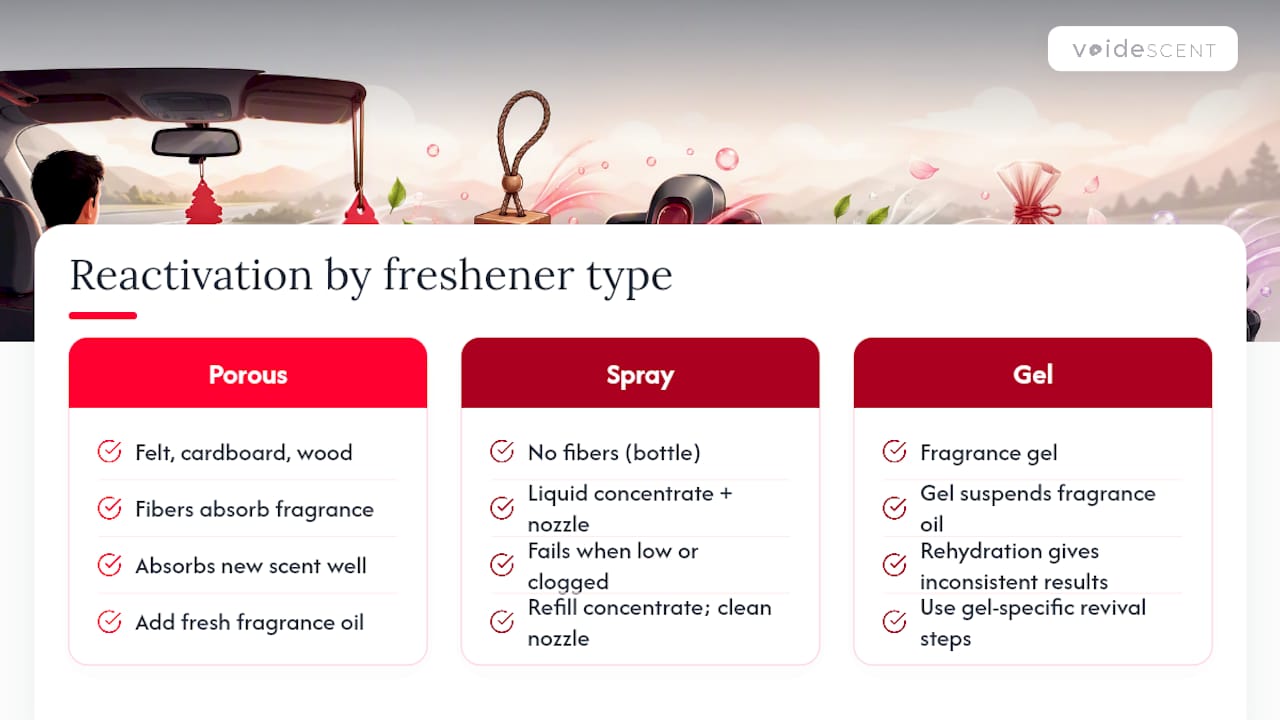
Reactivating a car air freshener means reintroducing fragrance to a material that has lost its scent through evaporation, not necessarily replacing the whole product. Porous materials like felt, cardboard, and wood act like little sponges. Once the original fragrance oil evaporates, the fibers are still there, just dry. Add new scent and they absorb it the same way they did the first time.
Spray bottles work on a different principle. There’s no fiber to reload, so a stalled spray usually means the fragrance concentrate ran low or the nozzle clogged with dried residue. Gels are the outlier. They rely on a gelling agent holding fragrance oil in suspension, and once that gel skins over or dries out, rehydration attempts with water or household oils produce inconsistent results at best. That’s why gel revival gets a different set of instructions than the felt-and-wood crowd.
Knowing which category your freshener falls into is the whole game. Try to treat a gel like a piece of felt and you’ll end up with a sticky mess and no extra scent to show for it.
Quick Hacks: 6 Fast Ways to Refresh Scent Right Now
If you need a fix before your next drive, start here.
- Essential oil top-up. Add 3 to 7 drops of concentrated essential oil directly onto felt, cardboard, or wood. Let it sit for 2 to 3 minutes before hanging it back up so the fibers absorb the oil instead of dripping it onto your seat or dash.
- DIY spray refill. Mix rubbing alcohol or vodka with distilled water and a few drops of essential oil, then pour it into the empty bottle. The alcohol helps the oil disperse evenly instead of floating on top, which keeps the spray consistent instead of sputtering out pure water first and then a blast of fragrance.
- Vent-clip or clothespin trick. Put a couple of drops on a spare felt pad, cotton ball, or wooden clothespin and clip it to the vent. The airflow does the diffusing for you.
- Gel repurpose. Skip trying to rehydrate a dried gel with water. Instead, drop it into a glovebox, center console, or drawer where it can keep working in a smaller, more contained space.
- Warm-up trick. A few minutes of sun or a warm cabin (short exposure only) softens porous materials just enough to help fresh oil absorb faster. Don’t leave it baking for hours, since heat is also what dried it out in the first place.
- Know when to skip it. Sealed plastic units with no visible pad, anything coated in grease or grime, or a freshener with visible residue or discoloration isn’t worth reactivating. Replace those instead.
Pro Tip: Layer a heavier base note like cedarwood or sandalwood underneath a lighter top note. Base notes evaporate slower, so the refreshed scent lasts longer than a single bright note applied alone.
Step-by-Step: Reactivating by Freshener Type
Different materials need different handling. Here’s how to do it right for each one.
Felt, cardboard, or wood hangers:
- Start with 5 to 7 drops of essential oil spread across the surface, not pooled in one spot.
- Let the material absorb the oil for 2 to 3 minutes before hanging it in the car.
- Expect a refresh that lasts about one to two weeks before you need to top up again.
- Add 2 to 3 fewer drops on each subsequent top-up since some residual oil usually remains in the fibers.
Two-piece plastic or pad diffusers:
- Check whether the casing snaps apart or twists open. Forcing a sealed unit usually cracks the plastic.
- Remove the internal felt or foam pad and apply oil directly to it, away from the plastic housing.
- Let the pad absorb before reassembly, and confirm the casing clicks fully shut so nothing leaks onto your upholstery.
Gel fresheners: Because gels depend on a solvent to hold fragrance in suspension, water alone rarely restores them. A small amount of light mineral oil or baby oil sometimes softens the gel surface, but results are inconsistent and carry some staining risk. Treat rehydration as a low-odds experiment rather than a reliable fix, and lean on repurposing in an enclosed space instead.
Spray bottles:
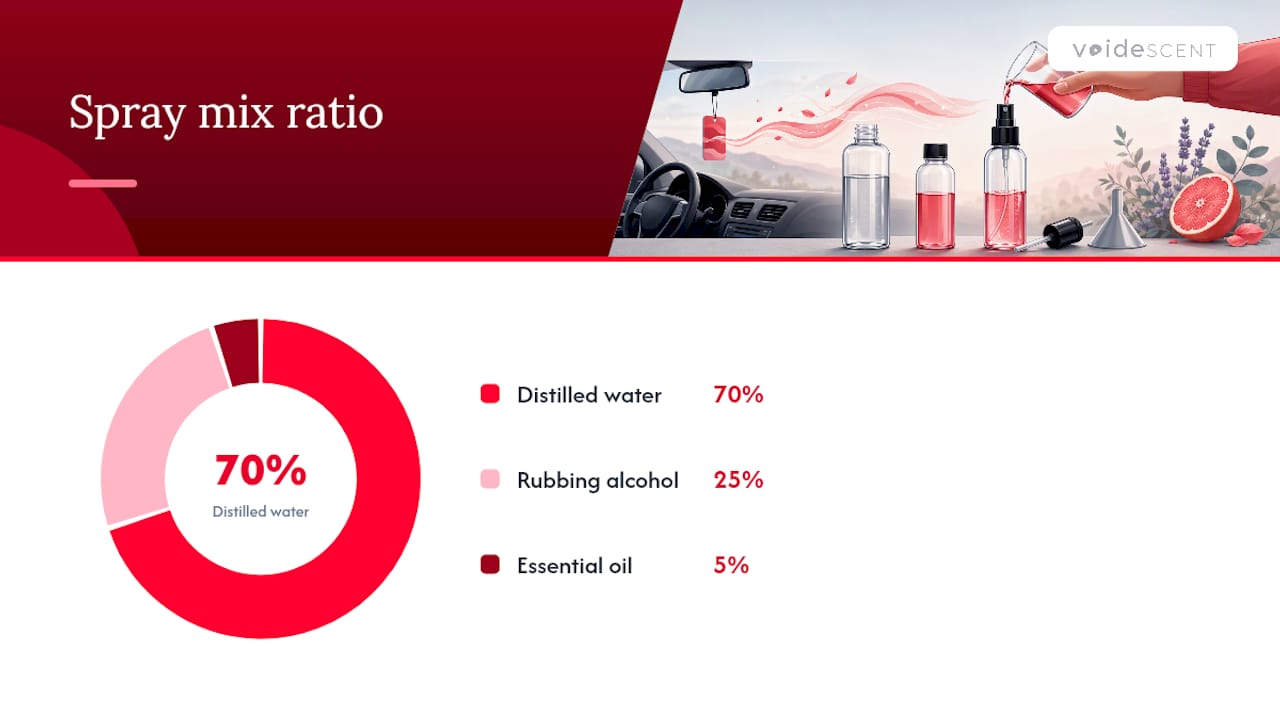
- Mix roughly 70% distilled water, 25% rubbing alcohol, and 5% essential oil as a starting ratio.
- Rinse the nozzle in warm water first to clear dried residue that causes clogging.
- Prime the pump with a few test sprays into a paper towel before using it in the car.
Where You Hang It Determines How Long It Lasts
Where you put a reactivated freshener matters as much as how you reactivate it. Three environmental factors drain scent faster than anything else:
- Direct airflow. A vent clip catches every blast of AC or heat, which speeds up evaporation dramatically.
- Heat and sunlight. A dashboard baking in direct sun turns your fragrance oil to vapor in a fraction of the time it would take in shade.
- Humidity. Damp conditions can interfere with how evenly porous materials release scent.
Hanging a freshener on the rearview mirror, away from direct vent blast, or clipping it to a lower console vent at an angle that avoids point-blank airflow both work better than centering it directly in the strongest airflow path. If you’re storing spare fresheners for later, seal them in airtight bags and keep them somewhere cool and dark, never on a dashboard or in direct sun. For more on where scent actually holds up best, Voidescent’s guide on where to hang a car air freshener breaks down specific placement zones.
Heat parked inside a closed car accelerates fragrance oil evaporation well beyond what happens at room temperature, which is exactly why a freshener that smells strong in your garage fades within days once it’s baking on your dash. Once you’ve reactivated a freshener, plan on a light oil top-up weekly, or a fuller refresh every 1 to 2 weeks depending on placement and heat exposure. When a hanger stops holding scent at all even right after a fresh application, that’s your signal the material itself has broken down and it’s time to replace it.
What to Avoid When Reactivating a Freshener
A few materials and shortcuts cause more harm than good.
- Skip industrial solvents. Acetone, MEK, and similar chemicals can damage plastic housings, interior surfaces, and your lungs if used in an enclosed car. They’re not worth the risk for a $3 air freshener.
- Spot-test first. Apply a single drop to an inconspicuous corner of the material, wait a few minutes, and blot any excess with a paper towel before reinstalling it in the car.
- Watch concentration near passengers. Keep oil amounts modest, especially with kids or pets riding along, and crack a window after the first application to let strong scent dissipate.
- Know your stop-and-replace signals. Persistent odor that won’t fade, sticky residue on the material, or visible breakdown of the felt or plastic means it’s time to toss it, not treat it.
For more on which oils are actually safe to use in a vehicle interior, Voidescent’s breakdown of fragrance oils versus essential oils covers what to look for on a label.
Pro Tip: Never reinstall a freshener while it’s still wet with oil. Give it the full absorption window first, or you’ll end up with a stain on your seat and a scent that fades twice as fast because half the oil evaporated before it ever reached the fibers.
When DIY Refreshing Makes Sense (and When It Doesn’t)
Some brands build slow-release botanical hangers designed to hold a consistent, evolving scent for several weeks without any topping up. DIY reactivation is a smart, cheap fix when you’re stretching a freshener a few extra days before a road trip. But if you’re refilling the same hanger every week, that’s usually a sign the base material or oil quality has hit its limit, and a hanger engineered for slow release will save more time than it costs.
— Azanone
A Longer-Lasting Option When You’re Done Topping Up
Constant refilling gets old fast, and Voidescent built its lineup for exactly that fatigue. Heavens leans into a soft, ambient botanical blend designed for slow release over weeks, not days. Descent offers a deeper, more grounded scent profile for drivers who want something that doesn’t fade into the background by day three. Nebula is built around an evolving fragrance that shifts subtly as it releases, so the car doesn’t smell identical on week one and week four.
Each is a minimalist scent hanger made with eco-friendly ingredients instead of the harsh synthetics packed into most disposable fresheners, and some are backed by a money-back guarantee if they don’t perform. If you’re tired of counting drops and mixing spray bottles every weekend, compare notes and pick one on the Voidescent product pages and let a single hanger handle the next month and a half on its own.
Sources
For deeper technique detail and safety context beyond what’s covered here, these resources are worth a look:
FAQ
How Do You Reactivate a Car Air Freshener?
Add a few drops of concentrated essential oil to felt, cardboard, or wood hangers and let them absorb for 2 to 3 minutes before reinstalling. For sprays, refill with a diluted alcohol and oil mixture; for gels, repurpose the freshener in a small enclosed space instead of trying to rehydrate it.
Can You Revive a Car Air Freshener That’s Completely Faded?
In most cases, yes, especially with felt, cardboard, or wood materials that still have functional fibers. A fully dried gel is the exception since it often can’t fully rehydrate, though it still works well tucked into a glovebox or drawer.
How Do You Reactivate a Refresh-Style Car Air Freshener?
Two-piece plastic diffusers with a removable pad open by snapping or twisting apart. Apply oil directly to the internal pad, let it absorb, then reassemble and confirm the casing seals fully before hanging it back up.
How Do You Make an Air Freshener Work Again After It Stops Smelling?
Check what type of freshener you have first. Porous materials need a light oil top-up, sprays need a fresh alcohol-and-oil refill, and gels usually respond better to relocation into a smaller space than any attempt at rehydration. If none of that revives the scent, a slow-release option like Nebula skips the guesswork entirely for the next several weeks.