

UK Drivers: Azanone Explains Air Fresheners, Airbags and MOT Risk
Yes, air fresheners can interfere with airbags and cause MOT problems, but only in specific, avoidable situations. Liquid containers stuck to the dash can sit inside an airbag’s deployment path, and anything hanging near the mirror can obstruct your view enough to fail an MOT or draw a fixed penalty. The fix is simple: check what’s on your dash and mirror right now, then read on for exactly where these risks come from and how to place a scent product safely.
TL;DR:
- Placing liquid air fresheners or bulky objects on the dashboard can cause airbags to deploy projectiles or trigger MOT failures due to obstructed views.
- Items pinned near the mirror or on the dash often violate UK regulations requiring an unobstructed view and are frequently flagged during MOT checks.
- Safe placement of scent products includes low-profile vent clips, high-mounted small hangers, or sealed units away from airbags and sightlines.
- Active diffusers with liquid chambers pose higher risks of leaks and damage to electronics than passive, slow-release botanical hangers.
- During deployment or spills, immediate steps include ventilating, inspecting for damage, and consulting a garage if electronics are affected or warning lights appear.
Table of Contents
- How Airbags Deploy and Why Dashboard Clutter Is Dangerous
- Can an Air Freshener Cause You to Fail an MOT?
- Where Should You Actually Put an Air Freshener?
- Passive vs. Active Scent: Which Is Actually Safer?
- What to Do After a Deployment or a Spill
- Why Manufacturers Warn Against Liquid Bottles on the Dash
- How Heat and Humidity Change the Risk Picture
- Does the Chemical Makeup of an Air Freshener Matter Near Airbags?
- What Safety Authorities Actually Say About This
- Have There Been Real Incidents Involving Air Fresheners and Airbags?
- The Overlooked Trade-Off Between Style and Safety
- Where to Find Voidescent’s Safer Scent Hangers
- Sources
How Airbags Deploy and Why Dashboard Clutter Is Dangerous
An airbag isn’t stored loose behind a panel waiting to pop out. It’s folded tightly behind a molded seam in the dashboard, steering wheel hub, or door panel, seams designed to split open in milliseconds when a crash sensor triggers deployment. The bag then inflates at speeds that can exceed 100 miles per hour in the first fraction of a second. That force is the entire point. It’s also why anything sitting on or near that seam becomes a problem.
An object resting on the instrument panel, whether it’s a bottle, a clip, or a decorative hanger, doesn’t just get pushed aside. It can get launched. A rigid or liquid-filled container caught in that trajectory turns into a projectile capable of causing real injury to the driver’s face or chest. Kia’s owner documentation specifically warns against placing liquid air fresheners or similar accessories on the instrument panel or near the instrument cluster, because those zones frequently sit directly over hidden deployment paths.
There’s also a secondary effect worth knowing about. When an airbag fires, it releases a fine powder used to lubricate the bag as it unfolds. That dust can cause temporary eye or skin irritation, and it may aggravate asthma symptoms in sensitive occupants, according to post-deployment care guidance from Rhoads & Rhoads. None of this is exotic engineering. It’s a straightforward reason to keep the dash clear.
Can an Air Freshener Cause You to Fail an MOT?
It absolutely can, and this catches more drivers off guard than almost any other MOT detail. The Road Vehicles (Construction and Use) Regulations 1986 require every driver to maintain a full, unobstructed view of the road ahead and to the sides. That single requirement is broad enough to cover anything dangling from your rearview mirror, stuck to your windshield, or piled on your parcel shelf.
MOT testers and traffic officers use judgment here rather than a strict checklist, but certain setups are near-guaranteed trouble: a large hanging card freshener positioned directly in the driver’s sightline, multiple items clustered near the mirror, or anything mounted low enough to interrupt the view through the lower windshield. Elite Garages reports that garages regularly flag exactly this kind of accessory clutter during routine checks, sometimes resulting in an outright MOT fail. A traffic officer who judges your view obstructed can issue a fixed penalty on the spot, independent of any MOT timing.
Run a quick self-audit before your next test or long drive. Sit in the driver’s seat and ask: does anything hang below the top third of the windshield? Does anything sit directly in front of your eye line to the road? Is there more than one item competing for space near the mirror? If you answered yes to any of those, move it before a tester or officer does the judging for you.
Where Should You Actually Put an Air Freshener?
The safest placements share one trait: they stay well clear of both your sightline and any surface that might hide an SRS module. A few zones are strictly off-limits, and a few others work fine.
Avoid these spots entirely:
- The instrument panel or anywhere on the dash seam above a known airbag zone
- The steering wheel hub or spokes
- The passenger side dash directly above the front passenger airbag
- Anywhere below the top third of the windshield or clustered around the mirror
Safer alternatives that keep both view and deployment paths clear:
- Vent clips, which sit low and slim on the air vent fins rather than hanging free
- Low-profile hangers positioned on rearview mirror stems, but kept small and set high, away from direct eye line
- Under-seat or footwell diffuser options that release scent without occupying visible space
Liquid products deserve extra caution. If you’re using anything with liquid fragrance oil, keep the container sealed, mounted low, and away from direct sun exposure on the dash, since heat can cause leaks or pressure buildup inside cheap plastic housings. A look at safe placement strategy confirms that discreet, low-mounted positioning solves most of these problems at once.
Pro Tip: Pull up your vehicle’s owner manual before choosing a spot. Most manufacturers include a diagram showing SRS module locations, and five minutes with that page will tell you more about safe placement than any generic advice online.
Passive vs. Active Scent: Which Is Actually Safer?
Air fresheners split into two broad categories, and the difference matters more for safety than most drivers realize. Passive products, hangers, clips, and gel-based options, release scent slowly through evaporation with no moving parts and no exposed liquid reservoir. Active products, plug-in diffusers and spray systems, push fragrance out mechanically and often involve a refillable liquid chamber that can leak or rupture under heat and vibration.
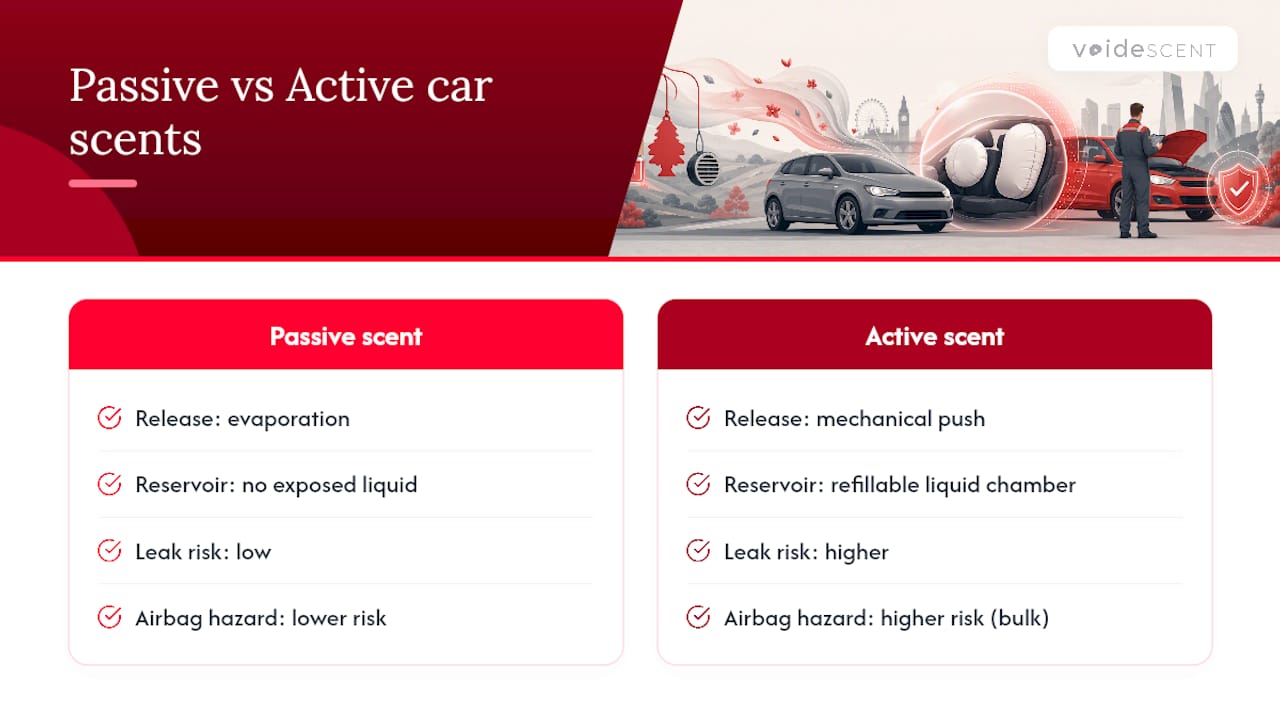
For airbag safety specifically, passive is the lower-risk category by default. There’s no bottle of liquid sitting exposed on a surface, no pressurized canister, nothing bulky enough to matter if it were ever caught near a deployment path.
This is exactly the design logic behind Voidescent’s own hangers. Heavens, Descent, Nebula, and Voidegrail are all low-profile botanical scent hangers built around a slow-release oil format rather than a loose liquid container, which cuts out both the spill risk and the bulk that make dashboard accessories dangerous in a deployment scenario. Whatever fragrance product you choose, though, check that it meets IFRA compliance standards and follow the manufacturer’s placement guidance rather than improvising.

What to Do After a Deployment or a Spill
If an airbag has deployed, check every occupant first. Rinse any powder residue from skin and eyes with clean water, and get medical attention if anyone is struggling to breathe or has ongoing eye irritation, following the same guidance Rhoads & Rhoads outlines for post-deployment dust exposure.
If instead you’re dealing with a spilled liquid air freshener, ventilate the car before doing anything else, and resist the urge to poke at any electronics near the spill yourself. Photograph the damage for insurance purposes, then clean the area with a method appropriate to your interior material rather than a generic all-purpose spray.
Book a garage visit if you notice a persistent airbag warning light, visible dashboard damage, or any sign that fragrance liquid reached wiring or sensor housings.
Why Manufacturers Warn Against Liquid Bottles on the Dash
The warning against dashboard liquid containers isn’t boilerplate legal language. It reflects a genuine engineering conflict between where people naturally want to place a freshener and where the airbag module actually lives.
Most front passenger airbags deploy upward and outward from a seam built directly into the dash surface, often spanning a wide section rather than a single small panel. That means the flattest, most tempting spot for a bottle, right on top of the dashboard, frequently overlaps with the exact zone engineered to split open in a crash. Kia’s SRS documentation makes this explicit, warning owners specifically against placing liquid air fresheners or comparable accessories on the instrument panel or near the instrument cluster because of this overlap.
There’s a second, quieter risk beyond the crash scenario itself. A bottle or gel container sitting in direct sun on a dashboard reaches temperatures well beyond what most fragrance packaging is designed for. Cheap plastic housings can warp, seals can weaken, and liquid can leak into the dash cavity underneath, an area that houses wiring harnesses and, in many vehicles, sensor connections tied to the SRS system itself. A Mirror investigation into dashboard mechanic warnings found that this kind of slow liquid intrusion is a recognized cause of dashboard electronics damage, not a rare fluke.
The practical takeaway is straightforward: whatever container holds your fragrance, keep it off the flat top of the dash entirely, and lean toward sealed, low-mounted formats that never depend on an open liquid reservoir sitting in direct light.
How Heat and Humidity Change the Risk Picture
Car interiors swing through some of the widest temperature ranges any consumer product has to survive. A dashboard can sit at room temperature overnight and climb past 140°F by early afternoon in direct sun, then cool again once the engine starts and air conditioning kicks in. That swing does two things at once: it degrades fragrance performance, and it raises the safety stakes for anything liquid-based sitting near the airbag zone.
On the performance side, heat accelerates evaporation unevenly. A liquid-based freshener that’s supposed to last a set number of weeks can burn through its scent in days once summer temperatures take hold, front-loading the fragrance and leaving nothing for the back half of its intended lifespan. Humidity plays a smaller but real role too, slowing evaporation in damp, cold months and making some products feel weaker than they actually are.
On the safety side, heat is the mechanism that turns a stable liquid container into a leak risk. Repeated thermal cycling stresses seals and plastic housings, and a container that seemed fine in the store can start seeping after a few months of dashboard sun exposure, right in a zone manufacturers already flag as an airbag deployment path.
Slow-release botanical formats sidestep most of this. Because they’re designed to diffuse gradually through a wick or porous material rather than through an exposed liquid pool, temperature swings affect intensity far less dramatically than they affect a sealed liquid reservoir, and there’s no growing pressure buildup to worry about as the cabin heats up.
Does the Chemical Makeup of an Air Freshener Matter Near Airbags?
It matters less for the airbag module itself and more for the plastics and electronics sitting around it. Airbag modules are largely enclosed and sealed, so a scent product isn’t going to chemically degrade the bag or its inflator through ambient exposure. The real concern is what a leaking liquid fragrance does to everything else under that dash panel.
Many synthetic air fresheners rely on solvent-based carriers to keep fragrance oils liquid and sprayable. Those solvents can be aggressive toward certain plastics and adhesives over sustained contact, the same plastics used in dashboard trim and the wiring conduits routed beneath it. A spill that seeps past the surface and pools against a connector or sensor housing tied to the SRS system creates exactly the kind of contamination that can trigger a false warning light or, worse, a genuine fault.
Botanical fragrance oils formulated for slow release generally avoid the harsh solvent load that comes with mass-market synthetic sprays, and because they’re designed to diffuse rather than pool, there’s simply less liquid volume available to cause damage even if a hanger does eventually leak. That’s a meaningful distinction if you’re choosing between a spray-based product and a hanger, less about which smells stronger and more about which one puts less liquid volume anywhere near sensitive components.
What Safety Authorities Actually Say About This
There’s no single dedicated regulator publishing rules that name air fresheners specifically, and that gap is part of why so much confusion exists. What does exist is a consistent, converging message from the sources that do carry weight: vehicle manufacturers, roadworthiness regulators, and the garage professionals who see the real-world consequences daily.
Manufacturer guidance, Kia’s SRS documentation among them, warns plainly against placing liquid accessories on or near the instrument cluster. UK roadworthiness law, through the Construction and Use Regulations 1986, sets the unobstructed-view requirement that governs anything hanging near your mirror. And detailer commentary reinforces both. Leasing Options advises removing hanging decorations before an MOT specifically because testers and officers treat sightline obstruction as a real, checkable fault rather than a technicality.
Read together, the guidance points in one direction: keep fragrance products off the dash surface, keep hanging items small and high enough to avoid the driver’s eye line, and treat manufacturer SRS diagrams as the final word on where not to place anything solid or liquid.
Have There Been Real Incidents Involving Air Fresheners and Airbags?
Documented, named incidents specifically tracing an airbag injury or malfunction back to an air freshener are rare in public reporting, and that scarcity is worth taking at face value rather than reading as reassurance. Most airbag-related dashboard object injuries that do get reported involve phone mounts, coffee cups, or aftermarket electronics rather than fragrance products specifically, simply because those items are bulkier and more commonly placed directly on the dash.
What’s better documented is the mechanical pathway that would make such an incident possible. Elite Garages has reported repeated cases of garages flagging accessory clutter, air fresheners among them, as MOT-relevant obstructions, and the same reporting confirms that objects positioned over dashboard seams face a genuine projectile risk during deployment, independent of whether a specific freshener-related injury has made headlines. The Mirror’s coverage of mechanic warnings similarly documents liquid intrusion damage to dashboard electronics as a recognized, recurring problem rather than a one-off.
The absence of a viral case doesn’t mean the risk is theoretical. It means the mechanism, a rigid or liquid-filled object sitting where an airbag needs to expand, has been well understood by manufacturers and garages long before it produces a news story, which is precisely why the warnings exist in owner manuals in the first place.
The Overlooked Trade-Off Between Style and Safety
Most guidance on this topic treats air fresheners as an afterthought to be tolerated or removed, not as a category worth designing well. That framing misses something real: drivers care how their car smells and looks, and pretending otherwise just pushes people toward whatever’s cheapest and most visible, which tends to be exactly the bulky, liquid-filled, dash-mounted products that carry the most risk.
The better answer isn’t fewer air fresheners. It’s smarter ones. A slow-release botanical hanger mounted low and secured properly solves the sightline problem and the deployment-zone problem at the same time, without asking anyone to give up scent they actually enjoy in their car.
Voidescent’s own design philosophy starts from that safety constraint rather than treating it as a footnote, favoring wick-based, low-profile formats over anything that depends on an exposed liquid reservoir. Before buying any car fragrance product, check its placement guidance against your own vehicle’s manual and prioritize a design that keeps liquid sealed and volume low.
— Azanone
Where to Find Voidescent’s Safer Scent Hangers
Voidescent built every hanger around the same constraint this whole guide has walked through: low profile, sealed botanical oil, and a slow release that runs four to six weeks without ever putting a liquid reservoir near your dash or your sightline. Every option mounts securely and stays clear of both the deployment zones manufacturers warn about and the view obstructions that trip up an MOT.
Heavens works well as an everyday entry point, a subtle, consistent scent for drivers who want something understated. Descent suits anyone after a longer, more secure hold for daily commuting. Nebula targets drivers who want a premium, design-forward option with the same discreet mounting. Voidegrail fits those who prefer a stronger, more assertive scent throw over a longer stretch.
If you’re ready to swap out whatever’s currently hanging from your mirror or sitting on your dash, browse the full scent hanger lineup or head straight to the Heavens product page to get started.
Sources
- SRS components and functions — Kia vehicle manual
- Legislation
- MOT fails and accessory risks — Elite Garages
- Airbag dust in eyes and post-deployment care — Rhoads & Rhoads blog