

Match Your Driving Needs: Gel or Oil Car Freshener
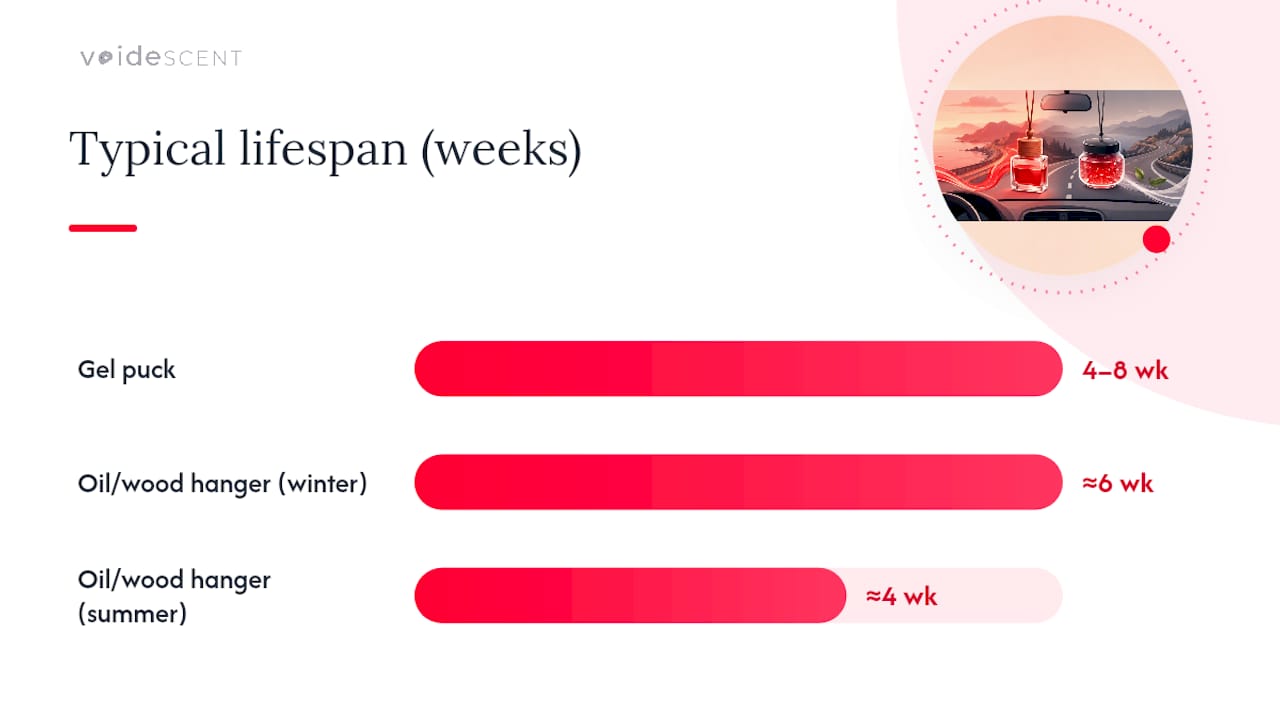
Gel fresheners win on low maintenance and spill resistance, running roughly 4 to 8 weeks on a steady, one-note scent. Oil-based hangers and wick diffusers win on scent quality, delivering a richer, evolving fragrance that shifts over its lifespan at the cost of a little more attention. Heat speeds up both. Odor elimination should always come before either one.
TL;DR:
- Gel fresheners typically last four to eight weeks with a consistent scent, while oil-based diffusers offer a layered and evolving aroma that may change over time.
- Spill resistance favors gels, as they are solid and less prone to leaks, whereas oil diffusers carry leakage risk if bottles crack or caps loosen.
- Heat accelerates evaporation in both formats, shortening their lifespan and altering scent intensity during hot weather.
- Oil diffusers and wood hangers often provide a more refined, dynamic fragrance experience, but require careful placement to avoid over-saturation or quick fading.
- Long-lasting scent is less important than choosing the format that aligns with your desired scent complexity and level of maintenance.
Table of Contents
- Gel vs Oil Car Freshener: How They Compare Where It Counts
- How Do You Choose Between Gel and Oil Car Fresheners?
- What Makes Gel and Oil Diffusers Smell Different for Weeks
- Where Voidescent Fits If You Want a Premium Evolving Scent
- Is the Longevity Debate Even the Right Question?
- Which Voidescent Scent Matches Your Car Freshener Goals?
- Sources
Gel vs Oil Car Freshener: How They Compare Where It Counts
The honest answer to “gel vs oil car freshener” depends on what you’re actually optimizing for: time, mess, or nose appeal. Here’s how the two formats stack up on the factors that actually change your day-to-day experience.
Longevity favors gel on paper. Gels typically hold scent for 4 to 8 weeks, and because they’re a continuous-release format, they burn down on a calendar schedule whether you drive daily or park the car for a week. Oil wick systems and wood hangers vary more. A well-made wood or felt hanger releases oil through evaporation from its surface, so a bigger surface or more exposed wick means a shorter but more intense life, and a smaller one stretches longer at lower intensity. You control that trade-off; a sealed gel puck doesn’t give you the option.
Spill risk is where gel has a clear structural advantage. It’s a solid matrix, not a liquid, so tipping the container over or a hot dashboard won’t send fragrance oil onto your seats or dash trim. Oil-based liquids carry real leakage risk if a bottle cracks, a cap loosens, or a hanger gets over-saturated during refilling. Placement matters here: keep any oil-based hanger away from direct vent airflow and off horizontal surfaces where a drip would land on upholstery.
Scent character is the part gel can’t compete on. Gel delivers one flat note from day one to day fifty. Oil and botanical hangers evolve, often opening brighter and settling into deeper notes over weeks, which is why premium diffusers get described as offering a more refined, evolving profile compared to a single-note gel puck.
- Gel: consistent, low-effort, shorter perceived complexity
- Oil/wood hangers: layered, evolving, more sensory payoff per sniff
- Powered atomizers: adjustable intensity, but require battery or 12V power
Temperature punishes both formats in a hot car, just differently. Heat accelerates evaporation in gels, which shortens their working lifespan and can make the scent feel stronger for a shorter window. Oils behave the same way, evaporating faster off a wick in summer heat, so a hanger that lasts six weeks in winter might only make it four in July.
Cost tells a different story once you count refills. Premium oil diffusers cost more upfront, but weekly costs can land close to cheaper disposables once you factor in how often you’re replacing gel pucks versus refilling an oil hanger.
Pro Tip: If your car has a persistent odor problem, like pet smell or mildew, treat it with a charcoal or enzyme-based odor eliminator first. Neither gel nor oil fresheners remove odor molecules. They just add fragrance on top.
How Do You Choose Between Gel and Oil Car Fresheners?
Match the format to the job you actually need done, not the one with the prettiest packaging.
Start by sorting yourself into a bucket:
- Set-and-forget drivers who don’t want to think about scent again for weeks should lean gel or a sealed continuous-release format.
- Premium scent lovers who want the car to smell intentional, not just “fresh,” should look at oil-based or wood hanger systems with refill capability.
- Sensitive passengers or frequent carpoolers need lower intensity and simpler formulas. Check the ingredient list before buying an oil-based product, since concentrated blends can bother some noses more than a diluted gel.
- Budget or every-week replacers who don’t mind swapping products often can go with the cheapest gel pucks and treat them as disposable.
Five questions to ask before buying, whether you’re comparing products online or reading a label at the store:
- Does the listing mention IFRA-related compliance or ingredient transparency? That’s a real signal, not marketing fluff, because IFRA sets industry standards for safe fragrance formulation.
- Is the lifespan claim realistic given typical heat exposure, or does it sound inflated?
- What’s the refill cost per month if you stick with the format long-term?
- Is the design genuinely spill-resistant, or is it a liquid in a cheap plastic clip?
- Does the brand disclose what’s actually in the fragrance oil, or just call it “fresh scent”?
Walk away from any product missing an ingredient list entirely, promising months of scent from a tiny puck, or offering zero safety information. Those are the three most common red flags in this category.
What Makes Gel and Oil Diffusers Smell Different for Weeks
The mechanics behind gel and oil formats explain almost everything covered above, including why one stays flat and the other evolves.
Gel fresheners work through a polymer and water matrix that holds fragrance oil suspended in a solid structure. As the gel sits in your car, fragrance molecules migrate to the surface and evaporate at a steady rate. Heat speeds that evaporation up, which is why gels fade faster in summer and why the scent intensity you get in July isn’t the same as what you’ll get in January with an identical puck.
Wick and wood-hanger systems work differently. Fragrance oil travels up through capillary action in wood, felt, or a cotton wick, then evaporates off the exposed surface. More surface area exposed to air means faster, stronger release; less exposure stretches the scent out. This is also why oil-based scents can shift over time: different fragrance compounds evaporate at different rates, so what you smell in week one isn’t identical to what’s left in week five.
- Passive gel: fixed release rate, no user control, most predictable lifespan
- Wick/wood hanger: adjustable via exposure, more nuanced scent evolution
- Powered atomizer: highest control and upfront cost, ongoing power/refill needs
For safety, ventilate your car briefly after installing any new fragrance product, especially aerosol or fogging formats, since VOC exposure in an enclosed cabin is worth minimizing. IFRA’s guidance on fragrance formulation is a reasonable checkpoint when comparing brands, and reading up on safe fragrance oil use in vehicles helps if you’re new to oil-based hangers specifically.
Where Voidescent Fits If You Want a Premium Evolving Scent
Voidescent builds its entire catalog around the oil-hanger side of this comparison, specifically for drivers who find gel pucks a little flat. Each hanger uses botanical fragrance oils designed to run four to six weeks with a scent that shifts rather than stays static, which lines up with what premium buyers tend to want out of a car scent: something that feels considered, not just “fresh.”
A few practical notes drawn from how these hangers actually perform in a car:
- Avoid over-saturating a wood or felt hanger when applying refill oil. A few drops spread across the surface outperforms a heavy pour that just drips.
- Hang away from direct vent blast for a more even, gradual release instead of a burst that fades fast.
- Rotate placement occasionally between mirror and vent clip to see which gives you the intensity you prefer.
…
Is the Longevity Debate Even the Right Question?
Most comparisons obsess over which format lasts longer, and that’s the wrong first question. Longevity only matters if the scent is worth smelling for that long. A gel puck that runs eight weeks but smells like a candy aisle by week two isn’t a win. The real question is whether the format matches what you’re trying to get out of your car’s scent, not just how many weeks it survives on a shelf spec sheet.
Where conventional advice falls short is treating gel and oil as interchangeable commodities differentiated only by price. They’re not. Gel is a maintenance decision. Oil is a sensory one. Car owners who default to gel because it’s cheap and forget-about-it often end up replacing it early anyway once the flat scent starts to grate, which erases the cost advantage that made gel appealing in the first place.
Prioritize matching format to how much you actually care about what your car smells like, not how little you want to think about it.
— Azanone
Which Voidescent Scent Matches Your Car Freshener Goals?
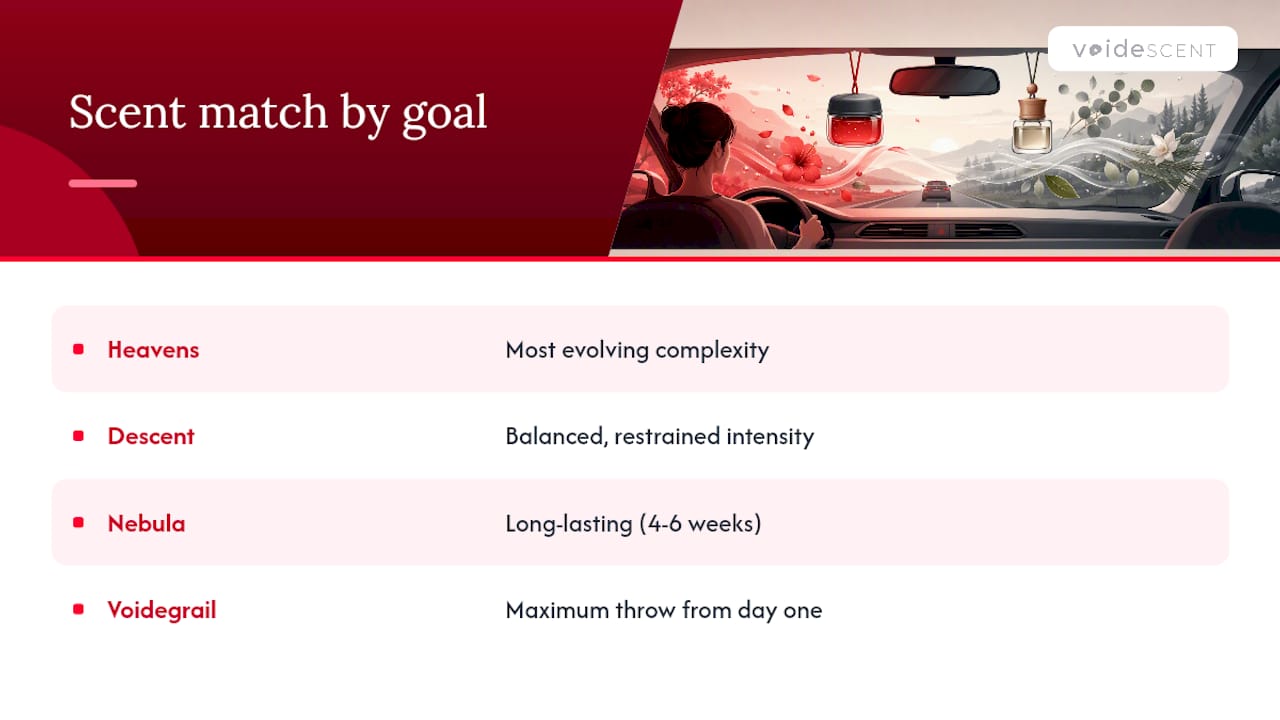
If the evolving, layered scent profile described throughout this comparison is what you’re after, Heavens delivers the most pronounced evolving character in the Voidescent lineup, making it the strongest pick if scent complexity matters more than anything else. For drivers with sensitive passengers or a preference for something more restrained, Descent offers a balanced intensity that won’t overwhelm a smaller cabin. If long-lasting performance across the full four-to-six-week window is your priority, Nebula is built around that steady, extended arc. And for anyone who wants maximum throw from day one, Voidegrail is the high-intensity option in the catalog.
Start with a lower application on your first refill and adjust up. It’s easier to add a drop than to fix an over-saturated hanger. Testing a scent against your own car and routine carries no real downside. Browse the full scent collection and find the format that actually fits how you use your car, not just what’s cheapest at checkout.
Sources
- Best Car Air Freshener: 6 Formats Compared (2026) – Aroma Paradise
- Cheap vs Expensive Car Air Freshener comparison — Car and Driver
- Best Car Air Freshener · CarCareTruth
- This is a fragrance — IFRA