

20% of People React: How Drivers Avoid Car Air Freshener Allergies
Yes. Fragranced car air fresheners can trigger allergic and respiratory symptoms, and the evidence is stronger than most drivers realize. A 2020 emissions study found 546 VOC occurrences across just 12 products, including 30 compounds classified as potentially hazardous. If your throat tightens or your head starts pounding after getting in the car, a useful way to determine if fragrances are involved is to remove all fragranced items from the cabin for a period and observe any change in symptoms.
TL;DR:
- Fragranced car air fresheners emit numerous volatile organic compounds, often in unlisted quantities, raising health concerns for sensitive individuals.
- People with asthma, migraine, or chemical sensitivities are more likely to experience symptoms such as headaches, coughing, and skin irritation from these emissions.
- Removing fragranced products, improving ventilation, and using low-dose, slow-release scent options can significantly reduce exposure and health risks.
- The common ingredients like limonene, linalool, and benzyl acetate can oxidize or react to produce secondary irritants such as formaldehyde, increasing reaction likelihood.
- “Natural” and “unscented” labels do not guarantee safety, as botanically derived products still release VOCs capable of causing allergic or respiratory reactions.
Table of Contents
- What Studies Say About Car Air Fresheners and Health Risks
- The Chemicals Behind Car Fragrance Allergies
- Who Reacts Most and What Symptoms Look Like
- Safer Alternatives That Actually Cut Exposure
- How to Cut Exposure and Confirm the Cause
- Why Dose and Transparency Matter More Than “Natural” Labels
- A Lower-Dose Option If You Still Want Some Scent
- Sources
- FAQ
What Studies Say About Car Air Fresheners and Health Risks
The research on this is more alarming than the pine-tree cardboard cutout on your rearview mirror would suggest. The 2020 study published in Air Quality, Atmosphere & Health tested 12 common car air fresheners and logged 546 total VOC occurrences representing 275 distinct chemical identities.
That gap between what’s emitted and what’s disclosed is the core problem. You can’t avoid what you can’t see listed.
By the numbers: About 20% of the general population and roughly 34% of people with asthma report health problems from air fresheners, according to figures cited by the American College of Allergy, Asthma and Immunology. A separate 2017 study found that number climbs to 41% among asthmatics specifically, with 54.4% of affected respondents reporting respiratory problems and 39.2% reporting full asthma attacks.
A car cabin makes a bad situation worse for a few concrete reasons:
- Small air volume. A typical car interior holds a fraction of the air a bedroom does, so the same dose of fragrance chemical produces a far higher concentration.
- Vent-driven dispersion. HVAC systems push air freshener emissions directly at your face at close range, unlike a room diffuser sitting across a house.
- Persistent emissions. Fabric seats, headliners, and carpet absorb volatile compounds and keep releasing them even after you remove the product, which is why some people still react days after pulling the culprit air freshener.
Public-health voices increasingly treat this as a real clinical issue rather than a fringe complaint. ColumbiaDoctors notes that clinicians should be asking patients about scented-product exposure directly, because most people never connect a car freshener to a chronic cough or recurring headache.
The Chemicals Behind Car Fragrance Allergies
Read the ingredient list on most car air fresheners and you’ll see the same handful of names repeating, whether the packaging says “tropical breeze” or “new car scent.”
- Limonene and linalool, two terpenes found in over 75% of tested car air fresheners, according to the 2020 emissions study.
- Benzyl acetate, a common fragrance solvent tied to eye and throat irritation.
- Acetaldehyde, a byproduct that forms when terpenes react with cabin air.
- Phthalates, used as fragrance carriers in many synthetic scent products.
- Toluene and related solvents, sometimes present in cheaper aerosol formulations.
The mechanism matters as much as the list. Limonene and linalool oxidize when exposed to air and sunlight, and that oxidation produces secondary pollutants, including formaldehyde, a known respiratory irritant. The oxidized versions of these terpenes are also more likely to sensitize skin and airways than the original fragrance molecule, which is part of why a scent that never bothered you for years can suddenly start triggering a reaction.
Here’s the detail that catches people off guard: “natural” and “unscented” labeling offers no real protection. Clinical case commentary from Mitchell Medical Group points out that botanically derived products can still carry the same sensitizing terpenes, and manufacturers rarely disclose complete emissions data regardless of how the product is marketed. Our own breakdown of phthalates in air fresheners covers why that particular ingredient class deserves extra scrutiny on any label.
Who Reacts Most and What Symptoms Look Like
Certain groups face a much higher risk profile, and the symptom pattern is usually specific enough to trace back to the car itself.
Highest-risk groups:
- People with asthma or COPD, where airway inflammation is already elevated
- Migraine sufferers, since fragrance chemicals are a documented trigger
- People with diagnosed chemical or fragrance sensitivity
- Children, whose airways are smaller and more reactive
- Pregnant people, who often report heightened smell sensitivity
Common symptoms: throat and eye irritation, coughing, wheezing, tension headaches or full migraine episodes, and in some contact cases, dermatitis on skin exposed to a diffuser or clipped freshener. One documented case involved severe facial and eyelid dermatitis linked to a car diffuser that resolved once the product was removed. That’s an individual case, not a universal outcome, but it shows how directly a car fragrance can manifest on skin, not just in the airway.
To test the link yourself: remove every fragranced item from the vehicle, keep a simple daily symptom log, and note whether things improve within a week.
Safer Alternatives That Actually Cut Exposure
You don’t have to choose between a fresh-smelling car and your health. You just have to be smarter about where the fresh smell comes from.
- Attack the odor source, not the smell. Vacuum seats and floor mats, wipe down interior surfaces, and treat lingering odors with baking soda or an enzyme-based odor neutralizer rather than covering them up with fragrance. Our comparison of odor neutralizers versus fresheners breaks down when each approach actually works.
- Use activated charcoal bags. These absorb odor molecules without emitting anything, making them one of the lowest-risk options for a fragrance-sensitive passenger.
- Upgrade ventilation, not fragrance. A cabin air filter that combines HEPA and activated carbon media traps particulates and adsorbs some VOCs before they reach you, functioning as an engineering control rather than a masking agent.
- If you want a scent, go passive and low-dose. Concentrated vent clips and plug-in diffusers dump fragrance continuously and at high concentration. A slow-release option that disperses gradually puts far less volume into that small cabin volume at any given moment.
- Don’t assume botanical means safe. Essential oils and plant-derived blends still emit VOCs capable of sensitizing airways, so even a “natural” hanger deserves a trial period rather than blind trust. Reader-friendly context on this lives in our guide to natural car air fresheners, and if you’d rather skip fragrance altogether, fragrance-free decor options extend the same logic to your home.
Pro Tip: Before committing to any scented product, run a 48-hour trial with the windows cracked and note any symptoms. If nothing flares up, extend the trial another week before treating it as safe for daily use.
How to Cut Exposure and Confirm the Cause
Run this checklist over the next few days if you suspect your car fragrance is behind your symptoms.
- Remove every fragranced item: hanging cardboard trees, vent clips, sprays, gel cans, all of it.
- Air out the cabin with windows down and fans running for at least ten minutes.
- Vacuum seats, mats, and crevices where dust and residue collect.
- Replace the cabin air filter, since old filters can continue releasing trapped VOCs long after the source product is gone.
- If you still want some scent, place a low-dose option away from direct vent airflow rather than clipped straight onto it.
For the short term, skip plug-in diffusers and aerosol sprays entirely, and crack a window for the first few minutes of any drive, especially after the car has sat in the sun.
Pro Tip: Keep a two-week log noting symptoms, time of day, and whether you drove that day. A clear pattern tied to car use is often enough for a doctor to take the connection seriously.
Contact a clinician if symptoms persist beyond removal of the suspected product, if you experience a suspected asthma attack, or if reactions are severe enough to affect breathing or vision. Bring your exposure log; it gives the clinician something concrete to work with instead of a vague complaint.
Why Dose and Transparency Matter More Than “Natural” Labels
The industry has trained drivers to ask “is this natural?” when the better question is “how much am I breathing, and how fast?” A concentrated diffuser blasting fragrance into a small cabin is a different exposure profile than a slow-release hanger, even with identical ingredients. Clinicians already recommend asking patients about scented-product exposure as a routine step, which tells you how underrated dose control still is. Tolerance varies person to person, so testing your own reaction always matters more than any label claim.
— Azanone
A Lower-Dose Option If You Still Want Some Scent
Most drivers don’t want a scentless car. They want one that doesn’t assault a sensitive passenger’s sinuses. Slow-release botanical fragrance oils are designed to disperse gradually over four to six weeks, instead of dumping concentrated fragrance into a small cabin the way vent clips and aerosol sprays do.
Each design in the catalog takes a different angle on that same low-dose approach. Heavens leans into a soft, airy profile suited to drivers who want something barely-there. Descent offers a deeper, more grounded scent for anyone who still wants presence without intensity. Nebula rounds out the range with its own distinct botanical blend, and if it isn’t a fit, the money-back promise means testing it costs you nothing but a short trial period.
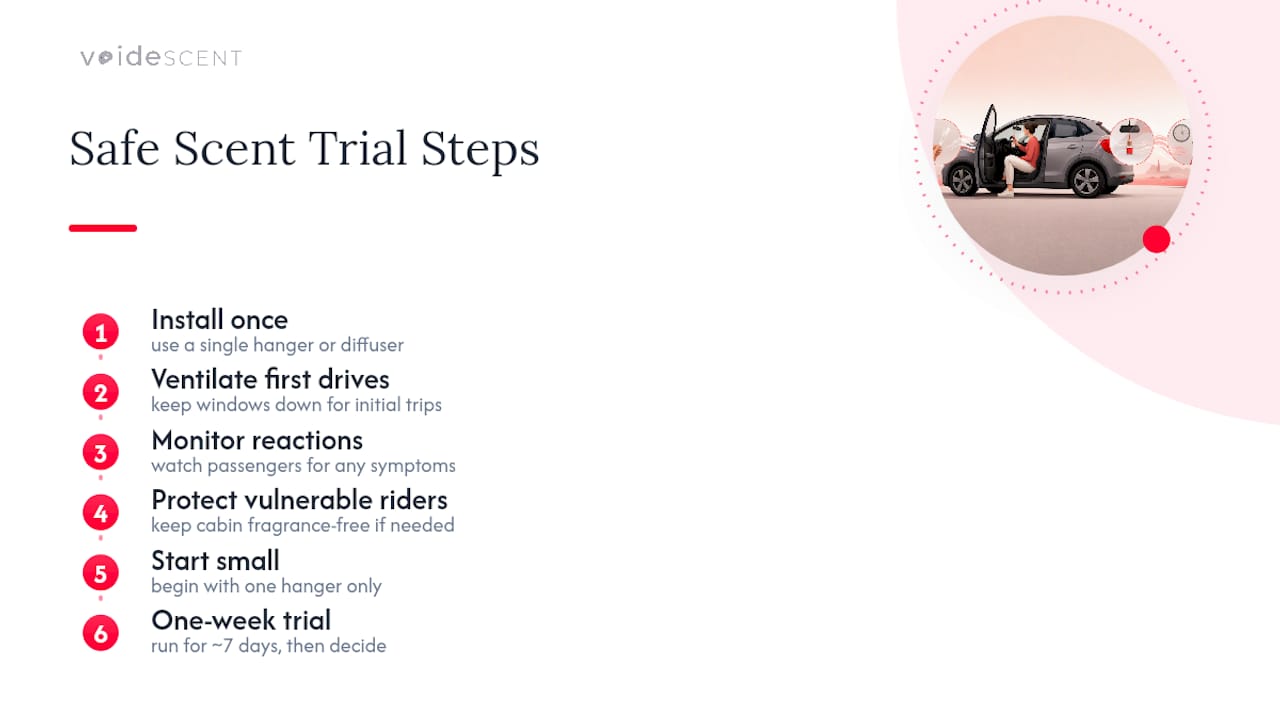
Run any of them the same way we recommend testing any car scent: install it, keep the windows down for the first few drives, and watch for symptoms. If you’re driving vulnerable passengers, keep the cabin fragrance-free entirely and lean on ventilation and cleaning instead. Start with one hanger, trial it for a week, and decide from there.
Sources
- Volatile chemical emissions from car air fresheners (Air Qual Atmos Health 2020)
- Weinberg et al. 2017 — fragranced product health effects (PubMed entry)
- Air fresheners can trigger allergy symptoms — Medical News Today
This article is general information, not a substitute for advice from a qualified doctor. Consult a qualified healthcare professional about your own circumstances before acting on anything here.
FAQ
What car air freshener is safe for people with allergies?
No product is guaranteed universally safe, but low-dose, slow-release options that avoid concentrated aerosol delivery, like a botanical scent hanger, put far less fragrance volume into cabin air than plug-in diffusers or vent-clipped sprays.
Can air fresheners cause allergic reactions?
Yes. Roughly 20% of the general population and about 34% of people with asthma report health problems tied to air fresheners, ranging from throat irritation to full asthma attacks.
What are the potential side effects of using a car air freshener?
Common effects include eye and throat irritation, coughing, headaches or migraines, and in some cases contact dermatitis, especially with prolonged exposure in a small, poorly ventilated cabin.
Can Febreze cause an allergic reaction?
Fragranced deodorizing sprays, including aerosol products like Febreze, contain VOCs and fragrance compounds that have been linked to respiratory and allergic symptoms in sensitive individuals, so anyone with asthma or chemical sensitivity should introduce them cautiously and watch for reactions.