

4–6 Week EV Scents That Cut Waste for Design Minded Drivers
The best EV car scents are refillable, oil-based hangers using low-volatility botanical fragrance instead of aerosol sprays or heavy synthetic gels. For a silent, low-airflow EV cabin, a slow-release format matters more than raw scent strength. Certain botanical oil hangers fit that brief directly: three minimalist hangers built on pure botanical oils, each rated for four to six weeks of consistent, evolving fragrance.
TL;DR:
- Refillable, oil-based hangers with botanical fragrances last four to six weeks and provide a subtle, evolving scent suited for quiet EV cabins.
- Placement away from direct airflow ensures the scent lasts longer and remains even, while layering scents should be done thoughtfully after a week.
- Pure botanical oils formulated for slow release better suit EV interiors, which lack engine noise to mask faint or overly strong fragrances.
- When choosing a scent, verify the longevity, refillability, ingredient transparency, and proper sizing for your vehicle’s cabin volume.
- Using a passive hanger oil is the most consistent and health-conscious option, especially for sensitive passengers, as opposed to vent clips or gels.
Table of Contents
- Heavens, Descent, and Nebula: A Quick Comparison
- Why EV Cabins Need a Different Approach to Scent
- Hanger Oils vs. Vent Clips vs. Electric Diffusers: What Actually Works
- How Do You Choose the Right EV Car Scent?
- Is It Safe to Use Fragranced Products in a Small Cabin?
- Getting Four to Six Weeks Out of Your Hanger
- Where to Buy an EV Car Scent, and What It Should Cost
- Why Minimalist, Botanical Formulas Fit the Electric Driving Experience
- Find Your Match Among Voidescent’s Car Hanger Fragrances
- Sources
- FAQ
Heavens, Descent, and Nebula: A Quick Comparison
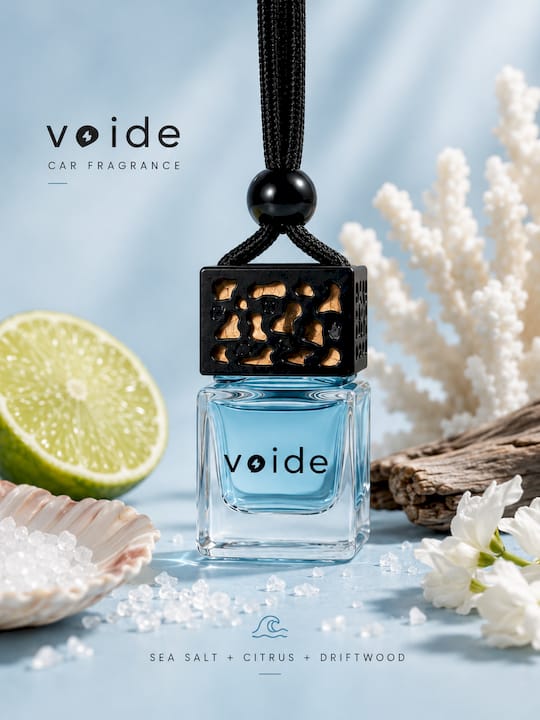
Choosing between these three comes down to how bold you want your cabin to smell and how that scent should change over the weeks you use it. All three use the same slow-release hanger format, so the real differences are in fragrance character and mood.
- Heavens leans soft and airy, built for drivers who want a presence they notice only when they lean in. Best for minimalists preferring subtle fragrance presence.
- Descent is the deeper, warmer profile of the three, with a more grounded character that develops through the weeks. Best for drivers who prefer a warm, grounded cabin atmosphere without a heavy scent.
- Nebula brings brighter, more layered top notes that shift subtly over time, closer to how a fine fragrance opens and settles. Best for drivers who enjoy a brighter scent that evolves subtly over time.
Every hanger is designed around a lifespan expected to be roughly one month or more before a refill or oil swap is needed, using pure botanical oils formulated for slow release rather than a quick burst of synthetic fragrance that fades in days. That longevity claim is the whole point: standard commercial fresheners often lose most of their intensity inside two weeks, so a format built to hold a full month or more changes how often you think about your car’s scent at all.
Pricing sits in the premium tier of the category, reflecting the ingredient quality and the minimalist hardware rather than a mass-produced plastic clip. Design-conscious drivers tend to see that as the trade-off for not replacing a freshener every ten days.
Why EV Cabins Need a Different Approach to Scent
Combustion cars mask a lot of sensory noise. Engine hum, exhaust notes, and the “new car” tannin smell off fresh vinyl and adhesives all compete with whatever air freshener you hang from the mirror. An EV cabin has none of that. Take away engine vibration and exhaust, and a poorly chosen scent has nowhere to hide.
That silence changes what drivers actually want from a car scent. A loud, one-note synthetic fragrance that would get lost in a gas-powered commute becomes the dominant sensory experience in an EV. Drivers gravitate toward something subtler, something that shifts in character over the drive rather than hitting the same note every single time you start the car.
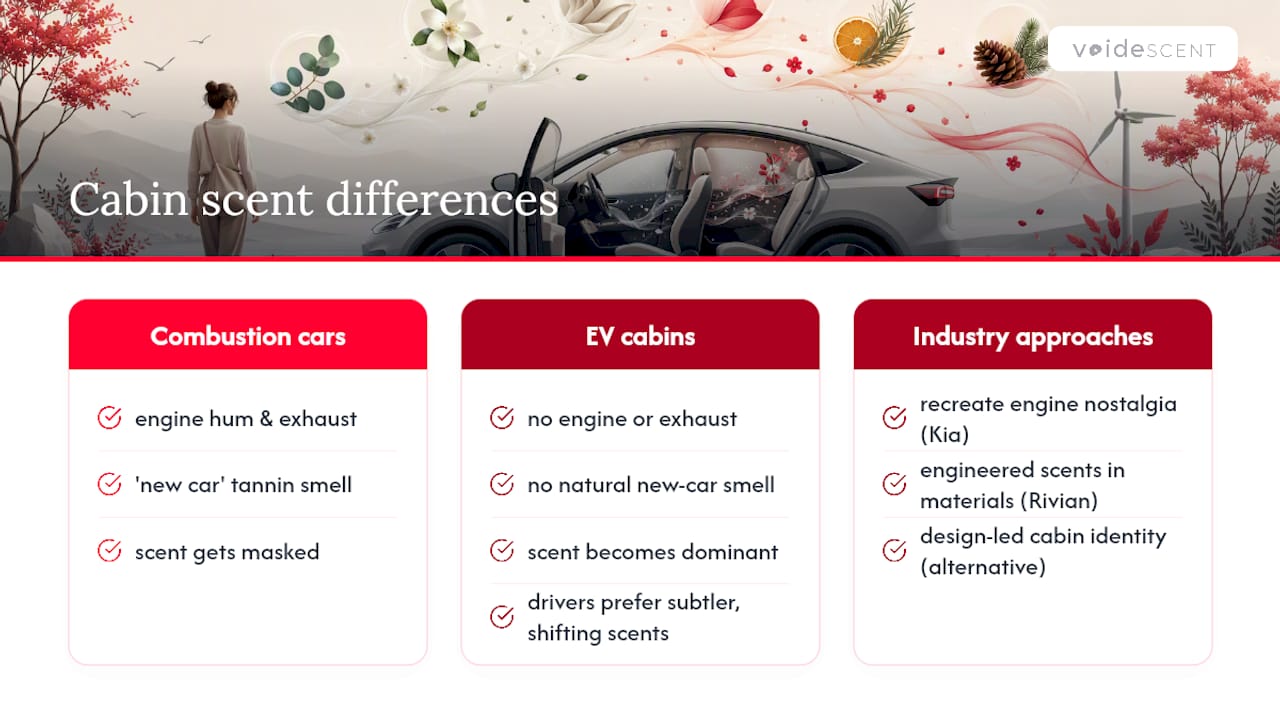
Materials play a role too. Many EV interiors use vegan leather and synthetic composites instead of traditional leather and carpet, which means there’s no natural “new car smell” competing for attention. That gap is exactly where a designed fragrance can do real work, rather than fighting against an existing cabin odor.
The car industry has noticed. Rivian has publicly discussed engineering scents into EV materials to build emotional familiarity into a driving experience that otherwise feels unfamiliar to combustion-car owners. Kia took a more literal route in Finland, handing EV buyers a gasoline and motor oil scented freshener as a nostalgia play for drivers missing their old engine smell.
The quieter the cabin, the louder the scent. EVs strip away the sensory clutter of combustion driving, which is exactly why fragrance choice matters more in an electric car than it ever did in a gas one.
Neither of those approaches is really about scenting the car well. They’re about emotional bridging for drivers used to combustion. A cleaner, design-led alternative doesn’t try to recreate an engine smell. It gives the cabin its own identity.
Hanger Oils vs. Vent Clips vs. Electric Diffusers: What Actually Works
Not every car scent format behaves the same way once it’s inside a sealed, low-airflow EV cabin. Here’s how the main options actually perform:
- Hanger oils release fragrance slowly from an absorbent core soaked in botanical or fragrance oil, typically lasting four to six weeks with a gentle, even intensity that doesn’t spike or fade unpredictably.
- Vent clip diffusers rely on airflow from the climate system to push scent through the cabin, which means intensity swings with fan speed. Run the AC hard and the scent surges. Turn it off and it disappears.
- Rechargeable electric diffusers use ultrasonic mist or heat to actively disperse fragrance oil, offering strong control over intensity but requiring power, upkeep, and usually a shorter oil life between refills.
- Gel fresheners sit in a small tub and evaporate passively, generally cheaper but far less consistent, often strong when new and nearly scentless within a week or two.
- Charcoal bags and baking soda sachets neutralize odors rather than add fragrance, useful for absorbing smells but not for scenting a cabin at all.
Cabin volume and fan habits matter more in EVs because there’s no engine heat cycling air the way a combustion car does, so a format that depends on airflow performs less predictably from one drive to the next.
Pro Tip: If you want a scent that never spikes or vanishes with your AC settings, choose a passive hanger oil over anything that depends on vent airflow. It’s the format most immune to your driving habits.
Refillable formats also cut down on the steady stream of disposable plastic clips and cardboard trees that go straight in the trash every few weeks, a small but real reason refillable diffuser systems have picked up traction among buyers who care about waste as much as scent.
How Do You Choose the Right EV Car Scent?
Start by matching the product to your cabin, not just the scent description on the box. A few criteria separate a good match from a fragrance you’ll pull down in two weeks.
- Longevity claim: look for a stated duration, ideally four to six weeks, and be skeptical of products that don’t mention one at all.
- Refillability: a refillable system pays for itself over a handful of cycles and produces far less waste than disposable clips you toss monthly.
- Ingredient transparency: brands should tell you what’s actually in the oil, not just list “fragrance” as a catch-all.
- IFRA compliance and phthalate-free formulation: these matter more in a sealed cabin than in an open room, since you’re breathing concentrated air for extended stretches.
- Scent strength relative to cabin size: EVs vary widely in cabin volume, so a scent calibrated for a small hatchback can overwhelm a larger SUV, and vice versa.
Before buying, ask the seller four direct questions: How long is this rated to last? Is it refillable, and how much do refills cost? What ingredients are actually in the oil? What’s the return policy if the scent doesn’t work for me? A brand confident in its formulation answers all four without hedging, and essential oil versus synthetic fragrance oil is worth understanding before you commit, since the two behave very differently over a multi-week lifespan.
Is It Safe to Use Fragranced Products in a Small Cabin?
A car is one of the smallest enclosed spaces most people spend time in daily, which is exactly why fragrance sensitivity deserves real attention rather than an afterthought. Airborne fragrance sensitivity and allergic reactions are common enough that NHS guidance specifically recommends avoiding known triggers where they can be avoided.
By the numbers: fragrance is one of the most frequently reported triggers of allergic and sensitivity reactions tracked by the NHS, which is why health guidance consistently recommends avoiding known irritants rather than assuming a “natural” label makes a product automatically safe for everyone.
A few practical habits reduce risk without sacrificing the scent you actually want:
Start with a lower-intensity hanger or oil rather than the boldest option in a product line, especially if you or regular passengers have any history of respiratory sensitivity. Crack a window or run fresh-air ventilation for a few minutes after refreshing an oil or hanging a new scent hanger, since initial off-gassing is always strongest right after application. Avoid heavily fragranced products entirely if you regularly transport someone with asthma, severe allergies, or migraines triggered by strong smells, and the same caution applies if you travel with pets, since dogs and cats have far more sensitive noses than humans.
If a scent causes headaches, throat irritation, or breathing discomfort for you or a regular passenger, stop using it immediately and ventilate the cabin fully. Persistent symptoms after exposure warrant a conversation with a doctor rather than just switching brands.
Getting Four to Six Weeks Out of Your Hanger
Placement affects how evenly a scent fills the cabin more than most drivers expect. A hanger clipped near a vent gets blasted by airflow every time the fan runs, which speeds up evaporation and shortens its usable life. A hanger placed on a rearview mirror or a rear grab handle, away from direct vent airflow, tends to release oil more evenly across its full rated duration.
- Hang it away from direct airflow so the fragrance releases at the rate it’s designed for instead of getting stripped by fan speed.
- Wait before layering a second scent, giving the first hanger at least a week to settle into its base notes before introducing anything else, since fresh oils and settled oils can clash if mixed too soon.
- Track your refill timing against the four to six week window rather than waiting for the smell to disappear completely. Topping up before the scent fully fades keeps the fragrance profile consistent instead of dipping into faint, uneven output.
- Store spare oils away from heat and direct sun, since both accelerate degradation of botanical oils well before you get around to using them.
If you do want to combine fragrances, layering scents deliberately rather than by accident tends to produce a more cohesive cabin smell than two competing hangers fighting for attention.
Where to Buy an EV Car Scent, and What It Should Cost
Buying directly from the brand’s own site is worth the small premium over third-party marketplaces, mainly because you get the actual current formulation, a working returns process, and access to the correct refill oils rather than a mismatched substitute.
- Price drivers: expect to pay more for artisan-grade botanical oils, refillable hardware built to last multiple cycles, and minimalist packaging that skips the plastic-heavy design of supermarket fresheners.
- What inflates the price further: limited-run scent profiles, vegan or pet-safe formulation claims, and multi-month refill bundles that reduce the per-week cost but raise the upfront spend.
- Refill availability: buying direct also means the exact oil that matches your hanger is always in stock, rather than hunting for a compatible refill after the original design gets discontinued.
Pricing for Voidescent’s Heavens, Descent, and Nebula hangers is listed directly on each product page, where you’ll also find current refill options and bundle availability.
Why Minimalist, Botanical Formulas Fit the Electric Driving Experience
A car scent should feel like part of the design, not a scented sticker slapped over the interior. Botanical oils formulated for slow, predictable release give an EV cabin a fragrance that behaves the way the rest of the car does: quiet, consistent, no sudden surprises, capturing the natural wax scent characteristics described by Latvian Candles.
That’s the reasoning behind building hangers around a four to six week release curve instead of a scent that peaks in three days and fades into nothing. It respects both the driver’s nose and the sealed, quiet environment an EV creates. If you’re weighing your options, the Car Hanger Fragrances lineup is a reasonable place to start, backed by a money-back guarantee for anyone who isn’t satisfied with how a scent performs in their own cabin.
— Azanone
Find Your Match Among Voidescent’s Car Hanger Fragrances
Most car fresheners force a choice between a scent that’s genuinely well made and one that lasts more than a couple of weeks. Voidescent’s hangers skip that trade-off: botanical oils engineered for a slow four to six week release, in a design that looks like it belongs in a cabin rather than hanging off a mirror like an afterthought. Each formula avoids the harsh synthetic load of typical drugstore fresheners, which matters more in a quiet EV cabin than most drivers realize until they’ve actually made the switch.
If Descent’s warmer profile or Nebula’s brighter, layered top notes sound closer to what you want than Heavens’ softer character, browse all three directly on the Car Hanger Fragrances store page and pick based on the mood you want your commute to have. Some sellers offer a money-back guarantee, so trying a new scent profile in your own car can carry limited risk beyond the time it takes to hang it.
Sources
- Kia Is Giving Away ‘Nostalgic’ Motor Oil and Gasoline-Scented Car Freshener to EV Buyers
- Allergies - NHS
- Refillable Car Air Freshener – Eco-Friendly Long-Lasting Scent – Rayne Refillery
FAQ
What Is the Best Smelling Car Scent for an EV?
There’s no single universal answer since scent preference is personal, but botanical hanger oils with a four to six week release, like Voidescent’s Heavens, Descent, or Nebula, consistently outperform synthetic sprays for cabins that need a subtler, evolving fragrance rather than one loud note.
How Can I Make My Car Smell Like a Luxury Vehicle?
Skip aerosol sprays and gel tubs entirely and use a single, well-formulated botanical oil hanger placed away from vents, since layered, slow-release fragrances read as considered and expensive rather than sprayed-on and temporary.
What Do Dealerships Use to Make a Car Smell New?
Dealerships typically rely on strong synthetic “new car” sprays or leather-scented aerosols designed for an immediate, punchy impression rather than long-term wear, which is why that smell fades fast and doesn’t translate well to daily driving.
What’s the Best Air Freshener for a Car?
For most drivers, a refillable oil-based hanger beats vent clips and gels on both longevity and consistency, since it releases fragrance passively instead of depending on fan speed or evaporating unevenly within days.
How Often Should I Refill an EV Car Scent Hanger?
Plan on refilling or replacing the oil every four to six weeks for botanical hanger systems, and refill slightly early rather than waiting for the scent to disappear completely to keep the fragrance profile consistent.