

Design Minded Drivers: Slow Release Car Fragrance That Lasts 4–6 Weeks
For a subtle scent that lasts for weeks, choose a slow-release oil hanger; for adjustable intensity on demand, pick a vent clip or electronic diffuser; if budget is your main driver, a paper hanger still does the job. Voidescent’s slow-release hangers suit drivers who want a design-forward, low-maintenance scent that evolves over time rather than one that hits hard and fades fast. The sections below walk through formats, scent families, longevity, and the placement details that make any choice actually work.
TL;DR:
- Slow-release botanical oil hangers typically last four to six weeks, provide a steady scent, and are better for shared cars and sensitive passengers.
- Vent clips and electronic diffusers offer adjustable control and can last from two to six weeks, but require more frequent refills and are less suited for subtle, continuous scent.
- Picking a subtle scent family like fresh, woody, or light floral is recommended for daily drivers and family vehicles, especially in enclosed cabins.
- Overlapping multiple scent formats simultaneously, using overly strong intensities, or layering scents without testing can lead to overpowering or clashing odors.
- Eco-friendly options favor longer-lasting formats like slow-release hangers with plant-based oils, reducing packaging waste and repeated replacements.
Table of Contents
- What Types of Car Fragrance Should You Choose From?
- Which Scent Family Actually Fits Your Drive?
- How Long Does a Car Fragrance Actually Last?
- Are Car Fragrances Safe for Sensitive Passengers?
- Where Should You Place a Car Fragrance for Best Results?
- How Eco-Friendly Are Different Car Fragrance Options?
- What Mistakes Lead to an Overpowering or Clashing Car Scent?
- Can You Combine or Layer Car Scents Yourself?
- Why Slow-Release Hangers Are the Right Call for Most Design-Conscious Drivers
- Try One and See How It Fits Your Car
- Sources
- FAQ
What Types of Car Fragrance Should You Choose From?
Car fragrances split into two broad categories: passive, which release scent constantly with no input from you, and active, which you control through timers, fan settings, or HVAC integration. Car and Driver’s breakdown of freshener types frames this as the first real fork in the decision, and it matters more than scent family for most buyers.
Here’s how the common formats stack up:
- Paper or fiber hangers: cheap, passive, easy to swap, but scent fades fast and gets harsh before it disappears.
- Vent clips: active-ish, since airflow controls intensity; good for quick adjustment but need frequent refills.
- Gel cans: passive, cupholder or dash-mounted, decent longevity but scent quality tends to be flat.
- Sprays: fully active, instant but temporary, best for a quick refresh before a passenger gets in.
- Cartridge or electronic diffusers: active, often adjustable for intensity, and can last several weeks per refill depending on how often you run the fan, according to that same Car and Driver guide.
- Fragrance-oil slow-release hangers: passive, minimal upkeep, built for a steady background scent rather than a burst.
Match the format to the job. Masking a specific odor (smoke, pet smell) calls for something stronger and more active, like a vent clip you can crank up. A subtle, continuous presence, the kind you barely notice until a passenger comments on it, is exactly what slow-release hangers are built for.
Which Scent Family Actually Fits Your Drive?
Scent families carry distinct sensory personalities, and picking one that clashes with how you actually use your car is the most common regret buyers report. Fresh and citrus notes read clean and energizing. New-car and “clean linen” profiles feel neutral and safe. Woody and leather scents lean warm and grounding. Floral notes soften a cabin but can read as heavy in a small space. Gourmand (vanilla, caramel, coffee-adjacent) scents feel cozy but fatigue quickly in daily use. Spicy or amber profiles work well in cooler months but can feel too intense in summer heat.
For commuting or long stretches behind the wheel, pick something subtle, such as fresh, woody, or a light floral. Anything gourmand or heavily spiced turns from pleasant to grating somewhere around day four of a daily commute. Family cars benefit from neutral, low-allergen profiles since kids and passengers have less tolerance for strong scent. Rideshare and taxi drivers should lean toward the mildest end of any family they pick, since passengers can’t opt out of the smell the way a solo driver can.
Intensity matters as much as family. Save richer, bolder profiles for short trips or a car that’s mostly yours alone. Reserve subtle profiles for anything involving regular passengers or long stints on the motorway.
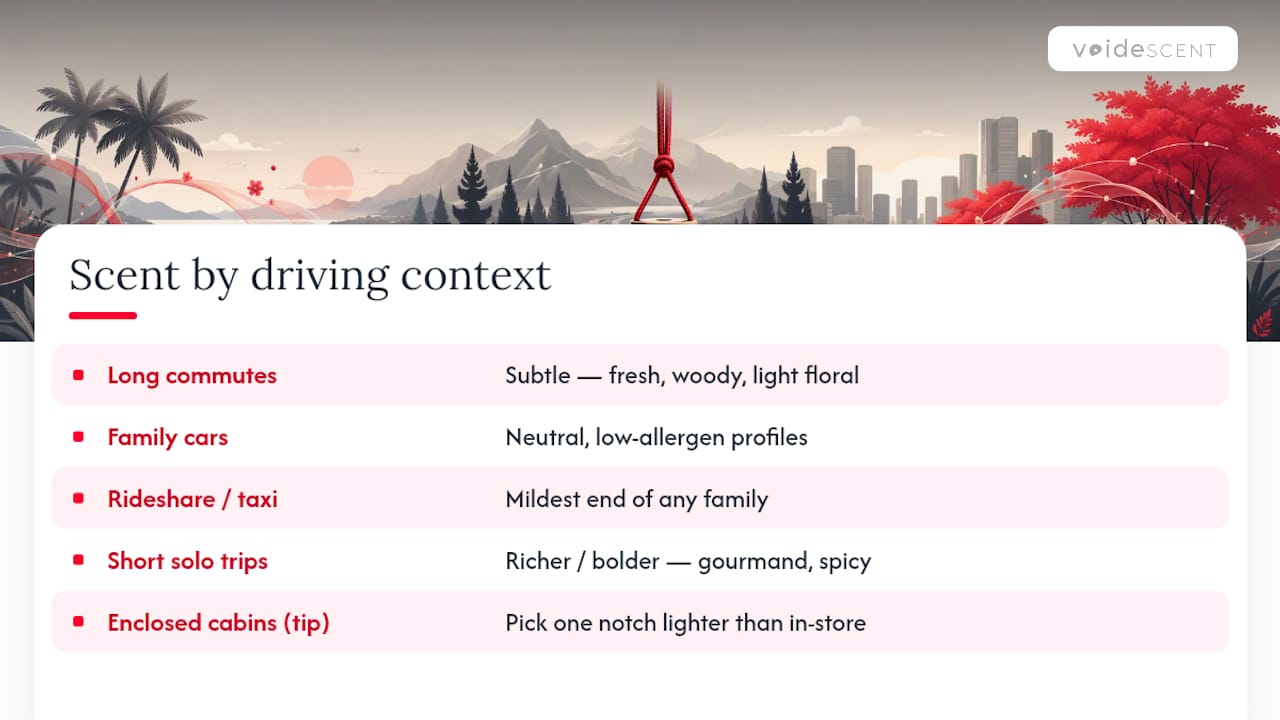
Pro Tip: If you drive the same route daily, pick a scent one notch lighter than the one you’re drawn to in the shop. Enclosed cabins amplify fragrance more than open-air testing ever suggests.
How Long Does a Car Fragrance Actually Last?
Lifespan varies enormously by format, and most buyers underestimate how much heat and airflow shorten it. Rough ranges, assuming normal UK driving conditions:
- Paper hangers: about one to three weeks before scent drops off noticeably.
- Vent clips: roughly two to six weeks, depending on fan use.
- Gel or fiber cans: four to eight weeks, though intensity fades well before the can empties.
- Electronic cartridge diffusers: runtime varies by usage pattern; heavy daily use shortens the cycle considerably, per Car and Driver’s testing.
- Slow-release oil hangers: typically four to six weeks of a steady, evolving scent rather than a flat plateau.
Heat and direct sunlight are the biggest lifespan killers, since they cook fragrance oils out faster than normal evaporation would. High fan settings do the same by forcing air past the product constantly. A tested comparison from Better Homes & Gardens found that budget hangers deliver strong scent early but fade quickly, while premium diffusers spread that scent more evenly over their lifespan, which usually means a better cost-per-week even at a higher sticker price.
Are Car Fragrances Safe for Sensitive Passengers?
Many synthetic air fresheners release volatile organic compounds (VOCs), airborne chemical particles that can trigger headaches, throat irritation, or allergy flare-ups in sensitive people, especially in a small, poorly ventilated cabin. Around 40% of scent-related driver complaints trace back to synthetic sprays or gels used at full strength rather than to natural or slow-release alternatives.
Safer choices include:
- Hypoallergenic-labeled products where the ingredient list is disclosed.
- Plant-based or botanical fragrance oils instead of synthetic blends.
- Slow-release formats, which spread exposure evenly instead of hitting you with a peak concentration right after installation.
Before committing to a new scent, run it at low intensity for a week and check whether anyone in the car reacts to it. Crack a window after first installing anything, and never spray directly toward a passenger’s face. If sensitivity shows up, rotate to a different product rather than layering something stronger on top.
Where Should You Place a Car Fragrance for Best Results?
Placement changes both how evenly scent spreads and how fast it fades. Center vents give the most even distribution since airflow carries the scent through the whole cabin. Cupholder diffusers work well for anything liquid-based since spills stay contained. Rearview mirror hangers are the classic choice, but only if the hanger is small enough not to block your line of sight.
- Install near a central vent or the rearview mirror rather than a side door, where airflow is weaker.
- Control intensity by adjusting fan speed, alternating which vent you use, or partially unwrapping a hanger instead of exposing it fully on day one.
- Rotate placement occasionally to avoid what’s often called scent fatigue, where your nose stops registering a smell you’ve been sitting next to for weeks.
- Wipe up any oil or gel spills immediately, since some fragrance oils can stain leather or cloud plastic trim over time.
- Store spare refills away from heat and direct sun, ideally in a glovebox rather than a dashboard tray.
Pro Tip: Partial unwrapping is the cheapest intensity control there is. Peel back a hanger’s packaging in stages over its first week instead of exposing the whole surface at once, and you’ll stretch both its life and its impact.
How Eco-Friendly Are Different Car Fragrance Options?
Most mainstream sprays and gel cans rely on synthetic fragrance compounds and single-use plastic housings that end up in landfill after a few weeks of use. Aerosol sprays add propellant gasses to that footprint, and cartridge-based electronic diffusers usually require ongoing battery power plus replacement cartridges shipped in plastic packaging.
Paper and fiber hangers are lower-impact on the packaging side but tend to be used and discarded more frequently, since their scent fades so quickly. That turnover adds up. A hanger replaced every two weeks generates roughly twice the packaging waste of one that lasts a full month.
Slow-release botanical oil hangers address both problems at once: fewer replacement cycles because the scent lasts longer, and formulations built around plant-based oils rather than synthetic petrochemical fragrance carriers. Minimalist packaging design, common among premium hanger brands, also cuts down on the plastic clamshell waste that dominates budget freshener aisles. If sustainability matters to your buying decision, the math favors any format that stretches replacement intervals from weeks to over a month, since fewer units bought means less packaging produced, shipped, and thrown away over a year of driving.
What Mistakes Lead to an Overpowering or Clashing Car Scent?
The most common mistake is stacking products: a vent clip, a hanging tree, and a scented spray all running at once, each fighting for attention. The result rarely smells like any one of them. It smells like confusion, and it’s usually the first thing a passenger mentions when they get in.
A second mistake is choosing intensity based on a five-second sniff in a shop rather than how that scent behaves in an enclosed cabin over hours. Fragrances that seem “just right” on a test strip often turn overpowering once trapped in a small space with the windows up. A reliable fix is a one-week test at the lowest available intensity before deciding whether to keep a product or size up.
A third mistake is masking instead of addressing the source. Spraying something floral over a lingering smoke or pet odor doesn’t eliminate the underlying smell, it layers on top of it, and the combination is usually worse than either scent alone. Reputable guides consistently recommend cleaning the cabin, vacuuming upholstery, and swapping the cabin air filter before introducing any fragrance product, since a fresh baseline makes any scent choice work better and last longer.
Finally, drivers often forget to remove old products before adding new ones. A half-dead paper hanger left in a door pocket still off-gasses faint scent, and it will clash with whatever you introduce next even if you’ve forgotten it’s there.
Can You Combine or Layer Car Scents Yourself?
Layering scents works the same way it does in perfumery: pair a light, neutral base with one accent note rather than combining two dominant profiles at full strength. A fresh citrus base paired with a faint woody accent tends to read as balanced. Two bold gourmand or floral scents run together almost always tip into overpowering territory.
Start with a single slow-release hanger as your base layer, since its consistent, moderate output gives you a stable foundation to build on. If you want a seasonal shift or a bit more complexity, introduce a second, lighter scent rather than swapping the base entirely. Testing one new element at a time also makes it easy to identify what’s causing irritation if a passenger reacts badly.
Rotate combinations rather than committing permanently. Swapping accent scents every few weeks keeps your nose from adapting to the point where you stop smelling it, and it lets you match mood to season, brighter and citrus-forward in summer, warmer and woodier in colder months. For anyone who wants a more detailed walkthrough of building a layered scent profile without overdoing it, Voidescent’s guide on layering scents in your car covers pairing logic in more depth.
Why Slow-Release Hangers Are the Right Call for Most Design-Conscious Drivers
The honest case for slow-release botanical oil hangers isn’t that they’re flashy. It’s that they solve the two problems every other format struggles with at once: fading too fast and hitting too hard. A four to six week release cycle means you’re not replacing a hanger every ten days, and because the release is gradual, you never get the initial overpowering blast that makes cheaper products feel harsh in the first week and forgettable in the third.
That trade-off matters most for shared cars, sensitive passengers, and anyone who simply wants their car to smell intentional rather than sprayed. If you’re curious about the safety side of fragrance oils specifically, Voidescent’s piece on using fragrance oils safely in a car is worth a read before you commit to a bottle.
— Azanone
Try One and See How It Fits Your Car
Slow-release hangers cost less over a year than replacing paper hangers every two weeks, since one hanger covers what would otherwise take four or five cheap replacements. Descent suits drivers who want a warm, grounding profile for daily commutes. Heavens leans lighter and cleaner, a good fit for family cars or anyone sensitive to stronger scents. Nebula offers a different aromatic character for drivers who want something distinct from the usual citrus or vanilla defaults.
Start with one hanger, run it at its natural intensity for a week, and judge from there whether you want to add a second scent or switch profiles. Browse the full range on the Voidescent product pages to compare Descent, Heavens, and Nebula side by side before you decide.
Sources
Format and safety claims here draw on Car and Driver’s air freshener guide, Better Homes & Gardens’ tested comparison, and Zistoco’s safety guide. For lifespan specifics by format, see Voidescent’s post on how long car air fresheners last.
- Which Type of Car Air Freshener You Should Buy — Car and Driver
- The 5 Best Car Air Fresheners, Tested — Better Homes & Gardens
- The Complete Guide To Car Air Fresheners: Safe, Natural & Long-Lasting — Zistoco
FAQ
How Do I Choose the Right Car Scent?
Match the format to your control needs (passive for set-and-forget, active for adjustable intensity), then pick a scent family that suits how you use your car, subtle for commuting, bolder only for short or solo trips.
What Is the Best-Smelling Car Fragrance?
There’s no universal answer since scent preference is personal, but fresh, woody, and light floral profiles consistently test well across reviewer comparisons for being pleasant without overwhelming a small cabin.
Which Fragrance Type Works Best for Cars Overall?
Slow-release botanical oil hangers tend to perform best for drivers who want a subtle, evolving scent without frequent replacement, while vent clips or electronic diffusers suit anyone who wants to adjust intensity on demand.
How Do I Keep My Car Smelling Nice All the Time?
Start with cleanliness, vacuuming and swapping the cabin filter, before adding any fragrance product, then choose one primary scent and replace or refresh it on a schedule rather than stacking multiple products together.
Can Car Air Fresheners Cause Allergies or Irritation?
Yes, synthetic sprays and gels release VOCs that can trigger headaches or irritation in sensitive people, so hypoallergenic labels, plant-based oils, and slow-release formats are generally the safer choice.