

Drivers: Which Damages Your Dashboard in 24 Hours, Oils or Gels?
Short answer: concentrated botanical oils typically pose the higher risk of permanent surface damage, since they act like solvents on plastic and leather, while gels are more likely to just liquefy into a sticky, spreading mess. Heat and UV make both worse. If either spills, contain it immediately, then clean, before the liquid sits long enough to soak in or bake on.
TL;DR:
- Botanical oils pose a higher risk of permanent surface damage because they act like solvents and can break down plastics and leather over time.
- Gels are less likely to cause staining but can liquefy in hot climates, leading to pooling and container failure, especially if poorly engineered.
- Immediate containment and prompt cleaning within the first hour after a spill significantly reduce the risk of interior damage.
- Proper placement and regular inspection of fragrance products, along with using sealed or solid options, can prevent leaks entirely.
- Slow-release, solid, or charcoal-based scent options eliminate spill risk but offer less scent throw compared to traditional liquids.
Table of Contents
- What Interior Materials Are Most Vulnerable to Spills?
- Do Oils or Gels Behave Differently When It Gets Hot?
- What Should You Do the Moment a Spill Happens?
- How Can You Prevent a Spill Before It Starts?
- Are There Scent Options That Skip the Spill Risk Entirely?
- Why Voidescent’s Delivery System Was Built Around This Exact Problem
- The Real Trade-Off Nobody Talks About
- Where to Find Lower-Risk Scent Options That Still Deliver
- Sources
What Interior Materials Are Most Vulnerable to Spills?
Your dashboard isn’t one material. It’s a patchwork of ABS/PC plastics, polycarbonate trim, PVC or PU soft-touch coatings, painted surfaces, leather, and fabric, and each one fails differently when fragrance liquid touches it. Soft-touch PVC/PU panels are the most exposed: fragrance oils dissolve their surface coating, leaving a tacky halo that never fully dries. ABS and polycarbonate trim can develop stress-cracks or a whitened, fogged look, especially where the plastic has already been softened by dashboard heat. Leather absorbs oil into its pores and stains from underneath, so wiping the surface doesn’t fix it.
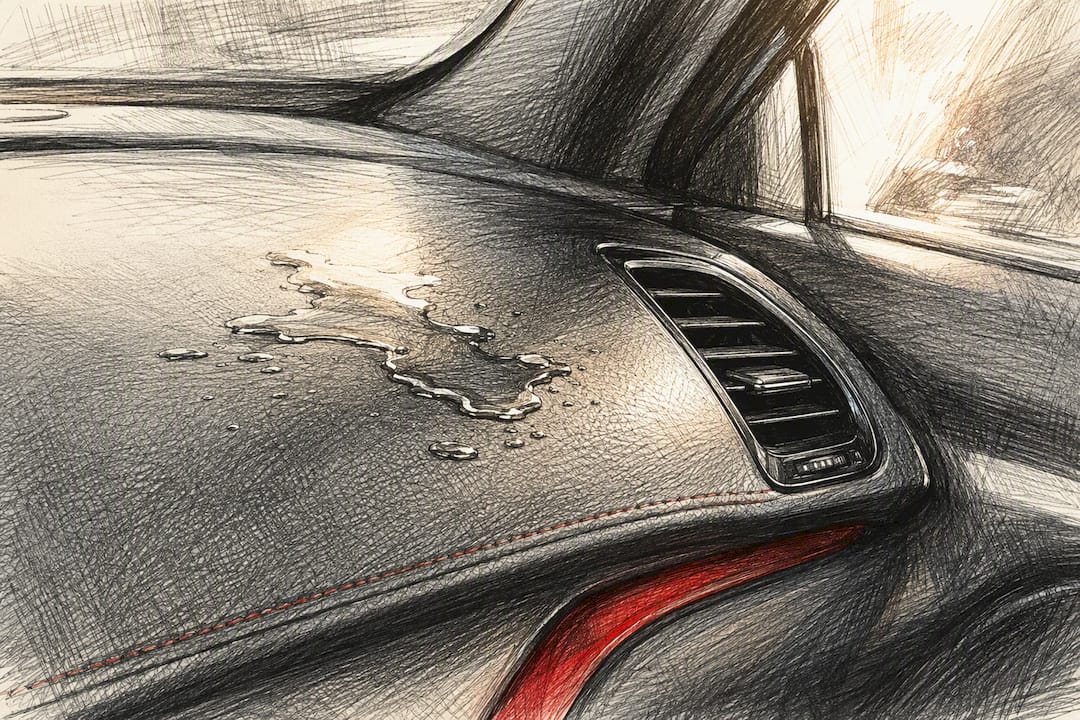
Fragrance oils behave like mild solvents, and heat accelerates that chemistry. Plasticizers migrate faster in warm plastic, which is part of why a spill that looks minor in March can leave a permanent mark by August. According to a material compatibility checklist for automotive fragrance products, ABS/PC blends, polycarbonate, and PVC/PU soft-touch coatings all carry medium-to-high risk ratings for contact damage.
Watch for these early warning signs:
- A greasy sheen or halo spreading beyond the visible puddle
- Softening or slight tackiness when you press the plastic
- Whitening, gloss loss, or a faint chalky texture
- A stain that darkens leather rather than sitting on top of it
Ventilation matters here too. One controlled test found that switching to external inflow ventilation dropped total VOC concentration to roughly 56 to 57 percent of what other airflow settings produced after a fragrance product was used, a real difference if you’re sitting in a parked car with a fresh spill.
Do Oils or Gels Behave Differently When It Gets Hot?
Botanical oils and gel air fresheners fail in almost opposite ways, and understanding that difference tells you what kind of mess you’re actually dealing with.
Oils stay liquid, and that’s the problem. They flow, wick into seams, and penetrate porous or coated surfaces on contact. Because they’re solvent-like, they don’t just sit on a plastic surface, they start breaking it down. Botanical oils also tend to have a lower flash point than water-based products, so keeping them away from anything hot (cigarette lighters, sun-baked dashboards) isn’t just about staining.
Gels behave differently. They’re built on a polymer matrix designed to hold shape and release scent slowly. Under sustained cabin heat, that matrix can break down through a process called syneresis, where the gel separates and weeps liquid, or dries into a crust that eventually falls apart. Cheaper gel products liquefy fast in hot climates, while better-engineered ones with spill-proof membranes hold up longer. Container design matters as much as the gel formula itself.
- Oil: penetrates fast, stains deep, higher flammability risk near heat sources
- Gel: liquefies slowly, pools rather than penetrates, container quality determines failure point
- Both: temperature cycling (hot days, cold nights) stresses seals and containers repeatedly, and UV exposure degrades plastics and containment materials over time
Neither format is immune to a parked car in July. The difference is what the aftermath looks like.
What Should You Do the Moment a Spill Happens?
Speed matters more than technique here. The longer either liquid sits, the deeper it goes.
- Contain it first. Upright the source if it’s still leaking, and keep the spill from spreading to adjacent panels or seams.
- Glove up and crack the windows. Fragrance concentrates aren’t something you want on bare skin or breathed in a closed cabin.
- For oil spills: blot, don’t rub, with a clean cloth. Cover the area with baking soda or cornstarch to pull the liquid out of the surface. Once dry, test isopropyl alcohol (70 percent or higher) on a hidden spot before using it on the stain, then follow with a mild detergent.
- For gel spills: scoop out any solid chunks first, then contain the pooled liquid before it spreads. Absorb with the same powder method, dry thoroughly, and vacuum residue. Avoid pushing gel into seams or vents while cleaning.
- Call a professional if the stain has darkened leather, penetrated fabric padding, or if plastic has already started cracking or whitening. Some interior polymer damage isn’t reversible with home methods.
- Document it with photos before and after cleanup, in case a warranty claim or insurance question comes up later.
A Toyota Camry owner’s dashboard peeled paint after a leaking hanging freshener sat too long, a reminder that the same blot, absorb, then cautiously use isopropyl alcohol sequence works, but only if you act within the first hour or two.
Pro Tip: Keep a small kit in your glovebox: nitrile gloves, a travel pack of baking soda, and a microfiber cloth. Most permanent damage happens in the 24 hours after a spill, not the moment it occurs.
How Can You Prevent a Spill Before It Starts?
Placement decisions do more work than any cleanup method ever will.
Never set an open reservoir or refillable container directly on the dashboard or on soft-touch panels. That’s the single most common cause of the peeled-paint scenario described above. Tethered hangers that clip to a vent or mirror, or units designed to sit low and secured, keep liquid away from horizontal surfaces where it pools if it leaks.
A shallow containment dish, a silicone tray, or even a cup-holder liner underneath any refillable product adds a buffer between a slow leak and your dashboard. It’s a five-dollar habit that prevents a five-hundred-dollar repair.
- Choose automotive-specific formulations over general household fragrance oils
- Look for heat-resistance claims backed by actual containment engineering, not just marketing language
- Inspect hanging or reservoir-style products weekly for cracks, discoloration, or swelling
- Pull products off the dashboard entirely on extreme-heat days
- Keep refillable containers at proper fill levels. Overfilling raises the odds of leakage during temperature swings
Are There Scent Options That Skip the Spill Risk Entirely?
If staining and cleanup risk bother you more than scent intensity, solid and dry formats sidestep the problem almost completely.
- Solid diffusers made from ceramic, wood, or porous stone release fragrance through evaporation, not liquid contact, so there’s nothing to leak onto plastic or leather
- Activated charcoal bags absorb odors rather than masking them, and carry zero spill risk since there’s no liquid involved
- Baking-soda sachets work the same way for lingering smells, especially in fabric seats and carpet
- DIY dry sachets with a few drops of essential oil sealed inside a small fabric packet limit exposure, though they still concentrate oil in one spot
- Membrane-based vent clips offer a middle ground, controlled release with a physical barrier between the fragrance and your trim
None of these match the scent throw of a well-designed liquid system, but for anyone who has already dealt with a stained dashboard once, that trade-off is an easy one to make.
Why Voidescent’s Delivery System Was Built Around This Exact Problem
Voidescent’s botanical fragrance oils use a slow-release delivery designed to hold scent for four to six weeks without the reservoir sitting exposed on a hot surface. The hangers are minimalist by design, which isn’t just aesthetic. Keeping the fragrance source off the dashboard and away from direct panel contact is one of the simplest ways to cut spill risk in the first place.
Every product ships with a money-back guarantee, so there’s no pressure to overfill or rush a refill just to get your money’s worth. For placement, keep the hanger tethered where it was designed to sit, check it during your weekly glance-over, and avoid letting it swing against soft-touch trim on long drives. The Scent Maxxing delivery system was engineered with exactly this kind of contact minimization in mind.
The Real Trade-Off Nobody Talks About
Most guides treat scent strength and interior safety as separate topics. They aren’t. The same solvent properties that make a fragrance oil throw scent further and last longer are usually the properties that make it more aggressive toward plastic and leather. That’s not a flaw to design around, it’s physics, and it’s why “natural” labeling means nothing when it comes to plastic compatibility. Even pure essential oils can strip a leather topcoat.
What actually protects your interior is boring and unglamorous: where you place the product, how often you check it, and how fast you react if something leaks. A $40 hanger placed correctly beats a $12 gel clip left forgotten on a dashboard through a heat wave. If you take one thing from this, take the checklist below.
- Keep any liquid or gel source off horizontal, sun-exposed surfaces
- Inspect weekly, more often in summer
- Blot and absorb within the first hour of any leak
- Spot-test any solvent before using it on a visible panel
- Call a professional the moment plastic cracks or leather darkens
— Azanone
Where to Find Lower-Risk Scent Options That Still Deliver
Voidescent designed its four core products around exactly the placement and containment principles covered above. Heavens uses a minimalist hanger shape that keeps the fragrance source clear of dashboard contact entirely. Descent offers a deeper, longer-lasting profile for drivers who want intensity without reservoir exposure. Nebula rounds out the catalog with a lighter, evolving scent built on the same slow-release carrier. Voidegrail runs on Voidescent’s Scent Maxxing delivery tech, built for drivers who want maximum throw without babysitting a refill.
Every one of them carries the same money-back guarantee and the same four-to-six-week longevity, so switching from a leak-prone gel clip costs you nothing to try. Browse the full scents collection to compare profiles, then place your order knowing the design itself is doing some of the risk reduction for you.
Sources
- Car fragrance oils: heat/UV resistance and material compatibility checklist
- Which car freshener types last longest in Singapore’s tropical heat?
- My air freshener leaked oil, my Toyota Camry’s dash peeled paint
- How to Fix a Leaking Liquid Car Air Freshener