

Charcoal vs Car Freshener: What Actually Clears Cabin Odor
Use charcoal when you want the smell gone. Use a slow-release fragrance when you want the cabin to smell good on purpose. Charcoal works through adsorption, quietly pulling odor molecules out of the air, while a scent hanger like the ones Voidescent makes gives you a deliberate, evolving fragrance layered on top. The two aren’t rivals. They’re stages in the same job.
Here’s the workflow that actually works:
- Find the source (spilled coffee, wet gym bag, dog blanket) before you buy anything.
- Deep clean if the smell is embedded in fabric or carpet, not just floating in the air.
- Add charcoal or another eliminator to handle what cleaning missed.
- Finish with a slow-release fragrance for the atmosphere you actually want to drive around in.
TL;DR:
- Charcoal needs monthly sunlight recharges and lasts six to twelve months depending on climate, making it a cost-effective odor elimination method.
- A clean cabin is essential; cleaning should always precede odor treatment or fragrance layering to prevent masking underlying issues.
- Fragrance products vary in lifespan from days for hanging cards to several weeks for slow-release oils, influencing maintenance frequency and costs.
- Combining cleaning, charcoal treatment, and a scent like Voidescent’s botanical hangers provides a proven sequence for lasting freshness.
- Charcoal is environmentally friendly and reusable, while many fresheners rely on disposable plastic units and aerosol propellants that produce more waste.
Table of Contents
- Charcoal Vs Car Freshener: A Side-By-Side Look
- How Does Activated Charcoal Remove Car Odors?
- What Are the Main Types of Car Air Fresheners?
- Should You Use Charcoal or a Car Freshener?
- A Practical Checklist for Getting This Right
- Where Voidescent Fits After the Cleanup
- Is Charcoal or a Car Freshener Better for the Environment?
- How Much Does Charcoal Cost Versus a Car Freshener?
- Key Takeaways
- Why Most Advice Gets This Comparison Wrong
- A Cabin That Smells Intentional, Not Just Clean
- Sources
Charcoal Vs Car Freshener: A Side-By-Side Look
The core difference comes down to mechanism. Charcoal traps odor molecules on its porous surface and holds them there. Most car fresheners work by masking, releasing their own scent compounds into the air to override whatever else is going on. Neither approach is “better” in isolation. They solve different problems.
Speed and persistence split the two approaches cleanly:
- A hanging card or spray gives you noticeable scent in seconds, but it fades fast and does nothing to the underlying odor.
- Charcoal takes longer to show results and produces no scent of its own, but it keeps working in the background for months.
Maintenance looks different too. Charcoal needs monthly sunlight to recharge and stay effective, while fresheners just get replaced when they run out of scent, often faster in hot weather.
Safety is where charcoal has a clear edge: it’s inert and emits nothing. Some fresheners list VOCs or sensitizers on their safety data sheets, which matters if you or a passenger has fragrance sensitivities or asthma.
How Does Activated Charcoal Remove Car Odors?
Activated charcoal is carbon that’s been processed to have an enormous internal surface area, riddled with microscopic pores. Odor molecules, especially the sulfur and nitrogen compounds behind smoke, sweat, and pet smells, get physically trapped inside those pores instead of drifting into your nose. That’s adsorption, and it’s a completely different process from spraying perfume into the air.
Don’t expect a miracle overnight. Charcoal is a maintenance tool, not a rescue remedy for a fresh coffee spill. Improvement typically builds over the first couple of days, with the fuller effect showing after one to two weeks as the bag keeps working.
- Buy a bag sized to your vehicle. Small sedans generally do well with roughly 100 to 150 grams of charcoal, while SUVs and larger cabins may need more or a second bag.
- Place it near a vent or footwell where air actually circulates past it.
- Set it in direct sunlight once a month to drive off trapped moisture and reset its capacity.
- Replace it every six to twelve months, or sooner if it’s been sitting in constant humidity.
Pro Tip: Humid climates cut charcoal’s effective life. If your car sits outside in damp weather often, recharge every two to three weeks instead of monthly.
Charcoal has limits. It won’t undo mold growth, deep-set biological contamination, or damage from extreme heat exposure. If the smell survives a proper clean and a fresh charcoal bag, that’s your signal to call a detailer.
What Are the Main Types of Car Air Fresheners?
Car fresheners aren’t one product; they’re a whole category with very different delivery methods and lifespans. Hanging cardboard trees release scent fast and fade within days. Vent clips use airflow to push fragrance around the cabin and typically last a few weeks. Gel-based units and diffusers release more slowly and can hold their scent for multiple weeks depending on the formula. Sprays and aerosol foggers deliver an instant burst but need frequent reapplication, which adds up in cost over time.
Most of these work by masking, layering fragrance over the existing air rather than touching the source. A few oxidizing or cyclodextrin-based products claim partial neutralization, binding to some odor compounds instead of just covering them, but they’re still not a substitute for cleaning.
- Hanging cards: cheap, fast, short-lived.
- Vent clips: moderate lifespan, tied to how often the fan runs.
- Gels and diffusers: slower release, more consistent scent over weeks.
- Sprays and foggers: strongest burst, shortest staying power, highest safety consideration.
On safety, some fresheners list VOCs or sensitizing compounds on their SDS sheets. Crack a window when using sprays, keep intensity low around kids and pets, and skip anything with a warning label if anyone in the car has respiratory sensitivities.
Should You Use Charcoal or a Car Freshener?
Diagnose the problem before you buy anything. A smell that comes and goes, or shows up only after certain trips, is usually transient and responds well to a freshener alone. A smell that’s constant regardless of what you do points to something embedded, which is where charcoal and cleaning earn their keep.
The odor-elimination-first sequence that testing consistently backs looks like this:
- Clean the actual source: vacuum, shampoo upholstery, wipe hard surfaces.
- Add an eliminator, charcoal being the simplest, if any residual smell lingers.
- Finish with a premium fragrance for the atmosphere you want day to day.
Choose charcoal when you’re scent-sensitive, dealing with pet odor, or just want ongoing maintenance without picking a fragrance. Choose a freshener when the air is already clean and you simply want a specific scent experience. For sizing and cadence, stick with the 100 to 150 gram range for smaller cars, recharge monthly, and rotate your fragrance every four to six weeks so it never goes stale.
A Practical Checklist for Getting This Right
Getting the sequence right matters more than which specific product you pick.
- Vacuum seats, mats, and crevices, then shampoo any fabric holding onto the smell.
- Replace the cabin air filter if it hasn’t been swapped in over a year; a clogged filter recirculates odor every time the AC runs.
- Place a correctly sized charcoal bag near a vent and mark a monthly reminder to set it in sunlight.
- Add your fragrance of choice at low intensity, checking that it isn’t sitting somewhere that bakes in direct summer heat, which shortens the life of both charcoal and scent products.
- Ventilate the cabin fully if you use a spray or fogger, and never run one with a passenger inside.
Pro Tip: If the smell comes back within a week of cleaning and a fresh charcoal bag, stop treating symptoms. That’s usually mold or a saturated carpet pad, and it needs a professional detailer, not another bag of charcoal.
If you’ve cleaned, filtered, and charcoaled and the smell persists after multiple rounds, that’s not a product problem. It’s a sign something’s trapped moisture under the carpet or in the HVAC housing itself.
Where Voidescent Fits After the Cleanup
Once the source is handled and charcoal has done its quiet work, that’s the moment for a deliberate scent, not before. Voidescent builds slow-release car scent hangers and botanical fragrance oils designed to hold a consistent, evolving aroma for four to six weeks, a long runway compared to a cardboard tree that fades in days.
Heavens, Descent, Nebula, and Voidegrail each carry a distinct botanical profile, and all are meant to sit in a clean, deodorized cabin rather than compete with existing odors. Clip one near a vent for even diffusion, or let it hang from the mirror for a slower, more ambient release. The minimalist design means it reads more like an accessory than an air freshener dangling in view.
Is Charcoal or a Car Freshener Better for the Environment?
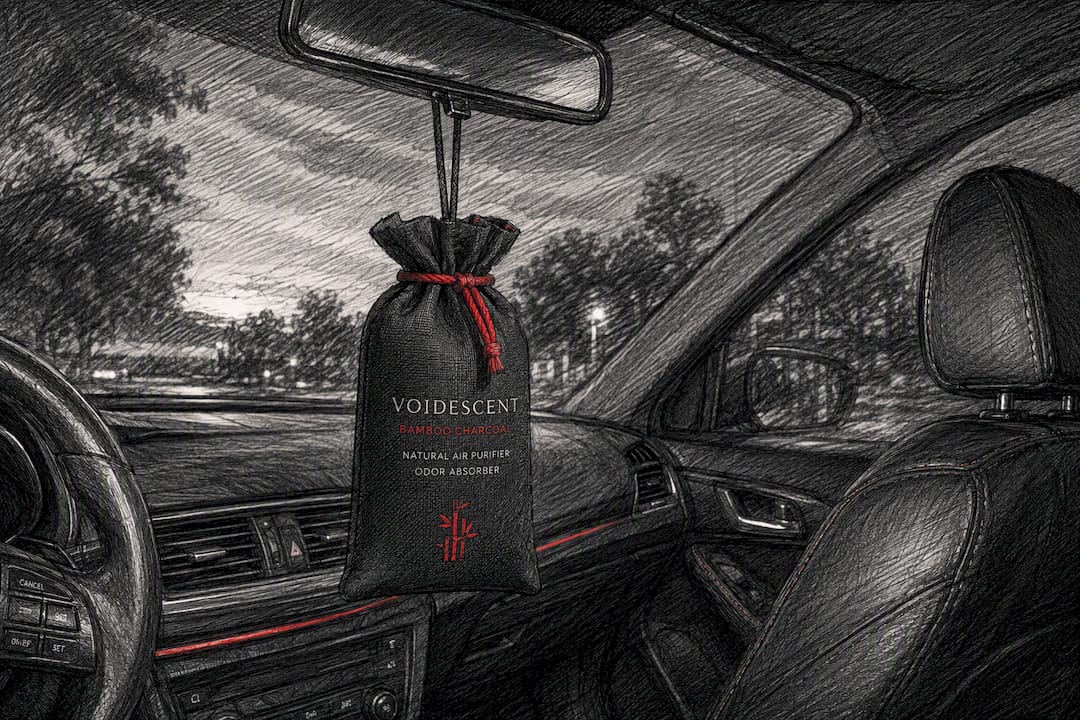
Charcoal generally has the lighter footprint, and it’s not close. A bamboo charcoal bag is compostable, contains no propellants, and can be recharged in sunlight for months before it needs replacing at all. When it’s finally spent, it breaks down naturally instead of sitting in a landfill releasing anything back out.
Aerosol sprays and foggers are the opposite case. They rely on pressurized canisters, often with propellants, and the canister itself is usually not recyclable once empty because of residual pressure and mixed materials. Gel units and plastic vent clips add up too. Most get tossed after a few weeks, and the plastic housing outlives the fragrance inside it by decades.
Slow-release fragrance products split the difference in a useful way. A well-made hanger with botanical oils, the kind Voidescent designs, typically lasts several weeks per refill, which means far fewer units discarded over a year compared to frequently replacing paper cards or cans. Eco-conscious drivers get more scent life per unit of packaging, and no propellant at all.
If disposability matters to you, run the numbers on frequency, not just material. A $3 cardboard tree replaced every week adds up to 52 discarded units a year. A charcoal bag recharged monthly and a fragrance hanger replaced every five weeks generates a fraction of that waste, even before you account for what each product is actually made of.
How Much Does Charcoal Cost Versus a Car Freshener?
Sticker price tells you almost nothing here. What matters is cost per month of actual performance, and that changes the math completely once you factor in how often each product needs replacing.
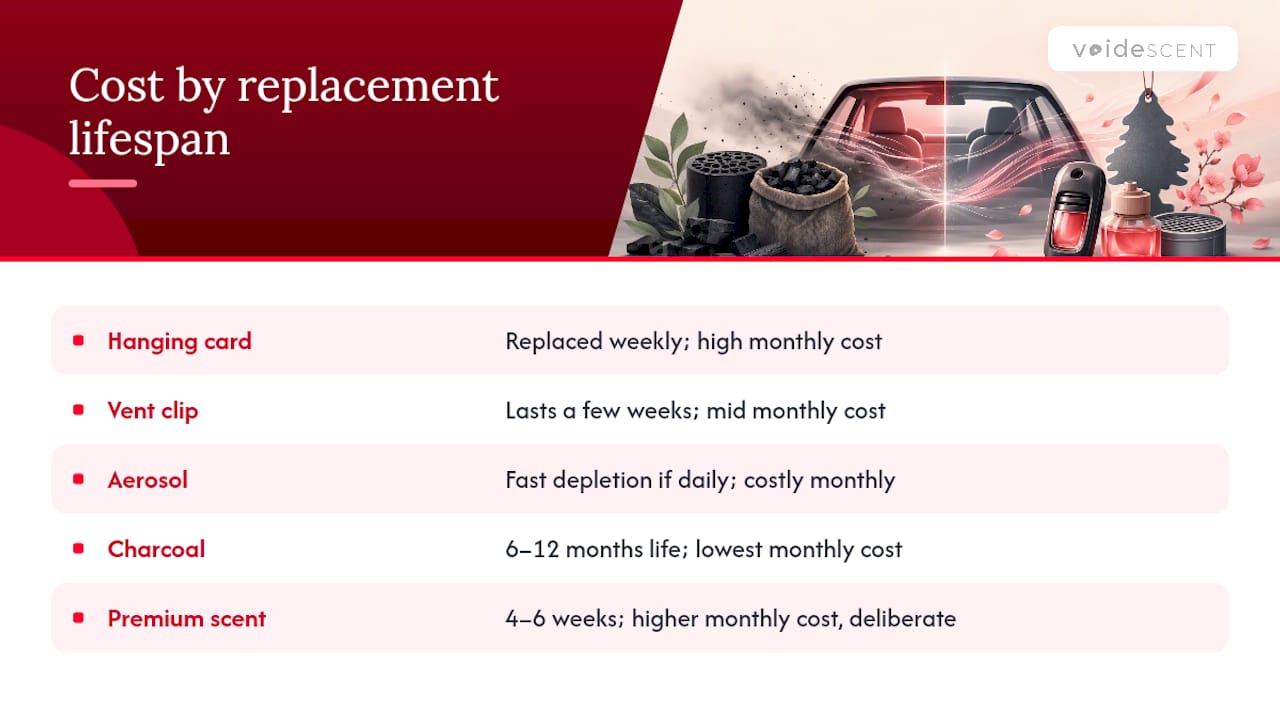
A basic hanging card runs a couple of dollars but fades within days, so keeping a car freshened with cards alone means buying a new one weekly. That’s the cheapest single purchase and often the most expensive habit. Vent clips cost more upfront but stretch across a few weeks, landing somewhere in the middle. Aerosol sprays look affordable per can but burn through fast if you’re spraying daily to keep up with an ongoing odor problem, and the cans themselves aren’t reusable.
Charcoal sits at the opposite end of the replacement curve. A single bag sized for a sedan lasts six to twelve months with nothing but a monthly sunlight recharge, which costs nothing but a few minutes. Divide the purchase price across that lifespan and it’s usually the cheapest odor solution per month you can buy, even though the upfront cost looks higher than a pack of cardboard trees.
Premium slow-release fragrances land in a different category entirely, priced for atmosphere rather than pure function. A product built to last four to six weeks, as tested formats in this range typically deliver, costs more per unit than a vent clip but replaces far less often and performs more consistently across that window. Treat it as a deliberate purchase for the driving experience you want, not a line item you’re minimizing.
Key Takeaways
Charcoal eliminates odor through adsorption over weeks, while a slow-release fragrance like Voidescent’s delivers the atmosphere once that odor is actually gone.
| Point | Details |
|---|---|
| Different jobs | Charcoal removes odor molecules through adsorption; fresheners add scent on top of clean air. |
| Charcoal needs upkeep | Recharge bags monthly in sunlight and replace every six to twelve months for consistent results. |
| Format changes freshener lifespan | Hanging cards fade in days, vent clips last weeks, and slow-release oils can run multiple weeks longer. |
| Clean first, always | Vacuum and shampoo the source before adding any eliminator or fragrance, per odor-elimination-first guidance. |
| Finish with Voidescent | After cleaning and charcoal treatment, Heavens, Descent, Nebula, or Voidegrail add a four to six week botanical scent for the cabin. |
Why Most Advice Gets This Comparison Wrong
Most guides treat charcoal and car fresheners as competing purchases, as if picking one means rejecting the other. That framing misses what’s actually happening in your car. Charcoal is passive and slow. A fragrance is active and immediate. They’re not competing for the same job; they’re stages of the same job, and treating them as interchangeable is exactly why people end up disappointed with both.
The overlooked mistake is skipping the cleaning step entirely. A fragrance layered over a dirty cabin doesn’t neutralize anything, it just adds a second smell on top of the first, and eventually the original odor breaks through anyway. Charcoal without a clean source underneath it works, but slower than it should.
What I’d prioritize first: clean the cabin properly, give charcoal a few weeks to do its quiet work, and only then invest in a fragrance you actually enjoy. That sequencing, more than any specific product choice, is what separates a car that smells temporarily better from one that actually smells good every time you get in.
— Azanone
A Cabin That Smells Intentional, Not Just Clean
Once the odor work is done, atmosphere becomes a design choice, and that’s where Voidescent operates. Unlike a cardboard tree that fades within days or a spray that needs constant reapplication, a Voidescent hanger holds a consistent, evolving scent for four to six weeks from a single application, so you’re not restocking every trip to the store.
Heavens, Descent, and Nebula each offer a different botanical direction, from lighter and airier to deep and resinous, and the Voidegrail option is built for drivers who want maximum diffusion in larger cabins. Every product uses botanical oils instead of synthetic fragrance loads, backed by a money-back guarantee if the scent life doesn’t hold up.
If your car is already clean and charcoal-treated, browse the full scent collection and pick the profile that fits how you actually want your drive to feel.
Sources
For hands-on format comparisons and lifespan data, BHG’s tested roundup breaks down how hanging cards, vent clips, and diffusers actually hold up. CarCareTruth’s odor-elimination guide lays out the clean-then-eliminate-then-scent sequence in more detail. For charcoal-specific mechanics and recharge behavior, CNN Underscored’s air freshener guide is worth a read.