

4–6 Week Slow Release Car Hangers That Ease Motion Sickness
Low-intensity peppermint or ginger, delivered through a slow-release car hanger rather than a strong spray, tends to calm motion nausea more reliably than heavy bursts of fragrance. Calming blends like bergamot and lavender help when anxiety is feeding the nausea, though the evidence there is thinner. Whatever scent you pick, start weak, ventilate the car, and watch how sensitive passengers respond before committing to a full trip.
TL;DR:
- Peppermint scent is most effective for sudden mild nausea, especially when delivered through a steady, low-dose, slow-release hanger.
- Ginger works better for persistent stomach-centered nausea, particularly when symptoms have been ongoing since the start of the trip.
- Calming blends like bergamot and lavender are more suitable for anxiety-related queasiness but have less consistent evidence of effectiveness.
- Using scent hangers at the lowest intensity and off to the side with proper ventilation minimizes the risk of triggering nausea or overwhelming sensitive noses.
- Strong synthetic or unfamiliar fragrances, including new-car VOC off-gassing, can worsen motion sickness, especially in sensitive individuals or under poor ventilation.
Table of Contents
- Best Car Scents for Motion Sickness: Peppermint, Ginger, and Calming Blends
- What Does the Research Say About Scent and Nausea?
- How Do You Use Car Scents Safely?
- Can a Car Scent Make Motion Sickness Worse?
- Quick Fixes That Work Alongside Scent
- Why Voidescent’s Approach Fits This Advice
- A Practical Note on Finding Your Scent
- Try a Slow-Release Hanger Before Your Next Long Drive
- Sources
- FAQ
Best Car Scents for Motion Sickness: Peppermint, Ginger, and Calming Blends
Three scent families come up again and again in both research and product design, and each one fits a slightly different kind of queasiness.
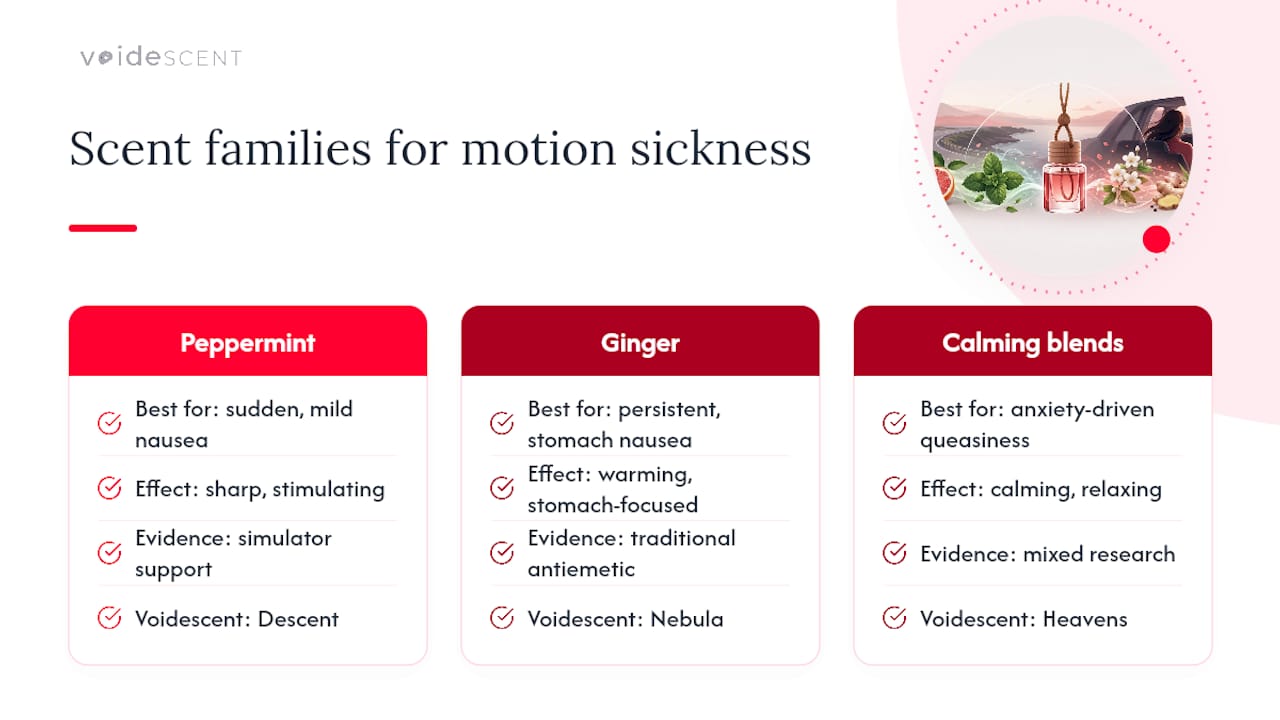
Peppermint is the closest thing to a go-to. Simulator research has linked peppermint to reduced motion-sickness symptoms alongside improved alertness, which makes it a solid pick for sudden, mild nausea that hits partway through a drive. It’s sharp enough to notice immediately, and that matters: pleasant scents tend to help mostly when people consciously perceive them, so a barely-there peppermint hanger is doing real work, not just sitting there.
Ginger has a longer history as an antiemetic, and it tends to suit persistent, stomach-centered nausea better than the sudden kind. If someone in the car gets queasy from the first mile and stays that way, ginger is worth trying before peppermint.
Bergamot and lavender blends work differently. They’re calming rather than stimulating, which helps when anxiety about the drive itself is part of the problem. The research on these two is more mixed than peppermint or ginger, so treat them as a good option for anxious passengers, not a universal fix.
On delivery: slow-release hangers that release scent steadily over weeks beat a strong aerosol burst almost every time, because a constant low dose keeps the scent noticeable without overwhelming anyone. Among Voidescent’s own lineup, Descent leans into cooler, sharper notes suited to peppermint-forward relief, Nebula balances mint with a broader botanical profile, and Heavens sits in the calmer, floral register for anxiety-driven queasiness.
What Does the Research Say About Scent and Nausea?
The evidence isn’t unanimous, but it does point in a consistent direction. A PubMed-indexed review covering multiple clinical and simulator trials found peppermint and ginger scents associated with reduced nausea and motion-sickness symptoms, though results shift depending on the study design and how the scent was delivered. A separate comparative simulator experiment tested peppermint, ginger, and ginger-lavender combinations against controls and found measurable drops in motion-sickness indicators using both subjective rating scales and physiological tracking.
That physiological tracking matters. Researchers lean on tools like the Simulator Sickness Questionnaire (SSQ), galvanic skin response (GSR), and EEG readings because “I feel less sick” is hard to verify on its own. When pleasant odors reduced visually induced motion sickness in lab settings, the effect only showed up in participants who consciously noticed the smell. Unnoticed scents did little. That’s the strongest argument against dousing a car in fragrance: a low, perceptible dose outperforms an overpowering one.

Not every review agrees on magnitude. Some broader syntheses of aromatherapy research describe the overall evidence as mixed, varying by scent, delivery method, and individual sensitivity. That’s a reason to treat scent as a low-risk adjunct, not a guaranteed cure. On the safety side, the EPA’s guidance on volatile organic compounds is a good reason to favor slow-release, IFRA-compliant formulations over high-concentration sprays that spike VOC levels in a closed cabin.
How Do You Use Car Scents Safely?
Getting the intensity and placement right prevents a good idea from backfiring.
- Start with the weakest setting or the mildest hanger you own, and get a thumbs-up from every passenger before a long drive.
- Hang the scent at head height, but off to the side rather than directly under anyone’s nose, and check where the vents are blowing.
- On longer trips, give the cabin scent-free breaks rather than running an intense source the whole way.
- Favor 4 to 6 week slow-release hangers over high-concentration cartridges or aerosol sprays, which peak hard and fade fast.
- Check the label for IFRA compliance or clear ingredient disclosure, and crack a window regularly to keep VOC levels down, especially in a smaller cabin.
Pro Tip: Run a short test before committing to a road trip. Ten to fifteen minutes in a ventilated, parked car at the lowest scent intensity, with the passenger reporting any change, tells you more than guessing ever will. Pull the scent immediately if anything worsens.
Can a Car Scent Make Motion Sickness Worse?
Yes, and it usually comes down to one of a few things. Some people are just more sensitive to smell, and an unfamiliar or synthetic-leaning fragrance can trigger the same aversion response as spoiled food. Choosing familiar, food-associated notes (think mint or ginger over something exotic) tends to sit better with sensitive noses, and this guide to natural, familiar car scents walks through picking gentler options.
New-car smell is its own problem. It’s largely off-gassing VOCs, and that chemical load can spike nausea before you’ve added any fragrance at all. Ventilate aggressively and skip strong synthetic air fresheners on top of it. Pregnancy, certain medications, and chronic conditions can also change how someone reacts to concentrated aromatherapy, so it’s worth checking with a doctor before leaning on active scent therapy in those cases. If symptoms do worsen, poison-control guidance on air fresheners recommends opening windows, removing the scent source, and switching to non-scent measures right away.
Quick Fixes That Work Alongside Scent
A few low-effort moves pair well with any scent strategy, or work on their own when scent isn’t the answer:
- Sit in the front seat if possible, face forward, and fix your eyes on the horizon rather than a phone or book.
- Crack a window for airflow, since stale, warm air makes nausea worse regardless of fragrance.
- Chew gum or suck on a peppermint lozenge, which gives you an oral peppermint dose that complements a scent hanger; peppermint-flavored chewing gum is a simple option to keep in the glove box.
- Sip water, eat something light, and try slow, controlled breathing before reaching for an over-the-counter antiemetic.
Why Voidescent’s Approach Fits This Advice
Voidescent builds its hangers around the same principle the research keeps pointing to: a low, steady dose beats a strong one. The botanical oils release gradually over 4 to 6 weeks, so the cabin gets a consistent, noticeable but never overwhelming scent instead of the sharp spike-and-fade cycle of a spray or clip-on cartridge. That slow curve is exactly what limits the risk of an intense burst pushing someone from mildly queasy to fully carsick.
If you’re testing this for a sensitive passenger, start with whichever scent family matches their trigger. Peppermint-leaning Descent suits sudden mild nausea, calming Heavens suits anxiety-linked queasiness, and Nebula splits the difference. Voidescent backs every hanger with a money-back guarantee, and its blog on calming car scents goes deeper on ingredient choices if you want to compare formulations before buying.
A Practical Note on Finding Your Scent
Treat this as trial and error, not a fixed prescription. Start with a peppermint or ginger hanger on a short trip, at the lowest intensity, and stop the moment anyone feels worse rather than better. What works for a straight highway run may fail on a winding mountain road, so test under a few different conditions before deciding it’s a keeper.
— Azanone
Try a Slow-Release Hanger Before Your Next Long Drive
Rather than relying on synthetic air fresheners that peak hard and fade in days, some botanical options are designed to last several weeks at a steady, low intensity. That matters most for motion sickness, where a gentle, noticeable scent beats a strong blast almost every time. If sudden mild nausea is the issue, Descent leans into peppermint. If anxiety is driving the queasiness, Heavens offers a calmer floral profile. For a balanced mint-forward option, Nebula is worth a look, and the full lineup sits on the car hanger fragrance page. Pick one, test it on a short drive with the windows cracked, and lean on the money-back guarantee if it’s not the right match for your car.
Sources
- Is there evidence that aromatherapy helps with nausea? (PubMed indexed review)
- CARoma Therapy: Pleasant Scents Promote Safer Driving (ACM/CHI proceedings)
- What are volatile organic compounds (VOCs)? — EPA
- Poison
FAQ
What is the best car scent for motion sickness?
Peppermint and ginger have the strongest research backing among scent options for motion-nausea relief, according to a PubMed-indexed review of clinical and simulator trials. Calming blends like bergamot and lavender can help when anxiety is part of the nausea, though the supporting evidence there is more mixed.
Why do car scents sometimes make me nauseous instead of helping?
Strong or unfamiliar fragrances can trigger the same aversion reflex as spoiled food, especially in people who are already sensitive to smell. High-concentration sprays and cartridges also push VOC levels up in a closed cabin, and the EPA links elevated VOC exposure to worse indoor air quality, which can compound queasiness rather than ease it.
What scent is good for motion sickness if I’m prone to anxiety in the car?
Bergamot and lavender blends tend to work better for anxiety-linked nausea than sharper scents like peppermint, since they’re calming rather than stimulating. A slow-release option like Heavens delivers that calmer profile at a low, steady intensity rather than an intense burst.
Can new-car smell cause or worsen motion sickness?
Yes. New-car smell comes largely from off-gassing volatile organic compounds, and that chemical load can spike nausea on its own, before any air freshener is added. Ventilating the cabin and avoiding additional strong synthetic scents on top of that new-car VOC load helps keep symptoms manageable.