

4–6 Weeks of Scent: Car Diffusers vs Fresheners for Daily Drivers
Diffusers beat traditional air fresheners on longevity and scent quality nearly every time, but they cost more upfront and need occasional upkeep. If you drive daily and want consistent, well-rounded fragrance without swapping products every few weeks, a diffuser or a refillable designer hanger like the ones Voidescent makes is the smarter buy. If you just need a quick, cheap burst of scent before a passenger hops in, a $3 hanging card still does the job.
TL;DR:
- Diffusers, especially ultrasonic models, last four to six weeks and provide more consistent scent profiles than traditional fresheners, which last only days to weeks.
- The initial cost of diffusers is higher, but they tend to be more economical over time if used daily due to longer-lasting scent performance.
- Proper maintenance, such as using distilled water with ultrasonic diffusers, is essential to extend the device’s lifespan and prevent buildup.
- For occasional drivers, a cheap hanging card or vent clip under $10 suffices, while daily commuters benefit from more durable diffusers or premium hangers.
- Voidescent’s botanical oil-based hangers offer a four to six-week scent lifespan and a variety of profiles, making them a better investment than disposable fresheners.
Table of Contents
- Car Diffuser vs Freshener: What Is a Traditional Air Freshener?
- Car Diffuser vs Freshener: How Does a Car Diffuser Work?
- Diffuser vs Freshener: Longevity, Cost, Safety, and Design Compared
- How to Choose Between a Diffuser and a Freshener
- Where Voidescent Fits in the Diffuser vs Freshener Debate
- Which Format Actually Fits Your Driving Life?
- Try Voidescent’s Scent Hangers Instead of Restocking Fresheners Every Month
- Sources
Car Diffuser vs Freshener: What Is a Traditional Air Freshener?
A traditional car air freshener releases fragrance through simple evaporation. There’s no mechanism controlling output, no reservoir to refill, and no adjustability. You hang it, clip it, or spray it, and the scent does whatever it’s going to do until it fades out.
The category breaks down into four common formats:
- Hanging cards and trees: cardboard or felt shapes soaked in fragrance oil, hung from the rearview mirror.
- Vent clips: small plastic clips that snap onto an air vent, using airflow to push scent around the cabin.
- Gels: fragrance suspended in a gel base, usually in a small cup or canister, releasing scent slowly as it dries out.
- Sprays and wipes: instant, on-demand scent bursts with zero lasting effect beyond a few hours.
The appeal is obvious: cheap, immediate, no setup. The downside shows up fast. Passive fresheners like hanging trees and vent clips often fade within days to a few weeks depending on cabin heat and how often you drive. A car that sits in direct sun all afternoon will cook a hanging card’s fragrance oil out far quicker than one parked in a garage. And because there’s no way to dial down concentration, fresheners often peak too strong right out of the packaging, then fade to nothing, with barely a comfortable middle stretch. That’s the core complaint people have with the format: short life, uneven intensity, and a “new car smell” that oversells itself for about 48 hours before flattening out.
Car Diffuser vs Freshener: How Does a Car Diffuser Work?
A car diffuser is built to control fragrance release rather than just let it evaporate on its own schedule. That distinction is the entire reason diffusers tend to outperform fresheners on longevity: slow-release and active diffusion methods maintain a steadier scent output instead of spiking and crashing.
Four main types dominate the market:
- Passive wick diffusers: a wick sits in a small vial of fragrance oil, wicking scent upward at a controlled rate, no power needed.
- Vent-wick diffusers: similar wick mechanism, but clipped to an air vent so moving air speeds up diffusion when the fan runs.
- Electric or USB diffusers: powered units that heat or aerosolize fragrance oil for a stronger, more consistent throw.
- Ultrasonic or nanomist diffusers: use vibration to break fragrance-and-water mixtures into a fine, cold mist with no heat involved.
Ultrasonic and cartridge-based systems need more attention than a hanging card ever will. Most water-based ultrasonic diffusers require distilled water and light oil dilution to prevent mineral scaling on the internal plates, and skipping that step shortens the unit’s working life. Battery-run diffusers also vary wildly in real-world runtime. Some retail listings claim up to 50 hours on a single charge, but that number shifts depending on mist mode, ambient temperature, and how often the fan cycles. The upside is real: richer, more layered scent profiles, adjustable intensity, and a product that keeps working for weeks instead of days. The trade off is a higher price at checkout and, for electric models, actual maintenance instead of “hang it and forget it.”
Diffuser vs Freshener: Longevity, Cost, Safety, and Design Compared
The differences between these two categories aren’t abstract. They show up in how long the scent lasts, what it costs per week, how much attention it demands, and what it does to your cabin’s air quality.
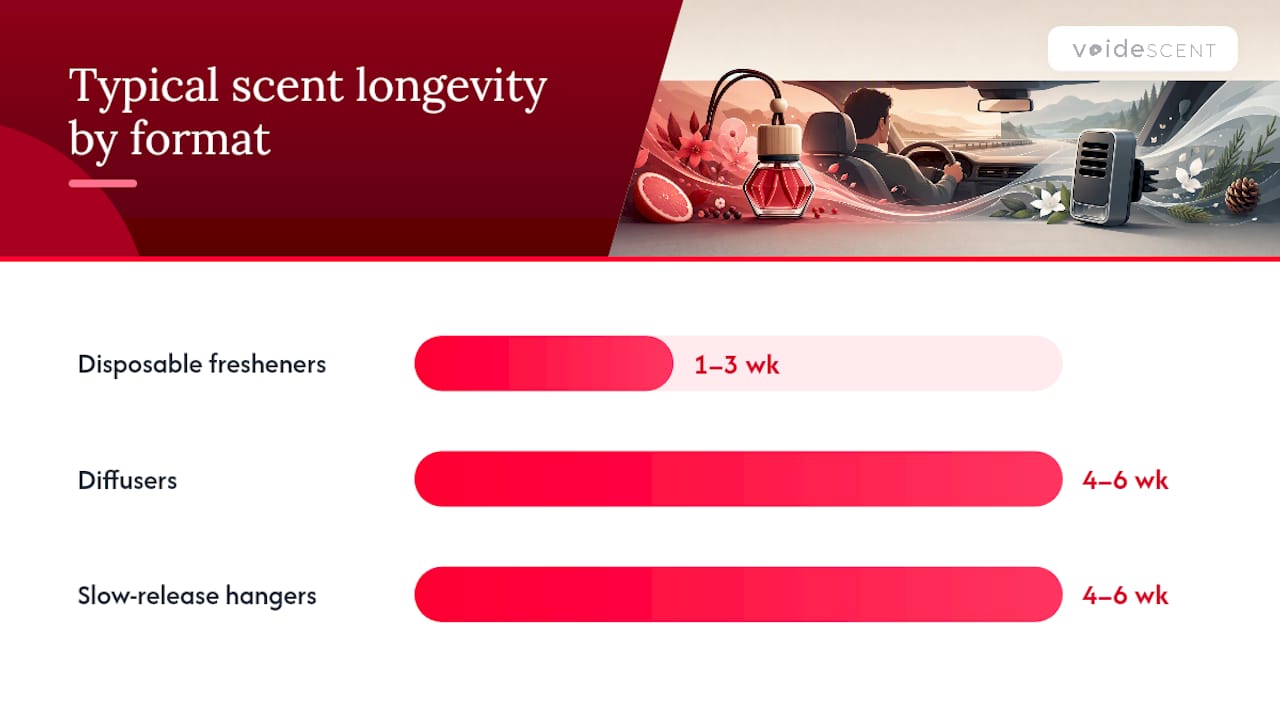
1. Longevity. Hanging cards and vent clips typically fade within one to three weeks in normal use, faster in hot climates. Diffusers, whether passive wick or electric, commonly run four to six weeks before needing a refill or replacement, and that gap widens further in temperate weather since heat is the biggest accelerant of fragrance evaporation. Some scent hangers are built around a four to six week window, using a slow-release oil blend rather than a quick-evaporating spray.
2. Scent quality. Cheap fresheners lean on synthetic fragrance compounds designed for a strong initial hit. Diffusers and premium hangers more often use essential oils or higher-grade fragrance oils, which tend to smell more layered and less like an air-conditioned candy store.
3. Cost over time. A pack of three hanging trees might run you $6 to $10 and last three to six weeks combined. A refillable diffuser cartridge or a premium hanger costs more upfront, often $15 to $30, but can work out cheaper per week than repeatedly buying disposable fresheners once you account for how often you’re replacing the cheap version.
4. Convenience. Hanging cards need zero setup. Vent clips take ten seconds. Electric diffusers need a power source and occasional cleaning. Wick-based hangers sit in between: no power, no water, just replace the vial when the scent runs out.
5. Health and safety. Overpowering scent in a closed cabin is a real complaint, especially for passengers with sensitivities. IFRA guidelines govern how concentrated fragrance ingredients can be in consumer goods, and checking whether a product follows those standards is worth doing before committing to a strong scent in a small enclosed space. Crack a window occasionally regardless of which format you use.
6. Design. This is where cheap fresheners lose ground fastest. A dangling cardboard tree or a bright plastic vent clip does nothing for a car’s interior. Diffusers and minimalist hangers take up less visual space and don’t clutter the mirror or vents.
Pro Tip: Before buying any diffuser, check whether it needs distilled water specifically. Tap water minerals build up on ultrasonic plates over time and can cut a unit’s lifespan short well before the fragrance runs out.
How to Choose Between a Diffuser and a Freshener
Match the product to your actual driving habits, not the packaging claims. A short checklist beats guesswork here.
- Budget first? A vent clip or hanging card under $10 covers occasional use without commitment.
- Long commute or daily driver? A diffuser or refillable hanger pays off since you’re in the cabin enough to notice fade and refill cost adds up either way.
- Sensitive passengers or asthma concerns? Choose lower-intensity, IFRA-aware fragrance formulas and keep a window cracked during longer drives.
- Care about how the interior looks? Skip the plastic clip and go with a slim hanger or a diffuser with a compact footprint.
Before buying, ask the seller or product page three questions: how often does it need refilling, does it require power or water, and what’s the actual fragrance concentration. Once you own it, placement matters more than people expect. Keep hangers away from direct sun on the dashboard, and never assume more product means more scent. A heavier dose of fragrance oil can overwhelm a small cabin fast. And cleaning still beats masking. Odor removal addresses the source; fragrance just covers it up.
Where Voidescent Fits in the Diffuser vs Freshener Debate
Voidescent builds automotive scent hangers around one core claim: consistent, evolving fragrance for four to six weeks, using botanical oils instead of synthetic fillers. That’s a direct answer to the biggest complaint about traditional fresheners: fast fade and flat, one-note scent.
A car’s cabin is small enough that fragrance choices are never neutral. The wrong scent, or too much of the right one, becomes noise instead of atmosphere. The goal isn’t more fragrance. It’s fragrance that changes subtly over weeks instead of disappearing after three days.
Voidescent’s hangers are sized for standard cabin volumes, not industrial diffusion, so there’s no need to guess at dosage or worry about overpowering a compact interior. Some products come with a straightforward guarantee: if the scent performance doesn’t hold up, customers can request a refund. That’s a meaningful signal in a category where most sellers won’t stand behind longevity claims at all.
Which Format Actually Fits Your Driving Life?
Budget-focused drivers doing occasional short trips genuinely don’t need to overthink this. A $3 vent clip or hanging card delivers exactly what it promises for a couple of weeks, and replacing it isn’t a burden if you’re not driving much.
Design-conscious drivers, or anyone doing daily commutes, get more value from a diffuser or a premium hanger. The math favors them once you factor in how often a cheap freshener needs replacing, and the scent itself tends to feel more intentional rather than accidental.
Sensitive riders should skip both high-concentration diffusers and cheap synthetic sprays. Start with a low-intensity, IFRA-aware option, keep ventilation open on long drives, and prioritize cleaning the cabin before adding any fragrance at all. A car that already smells clean needs far less scent to smell good.
— Azanone
Try Voidescent’s Scent Hangers Instead of Restocking Fresheners Every Month
Instead of buying another three-pack of fading cardboard trees every few weeks, Voidescent gives you one hanger that holds its scent for four to six weeks and looks like it belongs in your car, not like an afterthought from a gas station rack. Each product in the lineup covers a different mood: Descent leans into deep, grounded notes for drivers who want something understated, Heavens offers a brighter, airier profile, and Nebula blends the two into something more layered for anyone who wants the scent to shift subtly over its lifespan rather than sit static.
Hanging any of them takes seconds, refills follow the same four to six week rhythm, and every purchase carries Voidescent’s money-back guarantee if the performance doesn’t hold up. Compare scent profiles and check the Descent hanger, browse the Heavens option, or see the Nebula blend to find the one that fits your cabin.
Sources
- Car Diffusers vs. Air Fresheners: Which Is Better? | Aroma360
- Cheap vs. Expensive Car Air Freshener: Which One Should You Buy? | Car and Driver