

EEG Backed Scents for Drivers: Stay Alert 15–30 Minutes
Short answer: yes. Peppermint and certain citrus and menthol scents produce a measurable, short-term alerting effect behind the wheel, with the strongest signal showing up within minutes and fading within roughly 15 to 30 minutes as your nose adapts. Peer-reviewed driving-simulator trials and EEG monitoring back this up, though the effect is real and modest, not a substitute for sleep or a rest stop.
TL;DR:
- Peppermint produces an immediate alertness boost within minutes, with effects diminishing after 15 to 30 minutes due to sensory adaptation.
- EEG studies confirm scent-induced brain activity shifts toward wakefulness, allowing objective detection of increased alertness during driving.
- Citrus and rosemary scents can enhance alertness, but calming scents like lavender and ylang-ylang tend to promote relaxation and are unsuitable for driving.
- Continuous exposure to fragrances reduces effectiveness over time, so intermittent bursts or pulsed delivery optimize alertness and minimize sensory fatigue.
- Matching the scent to the driving context, such as peppermint for highway monotony or bergamot for urban overload, improves safety and focus.
Table of Contents
- Scent and Driver Alertness: What the Best Studies Actually Found
- Which Scents Boost Alertness and Which Calm You Down
- What Happens in Your Brain and Body When You Smell Peppermint
- How to Use Scent in Your Car Without Overdoing It
- Matching the Scent to the Drive
- What the Research Still Gets Wrong (or Hasn’t Answered Yet)
- Why Peppermint Gets the Headlines, and What That Misses
- Bring the Right Scent Into Your Own Car
- Sources
Scent and Driver Alertness: What the Best Studies Actually Found
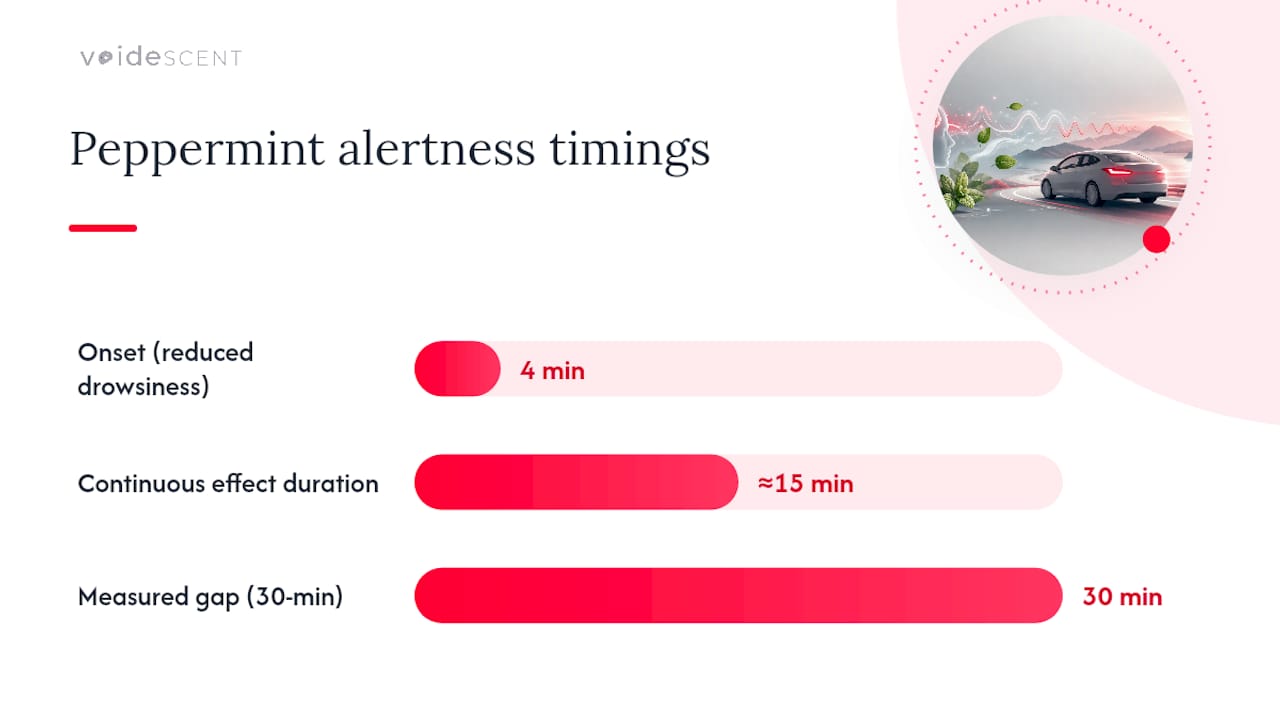
The strongest evidence linking scent and driver alertness comes from controlled simulator work, not marketing copy. Researchers running a peppermint intervention study clocked a reduction in driving fatigue and drowsiness within about four minutes of exposure. That is fast. It means a driver who feels the first pull of monotony on a highway does not have to wait long to notice a shift.
A separate simulator experiment tracking EEG activity found that peppermint exposure helped drivers maintain alertness relative to a placebo across a 30-minute drive, with brainwave data backing up what drivers reported feeling. This matters because subjective reports (how alert someone says they feel) can be unreliable. EEG strips that guesswork away.
More recent work pushed the science further with wearable EEG technology. A study modulating driver alertness through ambient scent found that a machine-learning model trained on brain activity could distinguish olfaction-induced alertness states with about 92.1% accuracy. That number matters because it shows scent-driven changes in brain activity are consistent enough for an algorithm to detect them reliably, not just a placebo effect drivers talk themselves into.
Duration and timing show up consistently across the research:
- Peppermint’s alerting effect on reaction time and drowsiness measures often appears quickly after exposure.
- Behavioral improvements from continuous fragrance delivery tend to hold for roughly 15 minutes before sensory adaptation sets in and dull the effect.
- Longer trials, like the 30-minute EEG simulator study, still detected a measurable gap between peppermint and placebo, suggesting the effect does not vanish instantly, it just weakens.
Key finding: A wearable EEG classifier reached 92.1% accuracy distinguishing scent-induced alertness states from baseline, one of the more objective pieces of evidence that fragrance changes brain activity in real time, not just self-reported mood.
Context changes which scent performs best. Controlled work comparing peppermint against bergamot found peppermint produced the largest drop in reaction time, the kind of benefit that matters most on a featureless highway where boredom is the enemy. Bergamot, by contrast, stabilized response rhythms and lowered perceived mental workload, a profile that fits stop-and-go city driving better than long-haul monotony. The takeaway is not “pick one winner.” It is “match the tool to the job.”
Which Scents Boost Alertness and Which Calm You Down
Not every pleasant smell helps you drive better. Some actively work against vigilance, which is worth knowing before you grab whatever oil is on sale.
Scents with alerting effects, backed by research:
- Peppermint. The most studied alerting scent in driving research, tied to reduced drowsiness, faster reaction times, and measurable EEG shifts across multiple simulator trials.
- Lemon and other citrus. Reviews of fragrance psychophysiology link citrus scents to increased subjective alertness and sharper cognitive performance, making them a reasonable substitute when peppermint feels too sharp.
- Rosemary. Associated with alertness and memory performance in broader fragrance research, though it has less driving-specific simulator data than peppermint.
Scents that calm rather than sharpen focus:
- Lavender. Consistently shows up in the literature as sedative, which is exactly why it is popular for sleep and exactly why it has no place near a steering wheel during a long drive.
- Ylang-ylang. Another scent with relaxing, mood-softening effects, useful for winding down after a trip, not during one.
Bergamot sits in its own category. It is not purely alerting the way peppermint is, and it is not sedative like lavender. The research shows it stabilizes response rhythm and reduces perceived workload, which reads less like a jolt of energy and more like a steadying hand. That makes it a strong fit for dense urban driving, where the problem is not boredom but sensory overload from traffic, pedestrians, and constant decision-making.
Pro Tip: Keep a calming scent like lavender out of the car entirely if you drive long distances regularly. It is a great choice for your bedroom, but it works against the exact state you need behind the wheel.
What Happens in Your Brain and Body When You Smell Peppermint
Scent affects alertness through more than just a psychological “pick me up.” Studies measuring EEG activity during scent exposure track two frequency bands that matter most for driver fatigue research: alpha waves, which rise during drowsiness and relaxation, and beta waves, which climb during focused, alert states. Peppermint exposure has been linked to increased beta-related alertness in controlled simulated driving, meaning the brain activity pattern itself shifts toward wakefulness, not just the driver’s mood.
The body’s autonomic nervous system responds too. Research on fragrance compounds found that limonene, the citrus-derived molecule responsible for much of lemon’s smell, increased sympathetic nervous system activation and boosted variability in respiratory rhythm, both signs of a body shifting out of a low-arousal state. Alpha-pinene, found in rosemary and pine-adjacent scents, showed a similar pattern of physiological response linked to counteracting drowsiness.
Here is the mechanism in plain terms:
- Alpha/beta EEG shift: Alerting scents nudge brain activity away from drowsy alpha patterns and toward alert beta patterns, an effect strong enough for machine-learning models to detect with roughly 92.1% classification accuracy.
- Autonomic activation: Compounds like limonene and alpha-pinene appear to activate the sympathetic nervous system, the branch responsible for the “alert and ready” response, rather than the parasympathetic “rest and digest” branch.
- Respiratory changes: Increased variability in breathing rhythm shows up alongside these autonomic shifts, another objective marker that something physiological, not just psychological, is happening.
None of this lasts forever, and that is the part drivers most often miss. Continuous exposure to any single fragrance leads to sensory adaptation. Your olfactory receptors essentially stop reporting the smell as strongly once they have registered it for a stretch, which is why the strongest behavioral effects in simulator studies cluster in that first 15-minute window after continuous delivery begins. Pulsed or intermittent exposure appears to blunt this adaptation better than a constant, unchanging stream of scent.
How to Use Scent in Your Car Without Overdoing It
Getting the alerting effect without a headache or a false sense of security takes a little strategy. Here is how to actually apply the research.
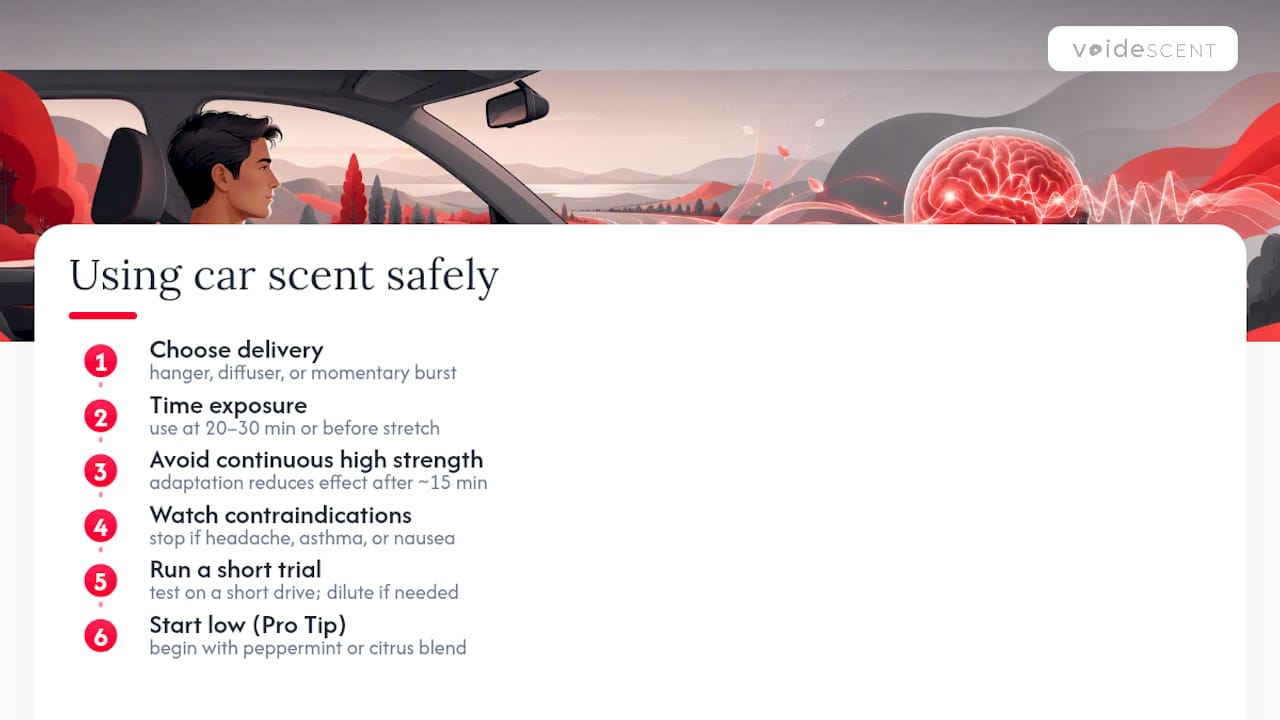
1. Choose your delivery method based on how you drive. Slow-release hangers work well for drivers who want a steady low-level baseline scent that shifts gradually over weeks, minimizing the shock-and-adapt cycle that comes from blasting a strong burst all at once. Diluted fragrance oils in a small diffuser give you more control over intensity but need more attention to concentration. A momentary burst from a stronger source can work for a quick jolt before a known monotonous stretch, but it is the least sustainable option for a multi-hour drive.
2. Time your exposure to when you actually need it. Do not run a strong scent continuously from the moment you start the engine. Save the strongest exposure for when monotony typically sets in, roughly 20 to 30 minutes into a long, featureless drive, or trigger it preemptively right before you know a boring stretch is coming (a rural highway, an overnight leg).
3. Avoid continuous high-strength exposure. Because sensory adaptation dulls the effect after roughly 15 minutes of steady delivery, running a diffuser at full strength for hours does not multiply the benefit. It just increases your odds of irritation and wastes product. Lower, steady background concentration paired with occasional refresh works better than a constant flood.
4. Watch for contraindications. Strong essential oils and concentrated fragrances can trigger migraines, worsen asthma symptoms, or cause nausea in sensitive individuals. If you notice a headache building, a tight chest, or queasiness, remove the scent source and crack a window rather than pushing through it.
5. Run a short trial before committing to a scent for long trips. Test a new scent on a short, familiar drive first. If it causes any irritation, switch scents or dilute further before relying on it for a longer trip.
Pro Tip: If you are new to using scent for alertness, start with a lower-intensity peppermint or citrus blend rather than the strongest option available. You can always add more; you cannot un-inhale an overpowering dose mid-drive.
Matching the Scent to the Drive
The research is fairly consistent on one point: context changes which scent works best, so the same fragrance is not automatically right for every trip.
- Long highway stretches (monotony is the enemy): Peppermint is the strongest evidence-backed choice here. Its effect on reaction time and beta-band alertness fits a scenario where the main risk is zoning out on an unchanging road.
- Dense urban driving (information overload is the enemy): Bergamot or a mild citrus blend fits better. The goal in traffic is not a jolt of stimulation, it is steadier processing under constant micro-decisions, and bergamot’s rhythm-stabilizing effect suits that better than a sharp alerting hit.
- Short trip while already tired: A quick, stronger burst of peppermint or citrus scent right before departure can help bridge a brief drive, though it is not a substitute for actually resting if fatigue is severe.
- Overnight or early-morning legs: Combine peppermint with pulsed rather than continuous delivery to fight both drowsiness and the adaptation effect that kicks in after sustained exposure.
Time of day interacts with all of this. A driver running on four hours of sleep at 2 a.m. is fighting a much steeper uphill battle than someone slightly bored on a Sunday afternoon drive, and no scent fully overrides that level of fatigue. Scent shifts the odds in your favor; it does not cancel out a genuine sleep deficit.
What the Research Still Gets Wrong (or Hasn’t Answered Yet)
The evidence linking scent and driver alertness is genuinely encouraging, but it has real gaps worth naming honestly. Most simulator studies run relatively short sessions, often under an hour, so the science says less about scent’s effect on a genuine six-hour overnight drive. Sample sizes in several of these trials are modest, which limits how confidently the findings generalize across age groups, sleep-deprivation levels, or medical conditions like sleep apnea.
Concentration standardization is another weak point. Studies vary in how much fragrance they diffuse and for how long, making it hard to translate lab conditions directly into “use this many drops in your car.” And most research isolates one scent variable at a time rather than testing how combinations, temperature, humidity, or car ventilation systems change the outcome in a real vehicle.
Future research would benefit from longer real-world trials using wearable EEG in actual vehicles rather than simulators, larger and more diverse driver samples, and head-to-head comparisons of delivery methods (hangers versus diffusers versus vents) under identical conditions. Until that work exists, the safest approach is treating scent as one layer of support, alongside real breaks, adequate sleep, and caffeine when appropriate, not a stand-alone fix.
Why Peppermint Gets the Headlines, and What That Misses
Most coverage of scent and driver alertness stops at “peppermint wakes you up,” and that is not wrong, it is just incomplete. The research actually supports a more useful idea: alertness is context-dependent, and the smartest approach matches the fragrance to the driving problem rather than treating one scent as a universal fix.
Conventional advice tends to ignore adaptation almost entirely. Drivers buy one air freshener, run it constantly, and wonder months later why it stopped “working.” It never stopped working; their nose stopped listening. That is a real limitation the studies keep surfacing, and it deserves more attention than it gets.
The bigger priority for readers is not “which scent is strongest,” it is “which scent fits my actual drive.” A commuter fighting city traffic has a different physiological problem than a driver crossing three states overnight, and the evidence backs treating them differently rather than reaching for the same bottle out of habit.
— Azanone
Bring the Right Scent Into Your Own Car
Reading the research is one thing, having a scent on hand that matches your drive is another. Voidescent builds slow-release car fragrances designed to sidestep the adaptation problem that undercuts cheap air fresheners, with eco-friendly botanical oils that hold a consistent, evolving aroma for four to six weeks instead of fading within days.
For long highway stretches where peppermint’s alerting profile matters most, Heavens delivers a sharp, invigorating menthol-citrus blend built for exactly that scenario. If your drives lean urban and you want something closer to bergamot’s stabilizing effect, Nebula offers a mid-strength profile suited to stop-and-go traffic. Want an intense, short-burst option for a tired final leg of a trip? Voidegrail is built for that stronger, momentary lift. And for drivers who want a focused, invigorating everyday profile without picking between extremes, Descent fits the daily commute.
Every Voidescent product ships with a money-back guarantee, so testing which scent fits your driving pattern carries no real risk. Browse the full scent collection and pick the one that matches your next drive.
Sources
- Study on Peppermint Scent Interventions for Fatigue Driving
- Modulating Driver Alertness via Ambient Olfactory Stimulation: A Wearable Electroencephalography Study
- Scented Solutions: Examining the Efficacy of Scent Interventions in Mitigating Driving Fatigue
- The Effectiveness of In-vehicle Peppermint Fragrance to Maintain Car Driver’s Alertness