

Car Odour Neutraliser vs Freshener: What You Need to Know
Use an odour neutraliser for persistent, embedded, or biological smells — pet accidents, smoke, food spills, mildew — and reach for a freshener only when you want a pleasant scent on top of a clean cabin. Layering a freshener over an unresolved smell doesn’t fix anything; it just adds a competing odour. The practical sequence is always the same: clean the source, neutralise what’s left, then scent if you want to.
For the fastest non-professional fix, enzymatic cleaners handle organic smells (urine, vomit, food), while a chemical neutraliser like GYEON Q²M OdorRemover tackles smoke and mildew. If the smell returns every time the fan runs, the HVAC system is the source and needs targeted cleaning before any freshener will help. When smells are deeply embedded after a flood, fire, or long-term pet use, professional ozone or steam treatment is worth the cost.
Voidescent’s scent hangers are designed for that final step — slow-release botanical fragrance after the cabin is genuinely clean.
Pro Tip: Never use a freshener as a first response to a strong biological smell. You’ll end up with two competing odours instead of one, and the original problem will still be there.
Key Takeaways
Neutralise embedded or biological smells before adding any fragrance — a freshener applied to an untreated source makes the problem worse, not better.
| Point | Details |
|---|---|
| Neutraliser vs freshener | Use a neutraliser for persistent, organic, or embedded smells; use a freshener only on a clean cabin. |
| Three-step workflow | Clean the source, neutralise what remains, then freshen if you want a positive scent. |
| HVAC is often the source | Smells that intensify with the fan usually need A/C cleaning and a new cabin filter, not a freshener. |
| Safety matters | Ozone and chemical oxidisers require ventilation and an unoccupied vehicle; botanical fresheners carry a lower VOC load. |
| Voidescent for the final step | Heavens and Descent are slow-release botanical hangers lasting 4 weeks, designed for a clean cabin. |
Table of Contents
- How does a car odour neutraliser actually work?
- How do car air fresheners and perfumes actually work?
- When should you use a neutraliser vs a freshener?
- Research-backed methods that actually remove odours
- Safety, health, and environmental considerations
- How to choose the right product for your situation
- Typical costs and how long each solution lasts
- Why neutralising first is the only approach worth taking
- Voidescent: the finishing touch after you’ve neutralised
- Sources
How does a car odour neutraliser actually work?
Odour neutralisers don’t just cover smells. They change or remove the molecules responsible for them, which is why they can solve problems that fresheners can’t touch. There are three main mechanism classes, and knowing which one applies to your situation saves time and money.
Adsorbents
Activated charcoal and baking soda trap odour molecules on their surface through physical adsorption. They work passively and slowly, which makes them useful for mild, ambient smells but inadequate for anything embedded in upholstery or carpet. As professional detailing guides note, charcoal bags are often too slow for deep-set smells and work best as a maintenance tool after a proper clean.
Enzymatic and probiotic cleaners
These are the workhorses for organic smells. Enzymatic cleaners break down the organic molecules that feed odor-causing bacteria, which is why they can prevent smells from returning rather than just suppressing them temporarily. ValetPRO’s Enzyme Odour Eater uses active probiotics that can remain dormant on a treated surface and reactivate when fresh moisture or organic material appears — meaning a single treatment can continue working long after it dries. That’s particularly useful for car carpets and upholstery, where residue can sit in the pile for weeks.
Chemical neutralisers and oxidisers
These react directly with odour molecules and alter their chemical structure so the nose no longer registers them as a smell. GYEON Q²M OdorRemover is a professional-grade example: it chemically binds and destroys odour molecules rather than masking them, making it effective against cigarette smoke, pet smells, and mold. Ozone generators work on the same principle at a larger scale, flooding the cabin with reactive ozone that oxidises volatile organic compounds (VOCs). They’re powerful but require the vehicle to be unoccupied during treatment and well-ventilated afterward.
Pro Tip: When using any chemical oxidiser or ozone-based product, open all doors and run the fan on recirculation for at least 15 minutes after treatment. Wear gloves and avoid breathing concentrated fumes directly.
The chemistry matters here. Odour molecules are typically volatile organic compounds — small, airborne molecules that bind to olfactory receptors. Neutralisers either adsorb them (physical trapping), enzymatically digest their organic source, or chemically react with the VOC itself to produce an odourless compound. A freshener does none of this. It simply adds more VOCs to the air, hoping the pleasant ones outcompete the unpleasant ones.
How do car air fresheners and perfumes actually work?
A freshener doesn’t remove anything. It introduces fragrance molecules into the cabin air, which either overwhelm the odour molecules or compete with them for your attention. When the smell is mild or already gone, that’s fine. When the source is still present, you’re just adding noise.
Delivery formats and their trade-offs
The format you choose determines how much control you have over scent intensity and how long it lasts.
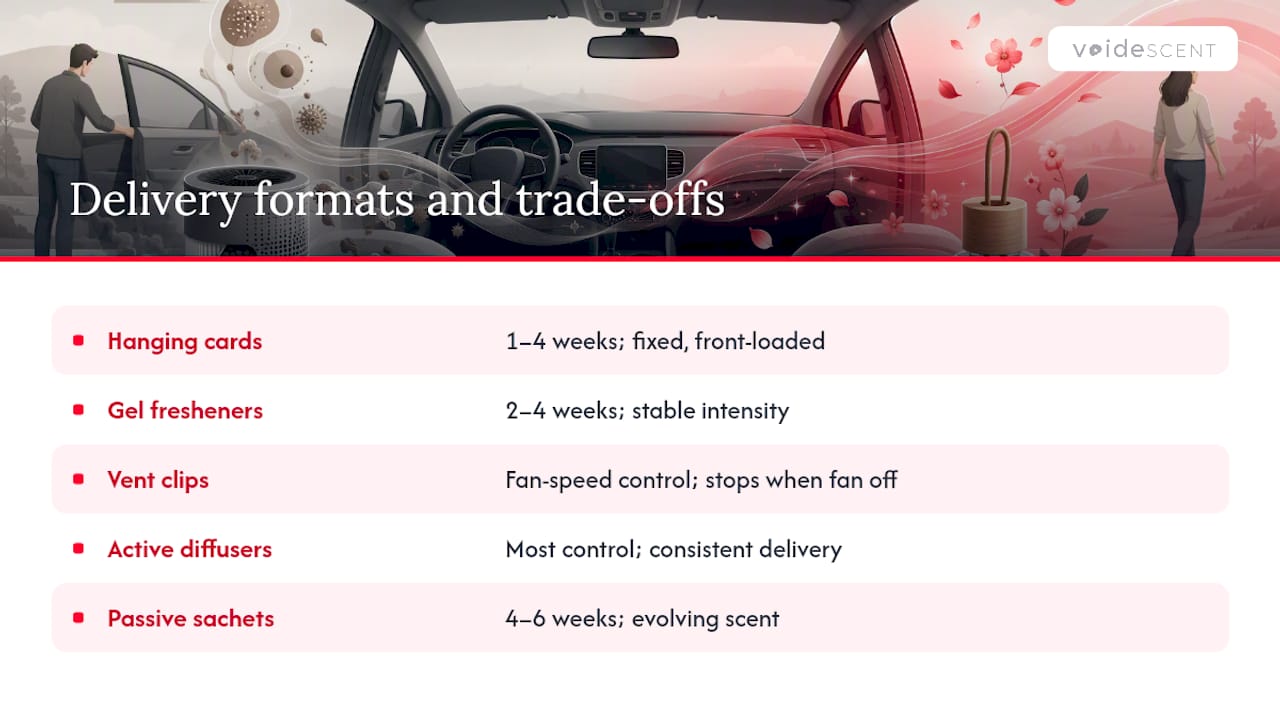
Hanging cards and paper hangers are the cheapest and most disposable option. Scent life is typically one to four weeks, intensity is fixed and front-loaded (strongest in the first few days), and there’s no way to adjust output. They’re fine for a quick refresh but not for consistent, long-term scenting.
Gel fresheners release scent as the gel evaporates. Duration is moderate, usually two to four weeks, and intensity is relatively stable. They can be placed out of sight but tend to leave a residue as they dry out.
Vent clips attach to the air vent and use airflow to disperse fragrance. Intensity is directly tied to fan speed, which gives some control but also means scent delivery stops when the fan is off. They’re practical and unobtrusive.
Active diffusers and plug-in units offer the most consistent delivery and the most control over intensity. Car and Driver’s comparison found that pricier diffusers deliver a closer approximation to a “new car” scent and more consistent output than cheap hanging trees — but also concluded that a thorough interior clean often outperforms buying a better freshener alone.
Passive sachets and botanical hangers sit between disposable cards and active diffusers. A well-made slow-release hanger using botanical fragrance oils can last four to six weeks with a scent that evolves rather than fading to nothing in week one.
Where fresheners consistently fall short: HVAC-sourced odours (the smell comes back every time the fan runs), embedded biological smells in foam or carpet backing, and any situation where the source hasn’t been removed. Mixing a freshener with an existing bad smell usually produces something worse than either alone.
When should you use a neutraliser vs a freshener?
The decision comes down to one question: is the smell coming from a source that still exists in the car?
If yes, neutralise first. If no, freshen freely.
Decision workflow
- Detect: Is the smell biological (pet, food, vomit, mildew) or chemical (smoke, fuel, cleaning products)?
- Inspect: Does it get stronger when the fan runs? (HVAC source.) Is it localised to a seat or carpet area? (Surface spill or embedded residue.)
- Clean the source: Vacuum, blot, or extract the physical material before applying any chemical treatment.
- Neutralise: Apply the appropriate treatment — enzymatic cleaner for organic smells, chemical neutraliser for smoke/mold, HVAC cleaner for vent-sourced odours.
- Freshen (optional): Once the cabin smells genuinely neutral, add a scent hanger or diffuser if you want a positive fragrance.
Scenario guide
New-car stale smell or general mustiness: A passive adsorbent (activated charcoal) combined with ventilation is usually enough. No enzymatic treatment needed.
Pet accident on upholstery or carpet: Blot immediately, then apply an enzymatic cleaner and allow full dwell time (usually 10–20 minutes). A second application is often needed for older stains. Follow with a scent hanger once dry.
Cigarette smoke: This is one of the hardest to shift because smoke particles embed in every porous surface. Vacuum thoroughly, treat with a chemical neutraliser, clean the HVAC system, and consider professional ozone treatment for severe cases. A freshener alone will not work.
Food spill: Clean physically first, then enzymatic treatment. Most food smells resolve with one or two enzyme applications if caught early.
Musty/mildew smell that intensifies with the fan: The source is almost certainly the HVAC evaporator. Targeted A/C cleaning and replacing the cabin air filter are the recommended steps before any freshener will make a lasting difference.
Pro Tip: After an enzyme treatment on upholstery, place a Voidescent scent hanger in the car only after the surface is fully dry. Moisture interferes with fragrance release and can encourage mold if trapped under a cover.
Research-backed methods that actually remove odours
Enzymatic cleaners
Enzymatic products are the most evidence-backed consumer option for organic smells. They work because they target the actual food source of odor-causing bacteria rather than the bacteria themselves. ValetPRO’s formulation uses active probiotics on porous surfaces like carpet and upholstery, and the dormant-reactivation property means a treated surface can continue breaking down new organic deposits over time. For vehicle owners dealing with recurring pet smells or food odours, this ongoing activity is a meaningful practical advantage over one-shot chemical sprays.
For RV and van owners managing similar challenges across larger living spaces, odor-free vehicle interior guidance covers many of the same principles at a larger scale.
HVAC and A/C cleaning
Foaming evaporator cleaners and one-step cabin sprays address different levels of contamination. Foaming products are better for heavy, long-standing deposits around the evaporator coil; one-step sprays work for lighter maintenance. Either way, replacing the cabin air filter after cleaning is non-negotiable — a dirty filter recontaminates the system almost immediately.
Professional options
Steam cleaning uses high-temperature vapor to sanitize upholstery and carpet without saturating the material. It’s effective for surface biological contamination and works well as part of a multi-step treatment.
Ozone generators are the professional standard for severe, embedded odours — smoke damage, flood aftermath, long-term pet habitation. Ozone oxidises VOCs at the molecular level and reaches surfaces that sprays can’t. The trade-off is that ozone is hazardous to breathe: the vehicle must be sealed during treatment and thoroughly ventilated before anyone enters. Professional detailing sources recommend ozone as part of a multi-step strategy, not a standalone fix.
Odour foggers/bombs disperse a neutralising or masking agent throughout the cabin. They’re useful for mild lingering odours after cleaning but are not a substitute for source removal.
Safety, health, and environmental considerations
Health risks
VOCs from synthetic fragrances are a real concern in an enclosed space like a car cabin. Many conventional air fresheners contain phthalates, formaldehyde-releasing compounds, and other synthetic VOCs that can irritate airways, particularly for children, people with asthma, or anyone with fragrance sensitivity. Botanical and natural fragrance formulations generally carry a lower synthetic VOC load, though some essential oils (citrus, eucalyptus) can still be sensitizing at high concentrations.
Ozone exposure is the most acute risk in the DIY neutraliser category. Ozone generators should never be used in an occupied vehicle. Even brief exposure to elevated ozone concentrations can cause respiratory irritation, and the gas can linger in fabric and foam after treatment. Professional detailing guidance consistently stresses ventilation and unoccupied-vehicle protocols for ozone use.
Concentrated sprays and oxidisers can irritate skin and eyes on contact. Always read the Safety Data Sheet (SDS) before using any professional-grade product, and wear nitrile gloves when applying.
Pro Tip: Keep all odour-treatment products, including freshener oils and enzyme concentrates, out of reach of children and pets. Many contain compounds that are harmless when diluted but toxic if ingested directly.
Environmental considerations
Enzymatic and probiotic cleaners are generally biodegradable — the active cultures break down organic matter and the carrier solutions are typically water-based. Synthetic fragrance compounds in conventional fresheners are less straightforward: many are not readily biodegradable and can persist in wastewater systems. Packaging is another factor; disposable hanging cards generate plastic waste at scale, while refillable diffusers and long-lasting hangers reduce per-use waste significantly.
Botanical fragrance oils, like those used in Voidescent’s hangers, tend to have a cleaner environmental profile than synthetic fragrance blends, though “natural” on a label doesn’t automatically mean low-impact. Look for products that list their fragrance ingredients and carry credible eco-certification.
How to choose the right product for your situation
The right choice comes down to five questions. Answer them before you buy anything.
- What is the smell source? Biological/organic (pet, food, mildew) → enzymatic cleaner. Chemical/smoke → chemical neutraliser or ozone. Mild ambient → adsorbent or freshener.
- Is the source still present? If yes, no freshener will solve it. Neutralise first.
- Where is the smell coming from? Surface upholstery or carpet → enzymatic spray. HVAC system → A/C cleaner and cabin filter replacement. Whole cabin, deeply embedded → professional ozone or steam.
- Do you have sensitivity concerns? Children, pets, or respiratory conditions in the car → choose low-VOC, fragrance-free neutralisers and botanical fresheners over synthetic sprays.
- What’s your budget and how often will you need to treat? One-off professional treatment vs. ongoing consumer products — see the cost section below.
Checklist before buying:
- Active mechanism is listed (enzyme, oxidiser, adsorbent — not just “eliminates odours”)
- Safety information and SDS are available
- Scent intensity is adjustable or appropriate for your sensitivity
- Duration and refill cost are stated clearly
- Eco claims are substantiated (ingredient list, certification)
Pro Tip: A product that lists “fragrance” as its only active ingredient is a freshener, not a neutraliser, regardless of what the label says. Look for “enzymatic,” “probiotic,” “activated charcoal,” or “chemical neutraliser” in the active-ingredient description.
For scenting options after cleaning, Voidescent’s scent collection covers the brand’s full range of botanical fragrance profiles.
Typical costs and how long each solution lasts
Costs vary widely depending on whether you’re handling the problem yourself or bringing in a professional. Here’s a realistic breakdown for the UK market.
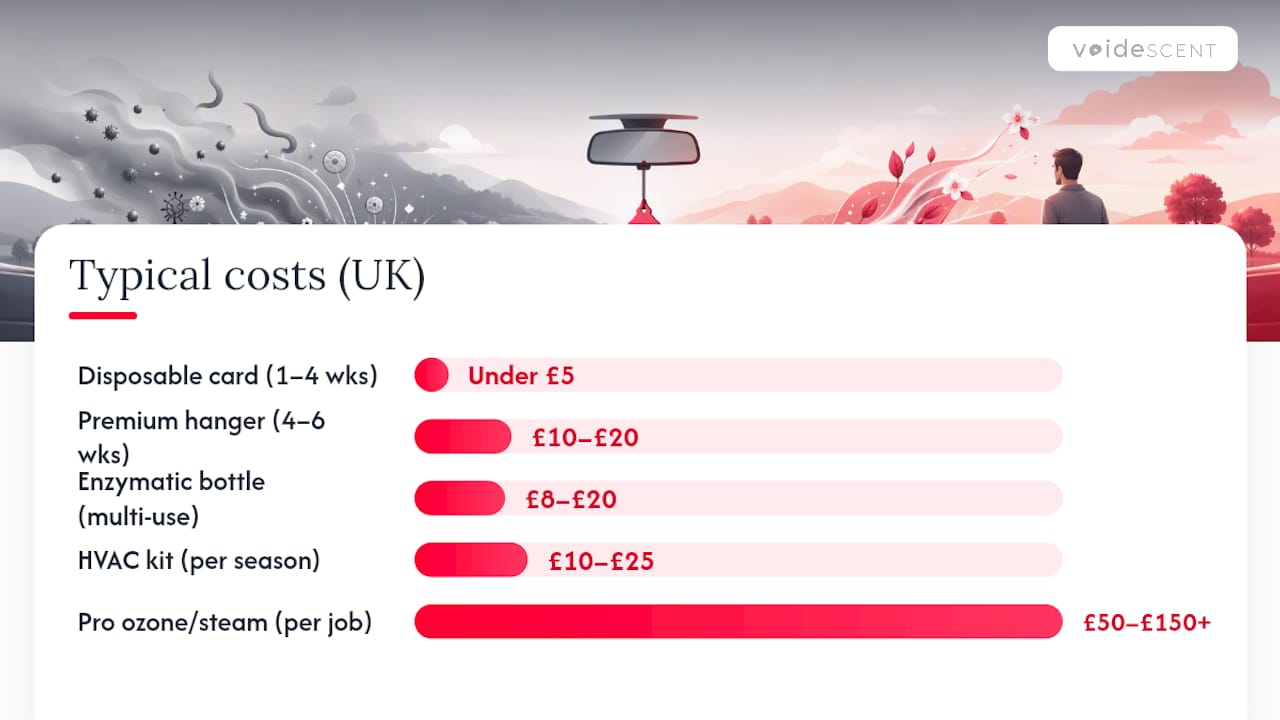
Disposable hanging cards and sachets are the cheapest entry point, typically under £5 per unit, lasting one to four weeks. Cost per week is low, but the scent is front-loaded and you’re replacing them frequently.
Premium slow-release hangers (botanical, refillable-style) cost more upfront — roughly £10–£20 — but last four to six weeks with a more consistent scent profile. Cost per week is comparable to or lower than cheap disposables when you factor in replacement frequency.
Enzymatic cleaners run roughly £8–£20 per bottle for consumer products, with one bottle typically covering multiple treatments. Professional-grade concentrates cost more but go further.
HVAC/A/C cleaning kits are generally £10–£25 for a consumer foaming kit. Cabin air filters add another £10–£20 depending on the vehicle.
Professional ozone or steam treatment is a one-off cost, typically ranging from £50 to £150+ depending on the severity of the problem and the detailer. For severe smoke or flood damage, it’s often the only option that actually works.
| Solution type | Typical cost (UK) | Typical duration |
|---|---|---|
| Disposable hanging card | Under £5 | 1–4 weeks |
| Premium botanical hanger | £10–£20 | 4 weeks |
| Enzymatic cleaner (consumer) | £8–£20 per bottle | Multiple treatments |
| HVAC cleaning kit | £10–£25 | One-off per season |
| Professional ozone/steam | £50–£150+ | One-off (per job) |
Duration is also affected by use patterns. A vent clip or active diffuser tied to fan use will deplete faster in a car driven daily with the A/C running than in one used occasionally. Continuous HVAC recirculation shortens cartridge life noticeably.
Why neutralising first is the only approach worth taking
Most car owners reach for a freshener first because it’s the easiest thing to grab. That instinct is understandable but almost always counterproductive when the smell has a biological or chemical source. A freshener applied to an untreated pet stain or smoke-saturated headliner doesn’t reduce the problem — it adds a layer of fragrance that fades within days, leaving the original smell intact and now mixed with something floral or citrus.
The evidence from professional detailers is consistent: clean the source, treat with the appropriate neutraliser, and use scenting as a finishing step rather than a first response. That sequence isn’t just more effective — it’s also more economical. A single enzyme treatment that resolves a pet smell costs less than months of fresheners that don’t.
Where premium scenting genuinely earns its place is after the cabin is clean. A slow-release botanical hanger in a genuinely odour-free car creates a consistent, evolving olfactory experience that a cheap disposable card simply can’t replicate. The scent isn’t competing with anything, so it can do what it’s actually designed to do.
Voidescent: the finishing touch after you’ve neutralised
Once the cabin is clean and neutralised, scenting becomes a pleasure rather than a cover-up. Heavens is Voidescent’s lighter option — a slow-evolving botanical fragrance that opens bright and settles into something quieter over its four-to-six-week life. It suits drivers who want a subtle, consistent presence rather than an immediate hit of scent. Descent goes the other direction: bolder, denser, and more immediately present. It’s the better fit for a larger cabin or for drivers who want the scent to be noticeable from the moment they open the door.
Both hangers use eco-friendly botanical fragrance oils and a slow-release design that avoids the front-loaded fade of conventional paper cards. Placement matters: hang from the rearview mirror or a rear headrest hook, away from the driver’s sightline, and keep out of reach of children. Voidescent backs every purchase with a money-back guarantee, so if the scent isn’t right for your cabin, there’s no risk in trying it. Browse the full range at Voidescent and find the profile that fits.
Sources
- Cheap vs. Expensive Car Air Freshener: Which One Should You Buy? | Car and Driver
- Tested Best Car Odor Eliminators - Apex Auto Pros
- Air Freshener vs A/C Cleaner: The Real Solution for Car Odors | Detailing Bliss powered by Detailer’s Domain