

275 Hidden VOCs: What Car Air Freshener Ingredients Actually Contain
Most car air fresheners are built from a fragrance mixture, a solvent or carrier, and either a gelling agent or a propellant, depending on the format. A GC/MS study of 12 car air fresheners found 275 unique volatile organic compounds across the sample, and neither natural nor synthetic versions came out clean. The safest move is to pick transparent, slow-release products, skip the heavy sprays, and crack a window when you can.
TL;DR:
- Slow-release formats like oil hangers and passive absorbents emit fewer VOCs and better control fragrance levels compared to sprays or aerosol-based products.
- Most VOC emissions consist of compounds like limonene, linalool, and benzyl acetate, with fewer than 2% disclosed on safety data sheets or labels.
- Hot, recirculated, or enclosed cabins significantly increase VOC concentrations and health risks from fragrance exposure.
- Natural and synthetic air fresheners often emit similar VOCs, and “natural” labels do not guarantee lower health risks.
- Choosing brands that disclose ingredients, comply with IFRA standards, and favor low-emission formats reduces potential health hazards.
Table of Contents
- Car Air Freshener Ingredients: The Functional Classes You’ll See on a Label
- What VOCs Show Up in Car Air Freshener Emissions?
- Can Car Air Fresheners Cause Health Problems in a Vehicle?
- Why Don’t Car Air Freshener Labels List All the Ingredients?
- Are Natural Car Air Fresheners Actually Safer Than Synthetic Ones?
- How to Choose a Lower-Risk Car Air Freshener
- How Do You Make a Safer DIY Car Air Freshener?
- Voidescent’s Approach to Lower-Emission Car Fragrance
- Try a Slow-Release Fragrance Built Around Transparency
- Sources
- FAQ
Car Air Freshener Ingredients: The Functional Classes You’ll See on a Label
Every car air freshener, whatever it looks like, is built from a handful of functional ingredient categories. Understanding what each one does turns a confusing label into something you can actually evaluate.
Fragrance mixtures sit at the center of the product. The word “fragrance” or “parfum” on a label is a legal shorthand that can represent dozens, sometimes hundreds, of individual chemical compounds, and companies rarely have to break that list out for consumers. The NCBI air fresheners fact sheet classifies these fragrance blends alongside the other functional ingredients that carry, stabilize, and deliver them.
Carriers and solvents do the work of dissolving fragrance oils and controlling how fast they evaporate. Ethanol and dipropylene glycol are common choices because they’re cheap, mix well with both natural and synthetic fragrance oils, and evaporate at a predictable rate. A higher proportion of a volatile solvent means a stronger initial burst of scent and a faster fade.
Propellants show up almost exclusively in aerosol sprays, where compressed gases like butane or propane push the fragrance mixture out of the can. Vent clips, oil hangers, and gel-based products skip propellants entirely since they rely on passive evaporation instead of pressurized release.
Gelling agents and thickeners are what turn a liquid fragrance blend into the semi-solid gel pucks and cartridge fresheners you find at gas stations. These polymers slow the rate at which fragrance molecules can escape into the air, which is part of why gel products last longer than a single spray but still eventually dry out.
Preservatives, antioxidants, and dyes round out most formulations. Preservatives keep the product from degrading or growing microbes over its shelf life, antioxidants prevent the fragrance oils from oxidizing and turning rancid, and dyes exist purely for visual branding.
Delivery format shapes almost every other ingredient decision:
- Sprays need propellants and higher solvent ratios to atomize the fragrance into a fine mist.
- Vent clips rely on airflow from the HVAC system to carry evaporated fragrance, so formulators lean on volatile carriers that evaporate quickly at cabin temperature.
- Oil hangers (cardboard, felt, or cotton wicks) use minimal solvent and depend on slow, passive evaporation.
- Gels trade volatility for polymer thickeners that stretch scent release over weeks instead of hours.
A comparison of car diffusers and traditional fresheners shows how much delivery format alone determines whether a product front loads its emissions or spreads them out gradually. That distinction matters more for your exposure than whether the fragrance is labeled “natural.”
What VOCs Show Up in Car Air Freshener Emissions?
Researchers running gas chromatography-mass spectrometry (GC/MS) on car air fresheners consistently detect a recurring cast of volatile organic compounds, regardless of brand or “natural” claims. Some come directly from fragrance oils; others form after the product is already in your car.
The most frequently identified chemicals include:
- Limonene (CAS 138-86-3), a citrus-scented terpene found in most citrus and “fresh” fragrance profiles.
- Linalool (CAS 78-70-6), a floral terpene alcohol common in lavender and many blended scents.
- Benzyl acetate (CAS 140-11-4), a fruity ester used in floral fragrance compositions.
- Acetone (CAS 67-64-1) and ethanol (CAS 64-17-5), both common carrier solvents.
- Acetaldehyde (CAS 75-07-0) and methanol (CAS 67-56-1), which can appear both as raw ingredients and as breakdown products.
- Beta-myrcene (CAS 123-35-3), another terpene common in pine and herbal scent profiles.
- Dihydromyrcenol and isoamyl acetate, both synthetic fragrance compounds widely used for their stability and low cost.
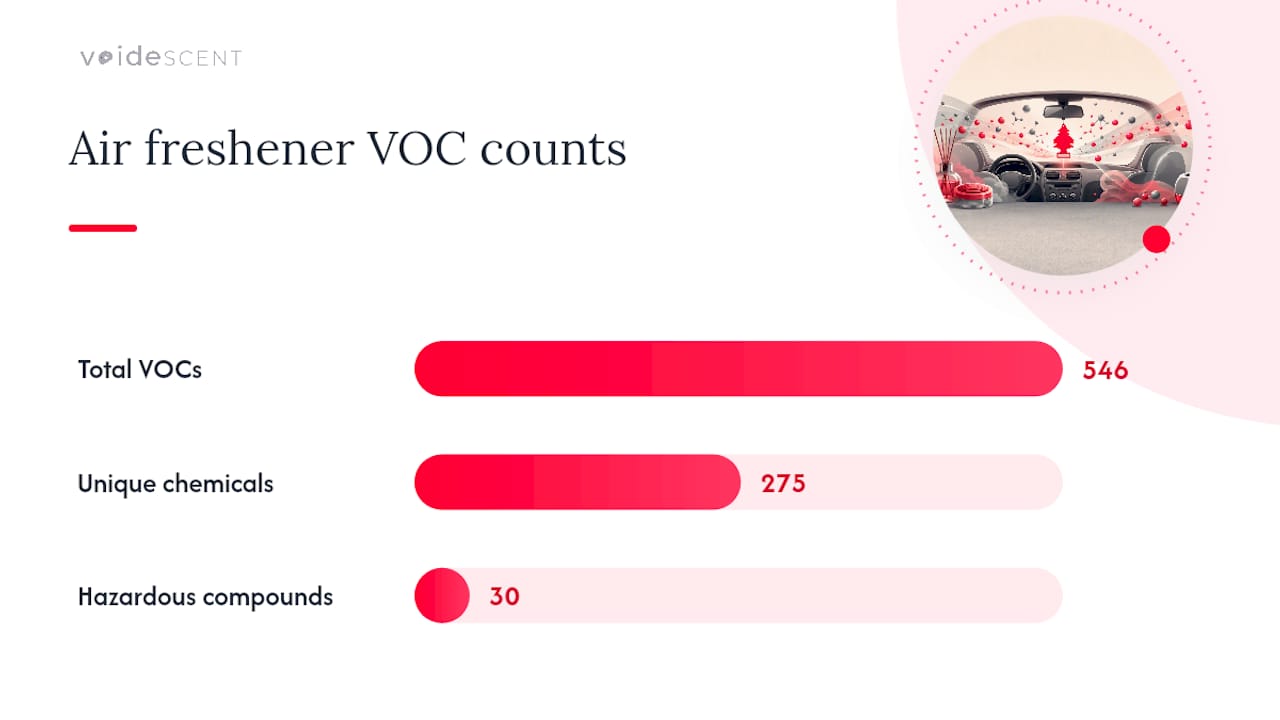
By the numbers: A GC/MS analysis of 12 car air fresheners logged 546 total VOC occurrences representing 275 unique chemical identities, and researchers classified 30 of those compounds as potentially hazardous. Fewer than 2% of the detected VOCs appeared anywhere on the product’s label or safety data sheet.
That gap between what’s emitted and what’s disclosed is the single most important fact in this entire category. It’s not that manufacturers are hiding a smoking gun ingredient. It’s that the regulatory and labeling system for air fresheners was never built to require full VOC disclosure in the first place.
Emissions also split into two distinct categories worth knowing. Primary emissions are the VOCs released directly from the product as fragrance oils evaporate. Secondary reaction products form afterward, when terpenes like limonene and beta-myrcene react with ozone already present in outdoor or cabin air, producing formaldehyde and other oxidation byproducts as a study on car air freshener emissions has outlined. A product can test relatively clean straight out of the package and still generate new pollutants once it’s sitting in a hot car for a few hours.
Can Car Air Fresheners Cause Health Problems in a Vehicle?
Inhalation is the dominant exposure route for anything hanging from your rearview mirror or clipped to a vent, and the vehicle cabin makes that exposure more concentrated than it would be in a house or office. A car interior holds a tiny volume of air compared to a room, so the same fragrance load produces a much higher concentration per cubic foot.
Vent-attached devices carry a specific risk worth understanding: the HVAC system itself becomes the delivery mechanism. Instead of scent diffusing slowly from a fixed point, the blower actively pulls evaporated VOCs off the clip and distributes them straight at your face through the dash vents. A passive hanger relies on ambient air movement, which is far gentler.
Documented health complaints tied to fragranced consumer products include:
- Eye, nose, and throat irritation
- Headaches, particularly with prolonged exposure in a closed cabin
- Asthma symptom flare-ups among sensitive individuals
- Fragrance sensitization, where repeated exposure triggers an allergic-type response over time
Population surveys and review data on fragranced consumer products and asthmatic responses found that a meaningful share of adults report health problems from fragranced products, and most people have no idea how many undisclosed compounds are packed into a single scent blend.
Three vehicle-specific conditions make things worse. Small cabin volume concentrates any released VOC more than open-air spaces would. Recirculation mode, the setting most drivers default to for faster cooling or heating, traps emissions instead of exchanging them with outside air. Warm interior temperatures, especially after a car sits in the sun, accelerate evaporation rates and push more compound into the air at once. Experimental cabin research backs this up directly: switching from recirculation to external inflow ventilation cut measured VOC concentrations by roughly half compared with recirculated air.
Pro Tip: If you use a spray-style freshener, apply it with the windows down and the fan on fresh-air intake, not recirculation, then wait a few minutes before closing up the car. That single habit change addresses the sharpest spike in concentration, which happens in the first several minutes after spraying.
Why Don’t Car Air Freshener Labels List All the Ingredients?
Consumers hoping to read a full ingredient list off the back of an air freshener box are almost always going to be disappointed, and understanding why comes down to three overlapping systems.
-
IFRA guidance exists, but it’s not full disclosure. The International Fragrance Association’s transparency list gives manufacturers safety guidance on fragrance materials and usage limits, and plenty of brands cite “IFRA compliant” on packaging. That statement means the fragrance house followed industry safety standards during formulation. It does not mean the retail package tells you which compounds are inside.
-
EU Cosmetics Regulation covers allergens, not air fresheners broadly. Regulation No. 1223/2009 requires certain known fragrance allergens to be declared on cosmetic products above specific concentration thresholds. Air fresheners generally fall outside that cosmetics framework, so the same allergen-declaration rules don’t automatically apply.
-
Safety data sheets fill in some gaps, but not all of them. A typical SDS for a fragranced product might name a handful of constituents, things like linalool, linalyl acetate, hexyl cinnamal, or eugenol, along with hazard statements for skin sensitization or eye irritation. The remaining formulation is frequently withheld as a trade secret, which is exactly why the 2% disclosure rate from the GC/MS study lines up with what SDS documents typically show.
Reading the phthalate concerns in air fresheners gives useful context here too, since phthalates are a textbook example of a fragrance-adjacent chemical class that historically slipped through gaps in exactly this kind of labeling system.
Are Natural Car Air Fresheners Actually Safer Than Synthetic Ones?
Not automatically, and this is the part of the category where marketing outruns the evidence. Comparative emissions testing has repeatedly found that products marketed as natural often emit the same commonly detected VOCs as synthetic products, sometimes at similar concentrations.
The reason comes down to chemistry rather than marketing. Limonene, linalool, and eucalyptol are all naturally occurring terpenes extracted from real plants like citrus peel, lavender, and eucalyptus, and every one of them can still cause skin or respiratory irritation in sensitive people. Limonene in particular is a known precursor for secondary formaldehyde formation when it reacts with ozone, and that reaction doesn’t care whether the limonene molecule came from a lab or a lemon rind.
That doesn’t mean “natural” and “synthetic” are interchangeable in every respect. It means the label itself isn’t a reliable safety signal. What actually separates a lower-risk product from a higher-risk one comes down to:
- How concentrated the fragrance load is relative to the carrier
- Whether the delivery format releases scent in a slow, steady trickle or a strong burst
- Whether the manufacturer discloses ingredients and hazard data at all
- Whether you personally react to specific terpenes, regardless of their origin
An overview of natural versus conventional car fresheners covers this distinction in more depth, but the short version is simple: prioritize transparency and delivery method over the word “natural” printed on the box.
How to Choose a Lower-Risk Car Air Freshener
Picking a safer product at the point of purchase comes down to a short checklist you can run through in under a minute, whether you’re standing in a store aisle or scrolling a product page.
- Favor slow-release formats over sprays. Oil hangers, felt wicks, and passive absorbents release fragrance gradually instead of dumping a concentrated burst into a closed cabin.
- Ask for a safety data sheet. A legitimate brand should be able to produce an SDS on request, and its presence alone tells you something about how seriously the company treats disclosure.
- Skip aerosol sprays in small, closed cabins. If you do use one, spray with windows down and doors open, never with the car sealed up.
- Consider unscented odor absorbers. Activated charcoal and baking soda neutralize odor molecules instead of masking them with a competing scent, which sidesteps the fragrance-VOC question entirely.
Before you buy, look for a few specific signals on the packaging or the seller’s website: a stated IFRA compliance reference, disclosure of any known allergens, and CAS numbers for flagged ingredients if the brand lists them at all. Red flags run the other direction, vague “fragrance” listings with zero SDS availability, marketing language like “non-toxic” or “chemical-free” with no supporting data behind it, and intensely strong burst scents that hit you the moment you open the car door.
Pro Tip: If a seller can’t produce an SDS or answer a direct question about what “fragrance” means on their label, treat that as your answer. Reputable brands don’t hesitate on this.
The health risks tied to air freshener use are worth a closer read if you or a passenger already deal with asthma or fragrance sensitivity, since the checklist above matters more for that group than for anyone else.
How Do You Make a Safer DIY Car Air Freshener?
Building your own low-emission car freshener is straightforward, and it gives you full control over concentration, something no commercial spray can offer.
The simplest approach is a cotton pad or felt hanger dosed with essential oil at a conservative dilution, roughly one part fragrance oil to three or four parts carrier, rather than saturating the material at full strength. A lighter dilution still produces a detectable scent while reducing the peak emission spike that happens when concentrated oil evaporates too fast in a hot, closed car.
Other simple, lower-emission options include:
- Baking soda sachets placed under a seat or in a cupholder, which absorb odor molecules rather than adding new VOCs to the air.
- Activated charcoal pouches, which work on the same absorption principle and last for weeks with no reapplication.
- A small jar with a few drops of essential oil on a wooden dowel or reed, giving you a passive diffuser you control entirely.
A few safety notes matter here. Never spray concentrated essential oil directly into an enclosed cabin. The concentration in a bottle of pure essential oil is far higher than anything formulated for air freshening, and spraying it undiluted can trigger the same irritation and secondary-reaction concerns as a synthetic product, sometimes worse. Test any new scent on a small skin patch first if you or a passenger have known sensitivities, and ventilate the car for a few minutes after introducing any new fragrance source.
Commercial products still have a place. A well-formulated product offers consistency you can’t easily replicate at home, validated longevity claims, and, when the brand is transparent, an actual SDS you can review before buying, three things a homemade hanger can’t fully guarantee.
Voidescent’s Approach to Lower-Emission Car Fragrance
Voidescent builds its car hanger fragrances around botanical fragrance oils delivered through a slow-release format designed to last several weeks rather than fading quickly, similar to formulations like the Skinny Jeans Lemon Myrtle Candle that showcase common fragrance ingredient blends. That design choice directly targets the sharpest risk this article covers: the concentration spike that happens when a product front loads its entire fragrance payload into a single burst.
A slow, steady release means lower peak emissions at any given moment compared to a spray or a strong gel puck, even when the total fragrance load over its lifespan is comparable. That’s the same principle behind the ventilation and dilution advice throughout this piece, spread the exposure out, and you reduce the risk without giving up scent entirely.
Design-conscious drivers who want to understand more about how phthalates, VOCs, and fragrance sensitization actually work should read through Voidescent’s own educational library before buying anything, including from Voidescent itself. Informed buying decisions start with understanding what’s actually in the product, not just how it smells.
— Azanone
Try a Slow-Release Fragrance Built Around Transparency
Voidescent replaces the guesswork of unlabeled synthetic sprays with botanical fragrance oils in a minimalist hanger format built to last four to six weeks per unit, not four to six hours. Three current formulations put the checklist from this article into practice: Heavens leans into a lighter, airy profile, Descent offers a deeper, warmer blend, and Nebula sits somewhere in between with a more complex evolving scent. Product pages provide some ingredient information to help customers understand what they’re buying beyond marketing claims. Voidescent backs every order with a money-back guarantee, which only makes sense if the product actually performs the way it’s described. Browse the full car hanger fragrance lineup and pick the profile that fits how you actually drive.
This article is general information, not a substitute for advice from a qualified doctor. Consult a qualified healthcare professional about your own circumstances before acting on anything here.
Sources
- Supplementary data: Volatile chemical emissions from car air fresheners (GC/MS results)
- Air Fresheners Fact Sheet: Default parameters for estimating consumer exposure – Version 2021
- Fragranced consumer products: effects on asthmatics (Air Quality, Atmosphere & Health)
- IFRA transparency list
FAQ
What are the main ingredients in car air fresheners?
Car air fresheners are typically built from a fragrance mixture, a carrier or solvent like ethanol, and either a propellant, gelling agent, or absorbent wick depending on the format. A GC/MS study of 12 products identified 275 unique VOCs across those formulations, most of which never appeared on any label.
Are there non-toxic car air fresheners?
No commercial or DIY air freshener is entirely free of volatile emissions, since fragrance itself relies on evaporating compounds to work. The safer path is choosing slow-release, low-concentration formats with transparent ingredient disclosure rather than searching for a product marketed as completely “non-toxic.”
How can I make my own car air freshener?
A cotton pad or felt hanger dosed with essential oil at a conservative dilution, mixed into a carrier rather than applied at full strength, gives you a scent source with a lower emission spike than a spray. Baking soda sachets and activated charcoal pouches work as odor absorbers without adding new fragrance VOCs at all.
Do natural essential oils emit fewer harmful chemicals than synthetic fragrances?
Not consistently. Testing shows natural and synthetic products often share the same commonly detected VOCs, including terpenes like limonene that can react with ozone to form secondary pollutants like formaldehyde regardless of their plant or lab origin.
What should I look for on an air freshener label before buying?
Look for a stated IFRA compliance reference, disclosed allergens, and a willingness from the seller to provide a safety data sheet on request. Vague “fragrance” listings with no SDS available and unsupported claims like “non-toxic” are red flags worth skipping.