

Air Freshener Health Risks: What You Need to Know
Most air fresheners do pose measurable health risks, particularly for people with asthma, allergies, or chemical sensitivities. The evidence comes from multiple directions: peer-reviewed chemical analyses using gas chromatography–mass spectrometry (GC–MS), nationally representative population surveys reporting adverse effects, and poison-control case reports documenting acute incidents from ingestion and ignition.
Who is most at risk: people with asthma or respiratory conditions, children under five, pregnant people, the elderly, and anyone with diagnosed chemical sensitivities or multiple chemical sensitivity (MCS).
Steps you can take right now:
- Open windows or run exhaust fans whenever you use any scented product indoors.
- Remove plug-in or automatic spray devices from rooms where children, pregnant people, or people with asthma spend significant time.
- Switch off any continuous-emission device in your car before passengers with respiratory conditions get in.
- Check whether a product lists individual fragrance ingredients. If it only says “fragrance,” you have no way to know what you are actually inhaling.
Table of Contents
- What counts as an air freshener, and which formats are you exposed to?
- What does the human evidence actually show?
- How exposure happens, and why secondary pollutants matter
- Which product formats carry the biggest risks?
- What U.S. law does and doesn’t require on labels
- When to call poison control or seek emergency care
- What the science still doesn’t know
- Key Takeaways
- The part most health articles miss
- Voidescent: a different approach to car scent
- Useful sources for further reading
What counts as an air freshener, and which formats are you exposed to?
“Air freshener” covers a wider range of products than most people realize. Regulatory agencies and researchers use the term to include aerosol sprays, plug-in electric devices, passive gel or solid blocks, reed diffusers, scented candles, incense, and essential-oil diffusers. Car-specific formats add hanging cardboard or fabric scent hangers, vent clips, and under-seat gel cans.
Each format delivers chemicals to your body through a different route and at a different rate.
| Format | Primary exposure route | Emission pattern |
|---|---|---|
| Aerosol spray | Inhalation (acute spike) | Short, high-concentration burst |
| Plug-in / heated device | Inhalation (continuous) | Low-level, 24/7 emission |
| Gel block / solid | Inhalation (passive) | Slow, continuous off-gassing |
| Reed diffuser | Inhalation + skin contact | Continuous, moderate concentration |
| Scented candle / incense | Inhalation (combustion particles) | Elevated during burn; soot and VOCs |
| Essential-oil diffuser | Inhalation (ultrasonic mist) | Intermittent or continuous |
| Car scent hanger | Inhalation in enclosed space | Slow-release, concentrated in small volume |
Common exposure settings include homes (living rooms, bathrooms), car interiors, office restrooms, hotel lobbies, and retail stores. The enclosed volume of a car interior is the most concerning: the same emission rate that would be diluted across a 1,500-square-foot home is concentrated into roughly 100 cubic feet of cabin air.
What does the human evidence actually show?
The evidence ranges from strong to limited depending on the health outcome. Here is where the science stands.
Strong evidence: irritation and asthma triggers in sensitive people. A nationally representative U.S. survey found that 34.7% of adults reported one or more adverse health effects from fragranced products, and 20.4% reported problems specifically from air fresheners and deodorizers. Reported effects included respiratory difficulties, migraine headaches, skin reactions, and asthma attacks. The same research found that a substantial share of people avoid public places where fragranced products are used, and some report lost workdays as a result.
Strong evidence: acute poisoning from ingestion and ignition. Poison-control data document hospitalizations after children ingested gel beads and reed diffuser liquids, and burn incidents from ignited aerosol sprays. These are not theoretical risks.
Moderate evidence: VOC emissions at measurable concentrations. A NASA-affiliated study of plug-in air fresheners and car Little Trees confirmed terpene emissions and their potential to form secondary pollutants under real-world indoor conditions. Chemical analyses of spray products found compounds including lilial, galaxolide, and benzyl alcohol that were not disclosed on labels.
Moderate evidence: mixture and secondary-pollutant effects. Risk assessment studies show that for some individual ingredients modeled at worst-case concentrations, calculated exposures fall below chronic reference values. But those assessments typically evaluate one chemical at a time, not the mixture of 50 or 100 compounds a product actually emits. Real-world exposures are more complex.
Limited evidence: long-term cancer risk at typical home-use levels. Lab studies expose airway epithelial cells to air freshener chemicals and document inflammation and barrier disruption. The American Lung Association notes these findings are preliminary and not yet definitive for population-level long-term outcomes. Chronic exposure data in humans are sparse.
The pattern across the evidence is consistent: people with pre-existing respiratory conditions are at the highest risk of acute effects, and the general population faces lower but non-zero risk from continuous or high-frequency exposure.
How exposure happens, and why secondary pollutants matter
The pathway from product to health effect runs like this: a device emits VOCs and terpenes into indoor air. Those compounds mix with whatever ozone is present, either from outdoor air infiltration or indoor sources like laser printers and some air purifiers. The terpene-ozone reaction generates formaldehyde and ultrafine particles, which you then inhale. Dermal absorption adds a secondary route, especially with reed diffusers and scented lotions used alongside air fresheners.
Factors that increase your total exposure:
- Poor ventilation (closed windows, no exhaust fans)
- Continuous-emission devices running around the clock
- Small enclosed spaces, particularly car interiors
- Multiple products used simultaneously (the “cocktail effect”)
- High ambient ozone levels, which are more common in urban areas during summer
Ultrafine particles are worth understanding specifically. They are small enough to penetrate deep into the lungs and cross into the bloodstream. Formaldehyde at elevated concentrations irritates the eyes, nose, and throat and is a known carcinogen at occupational exposure levels. Neither compound appears on any air freshener label.
Which product formats carry the biggest risks?
Not all formats are equally hazardous. Here is a ranked breakdown, starting with the highest-risk formats for most people.
1. Plug-in and heated electric devices. These run continuously, which means continuous VOC emission. In a bedroom or small office, that adds up to significant cumulative exposure over weeks and months. They are the format most likely to sustain chronic low-level exposure.
2. Aerosol sprays. Each spray creates a short, high-concentration inhalation spike. The propellants are also flammable, and burn incidents from spraying near open flames or pilot lights are documented in poison-control records. Avoid using aerosol air fresheners near any ignition source.
3. Reed diffusers and concentrated liquid products. The liquid in reed diffusers is often a concentrated fragrance oil solution. For children, ingestion of even a small amount can cause serious poisoning. Poison Control specifically flags reed diffuser liquids as a hazard requiring child-proof storage.
4. Gel beads and solid gels. Gel beads are visually appealing to young children and, when swallowed, can cause severe gastrointestinal effects and require hospitalization. Keep these completely out of reach.
5. Scented candles and incense. Combustion produces soot, carbon monoxide, and VOCs beyond what the fragrance itself emits. Paraffin candles tend to produce more particulate matter than beeswax or soy alternatives. Incense smoke in poorly ventilated spaces can reach particulate concentrations comparable to light cigarette smoke.
6. Essential-oil diffusers. Often perceived as the “safe natural option,” but natural does not mean inert. Essential oils are concentrated terpene mixtures. Diffusing eucalyptus or tea tree oil in a room with cats or small dogs can cause neurological symptoms in pets. In children, high concentrations of camphor-containing oils have caused seizures.
7. Car scent hangers and vent clips. The enclosed car cabin concentrates emissions more than any home environment. A hanging cardboard freshener or vent clip running with windows closed on a hot day can push VOC concentrations well above what you would encounter in a ventilated room. If you use any car scent product, crack the windows.

What U.S. law does and doesn’t require on labels
Federal law does not require manufacturers to disclose individual fragrance ingredients on consumer product labels. The word “fragrance” or “parfum” legally covers any mixture of scent chemicals, regardless of how many compounds it contains or what their individual safety profiles look like. This applies to air fresheners, cleaning products, personal care products, and laundry detergents alike.
The EPA’s indoor air quality guidance addresses VOCs broadly and recommends ventilation and source control, but does not mandate ingredient disclosure for consumer fragrance products. The Consumer Product Safety Commission (CPSC) has authority over product safety but has not issued specific fragrance-ingredient disclosure rules.
What does exist at the state level:
- California’s Cleaning Product Right to Know Act requires disclosure of certain ingredients in cleaning products, and the state maintains a fragrance ingredient database that some manufacturers voluntarily use.
- Some states have introduced broader fragrance-disclosure legislation, but as of 2026, no federal standard requires full ingredient transparency.
Practical implications for you as a consumer:
- “Natural,” “green,” “eco-friendly,” and “plant-based” are marketing terms, not chemical-safety certifications. Products carrying these labels have been found to emit hazardous compounds in GC–MS testing.
- Price is not a proxy for safety. Chemical analyses found undisclosed hazardous compounds in both budget and premium products.
- The absence of a warning label does not mean a product is safe for sensitive individuals or for continuous use in small spaces.
When to call poison control or seek emergency care
Call 911 or go to an emergency room immediately if someone:
- Has difficulty breathing, is wheezing severely, or loses consciousness after exposure.
- Has swallowed any reed diffuser liquid, gel bead product, or concentrated fragrance oil.
- Has burns from an ignited aerosol spray.
- Is having a seizure.
Call Poison Control at 1-800-222-1222 for any ingestion or exposure that is not immediately life-threatening. This line operates 24 hours a day, 7 days a week, and is staffed by toxicologists and pharmacists who can advise on whether home monitoring is sufficient or medical evaluation is needed. Have the product name and ingredient list ready when you call.
For non-emergency exposures (headache, eye irritation, mild coughing after using a spray):
- Remove the person from the exposure area and get fresh air.
- Turn off or remove the product.
- Ventilate the space thoroughly.
- Document the product name, lot number, and approximate exposure duration.
- Contact your primary care provider or call Poison Control if symptoms persist beyond 30 minutes or worsen.
What the science still doesn’t know
Honest synthesis of the current evidence reveals several important gaps.
- Mixture effects are poorly characterized. Risk assessments typically evaluate one compound at a time. The “cocktail effect” of 50 or 100 compounds interacting with each other and with indoor ozone is not well modeled.
- Airway cell research is preliminary. The American Lung Association notes that ongoing lab studies exposing airway epithelial cells to air freshener chemicals are generating early signals about inflammation and barrier disruption, but these findings have not yet translated into definitive population-level risk estimates.
The precautionary principle applies here: where evidence of harm exists for sensitive groups and the mechanism is plausible, reducing unnecessary exposure is reasonable even before the full dose–response picture is clear. That is especially true for children, pregnant people, and anyone with a respiratory condition.
Key Takeaways
Air fresheners emit dozens of undisclosed VOCs, and population surveys show that roughly one in three Americans reports adverse health effects from fragranced products, with the highest risks falling on people with asthma, children, and pregnant individuals.
| Point | Details |
|---|---|
| Survey-reported harm is substantial | 34.7% of U.S. adults reported adverse effects from fragranced products; 20.4% specifically from air fresheners. |
| Labels hide the chemistry | “Fragrance” on a label can legally represent hundreds of undisclosed compounds; GC–MS studies detect dozens of VOCs not listed anywhere. |
| Plug-ins carry the highest chronic risk due to continuous low-level VOC exposure; removing them can significantly reduce exposure. | |
| Children face acute poisoning risk | Reed diffuser liquids and gel beads can cause severe poisoning if ingested; call 1-800-222-1222 immediately. |
| Voidescent offers a disclosed-ingredient alternative | Voidescent’s botanical scent hangers use slow-release formulas designed for the enclosed car cabin, with ingredient transparency not typical of mass-market synthetic fresheners. |
The part most health articles miss
There is a tendency in coverage of air freshener safety to frame this as a binary: either air fresheners are dangerous and you should throw them all out, or the risk assessments show exposures below reference values and you should relax. Neither framing is honest.
The more useful frame is this: the risk is real, it is unevenly distributed, and the regulatory system is not designed to protect you from it. Fragrance ingredient disclosure is not federally required. “Natural” is a marketing claim, not a safety standard. And the risk assessments that find exposures “below reference values” are typically single-compound assessments that do not model the mixture you actually inhale.
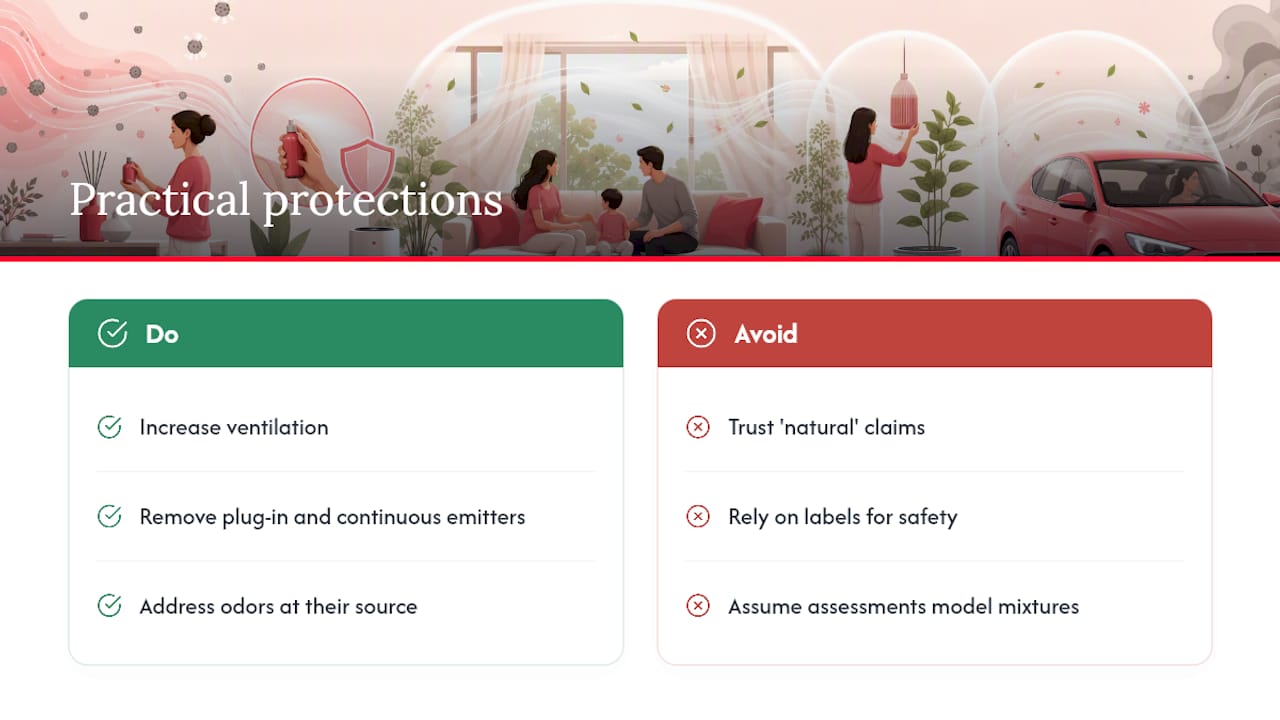
What that means practically is that the burden of protection falls on individual behavior, not on the label. Ventilation works. Removing continuous-emission devices works. Addressing odors at the source instead of masking them works. These are not glamorous interventions, but they are the ones with real evidence behind them.
The other thing worth saying directly: the people most harmed by fragranced products are often the people least able to advocate for themselves in shared spaces. A child cannot ask a parent to remove the plug-in. An employee with asthma may not feel safe asking a manager to change the office air freshener policy. Public health organizations including the American Lung Association support fragrance-free policies in shared spaces precisely because the burden of exposure is not shared equally.
Voidescent: a different approach to car scent
If this article has you reconsidering the synthetic plug-in or aerosol spray in your car, Voidescent was built for exactly that moment. The problem with most car air fresheners is not just the chemicals. It is that they are designed to be cheap, fast, and opaque about what is in them.

Voidescent’s automotive scent hangers use botanical fragrance oils in a slow-release format that lasts four to six weeks, without the continuous high-concentration emission spike of a vent clip or the undisclosed chemical cocktail of a mass-market cardboard hanger. The minimalist design means no plastic housing to off-gas, and the brand’s ingredient approach prioritizes transparency over the “fragrance” catchall that hides chemistry from consumers.
For design-conscious drivers who want their car to smell good without trading one set of concerns for another, Voidescent’s scent collection is the place to start. Every purchase comes with a money-back guarantee. Browse the full range at voidescent.com and find the scent that fits your drive.
Useful sources for further reading
- Fragranced consumer products: exposures and effects from emissions
- Indoor air quality: scented consumer products emit a bouquet of VOCs
- Volatile Organic Compounds Emitted from Air Fresheners: Plug-Ins at Home and Little Trees in Cars
- Risk assessment to human health: Consumer exposure to ingredients in air fresheners
- Volatile Organic Compounds’ Impact on Indoor Air Quality | EPA
This article is general health information, not medical advice. For acute exposures, call Poison Control at 1-800-222-1222 or seek emergency care. Consult a qualified healthcare provider for guidance specific to your health situation.