

How to Layer Scents in Your Car for Lasting Aroma
Yes, you can layer scents in your car, and the method is straightforward: pair a slow-release scent hanger with measured drops of botanical fragrance oils, building from base note to top note, and your cabin stays balanced and evolving for 4–6 weeks. Three things have to align: the right delivery system (a refillable, porous hanger), a planned note structure (base, middle, top), and measured dosing that respects the small, enclosed space.
- Delivery system: A slow-release hanger, like those from Voidescent, wicks fragrance gradually so intensity stays consistent rather than spiking and fading.
- Note structure: Base notes anchor the blend for weeks; middle notes carry the character; top notes give the first impression.
- Measured dosing: Start with fewer drops than you think you need. A car cabin amplifies everything.
Key Takeaways
Scent layering in a car works reliably when you build base-first, dose conservatively for the enclosed cabin, and maintain a 4–6 week refresh schedule tied to a slow-release hanger.
| Point | Details |
|---|---|
| Build base-first | Add base note drops before middle and top to anchor the blend for weeks, not days. |
| Dose for small spaces | Start at 15–25 drops per 7.5ml carrier; compact cars need fewer drops than SUVs. |
| Refresh on schedule | Light top-note refresh at days 3–5; full refill at weeks 4–6 to maintain balance. |
| Match notes to season | Citrus and green blends suit summer; woody, resinous bases perform better in cooler months. |
| Voidescent starter kit | Pair Heavens and Descent for a ready-made layered profile with 4–6 week slow-release longevity. |
Table of Contents
- What do you need to layer scents in a car?
- How do fragrance notes behave inside a car cabin?
- How to layer a scent hanger with botanical oils, step by step
- Six starter recipes to try
- How long does a layered car scent last, and when should you refresh it?
- Safety and sustainability: what eco-conscious owners need to know
- What to do when the scent goes wrong
- Why design and sustainability belong at the center of in-car scent
- Start with Heavens and Descent from Voidescent
- Sources
What do you need to layer scents in a car?
The right materials make the difference between a blend that lasts and one that overwhelms by Tuesday.
Scent hangers are the foundation. Look for refillable glass or wood-capped bottles with a wick or porous diffuser element. Reusable parts and recyclable packaging matter if eco-consciousness is part of your buying criteria. Avoid single-use cardboard fresheners entirely; they release fragrance in one uncontrolled burst.
Botanical fragrance oils and essential oils are your layering palette. Pure essential oils are complex natural extracts containing dozens of aromatic compounds that evaporate at different rates, which is exactly what makes layering interesting over time. Cosmetic-grade, phthalate-free fragrance oils are a reliable alternative when you want a specific scent profile (think “cedarwood and black pepper”) without sourcing individual botanicals. Both work; just confirm ingredient transparency before buying.
Carrier oils matter more than most guides admit. Fractionated coconut oil stays liquid at all temperatures, wicks reliably from wooden caps, and moderates release so your blend doesn’t dump all at once in a hot car.
Small tools: a glass dropper bottle (10ml), a pipette or dropper cap, a small funnel, and labeled storage for each oil. Store all bottles in a cool, dark place, away from the dashboard and direct sunlight, to preserve their aromatic integrity.
Quick eco-buying checklist:
- Refillable hanger with replaceable wick or pad
- Phthalate-free, cosmetic-grade fragrance or essential oils
- Fractionated coconut oil as carrier
- Recyclable or minimal packaging
- Ingredient list publicly available
How do fragrance notes behave inside a car cabin?
Car cabins are small, often hot, and sealed. That changes how fragrance behaves compared to a room diffuser or a candle.
Top notes (citrus, light herbs, green) hit first and fade within 30–60 minutes. They create the initial impression when you open the door. Middle notes (lavender, rose, cedarwood, clove) carry the blend’s character for hours. Base notes (sandalwood, amber, vetiver, musk) are the slowest to evaporate and do most of the work in a premium automotive fragrance designed to last weeks rather than days.
For a 4–6 week slow-release hanger, base notes are the structural backbone. Without a solid base, the blend smells sharp for a day, then disappears.
Concentration matters. A car is roughly 100 cubic feet of enclosed air. What smells subtle in a living room can cause headaches after a 20-minute commute. Start low and adjust upward in small increments rather than front-loading intensity.
Compatibility rules to follow:
- Citrus pairs well with woods and soft musks
- Florals work with light musks and green herbs
- Resinous bases (amber, benzoin) anchor almost any middle note
- Avoid stacking heavy spice (clove, cinnamon) directly on sharp citrus; the combination turns acrid in heat
A balanced starting ratio is roughly 50% middle, 30% base, and 20% top. That proportion gives you character, longevity, and a fresh opening note without any single layer dominating.
Pro Tip: Hot cabins accelerate evaporation. In summer, reduce your initial oil dose moderately and lean on base-heavy blends. In cooler months, woody and resinous bases perform especially well because lower temperatures slow their release to an ideal pace.
How to layer a scent hanger with botanical oils, step by step
Build base-first. That single rule prevents most layering mistakes.
- Prepare your hanger. If refilling, clean the bottle and wick with a small amount of unscented fractionated coconut oil, then let it dry. For a new hanger, skip this step.
- Add your base note first. For a 10ml bottle, add 4–5 drops of your base oil (sandalwood, vetiver, amber) directly to the carrier. Let it sit for 2 minutes.
- Layer the middle note. Add 6–8 drops of your middle note (lavender, cedarwood, clove). Swirl gently; don’t shake.
- Finish with the top note. Add 2–3 drops of your top note (bergamot, lemon, eucalyptus). This is the smallest portion by design.
- Fill with carrier. Top up to 7.5ml with fractionated coconut oil. This ratio of roughly 15–25 drops per 7.5ml carrier gives a consistent throw without overwhelming the cabin.
- Place the hanger. Central vents push scent through the cabin most evenly. Hanging from the rearview mirror concentrates fragrance near the driver. Rear placement suits passengers but reduces driver perception. Choose based on who you’re scenting for.
- Test with ventilation. On first use, crack a window for 10–15 minutes. This lets the blend settle and prevents the initial intensity spike from becoming unpleasant.
Dosage by car size:
- Compact/sedan: 15 drops total per 7.5ml
- SUV/crossover: 20 drops total per 7.5ml
- Large truck or van: 25 drops total per 7.5ml
Pro Tip: Run a “curation period” for the first 24–48 hours. Drive with the hanger in place but a window slightly open. After two days, the blend settles into its true character, and you’ll know whether to add a drop of top note or let the base take over.
Six starter recipes to try
Each recipe below is calibrated for a 10ml dropper bottle with fractionated coconut oil as carrier. Adjust drops proportionally for your car size using the guidelines above.
| Recipe Name | Top Note | Middle Note | Base Note | Drops (T/M/B) | Character |
|---|---|---|---|---|---|
| Minimal Citrus Lift | Bergamot | Lavender | Cedarwood | 2 / 5 / 3 | Fresh, clean, calm |
| Calmwood Evening | Eucalyptus | Clary sage | Sandalwood | 2 / 6 / 4 | Grounding, spa-like |
| Dark Resin Drive | Black pepper | Vetiver | Amber | 2 / 5 / 5 | Warm, smoky, bold |
| Green Forest | Lemon | Cedarwood | Vetiver | 3 / 5 / 4 | Crisp, woody, earthy |
| Soft Floral Cabin | Neroli | Rose absolute | White musk | 2 / 6 / 4 | Delicate, airy, feminine |
| Spiced Citrus Warm | Sweet orange | Clove | Benzoin | 3 / 5 / 4 | Festive, rich, autumn |
Minimal Citrus Lift and Green Forest suit summer driving and compact cars. Dark Resin Drive and Spiced Citrus Warm work best in cooler months when woody, resinous bases extend longevity and add perceived warmth. For a single-hanger setup, Calmwood Evening or Dark Resin Drive hold up best as standalone blends. Browse Voidescent’s fragrance collection for pre-formulated botanical blends that map directly onto these profiles.
How long does a layered car scent last, and when should you refresh it?
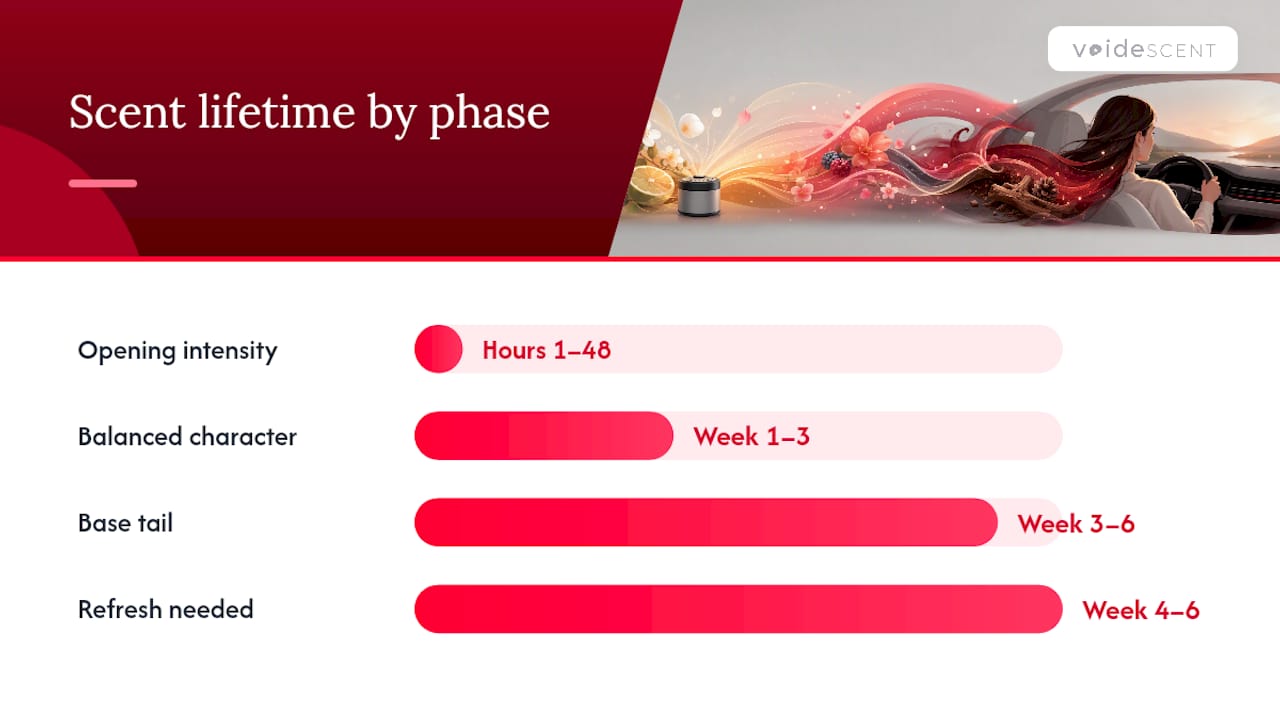
A well-built slow-release hanger moves through three phases. The first phase delivers the most intensity especially from top notes. Subsequently, middle notes dominate for a while, then base notes carry the scent quietly until the carrier runs dry. This typically happens after several weeks.
Refresh cadence:
- Days 3–5: Add 1–2 drops of your top note directly to the wick or pad if the opening impression has faded.
- Weeks 2–3: Check carrier level. If the bottle is below half, top up with 3–4ml of fractionated coconut oil and 5–8 drops of your blend.
- Weeks 4–6: Full refill or pad replacement. Clean the bottle, replace the wick or felt pad, and rebuild the blend from scratch.
Store all oil bottles away from the dashboard. Direct sunlight degrades aromatic compounds and shortens the effective life of your blend. A glove box or center console works well.
Lifecycle at a glance:
| Phase | Timeframe | What you notice |
|---|---|---|
| Opening intensity | Hours 1–48 | Top and middle notes prominent |
| Balanced character | Week 1–3 | Middle and base in harmony |
| Base tail | Week 3–6 | Subtle, grounding base note only |
| Refresh needed | Week 4–6 | Scent barely perceptible |
Safety and sustainability: what eco-conscious owners need to know
Small enclosed spaces concentrate fragrance faster than any other environment. A few precautions protect both passengers and your car’s interior.
Safety checklist:
- Never place glass diffuser bottles on a hot dashboard; thermal expansion can crack the bottle or accelerate release to an unsafe level.
- Test any new blend on a small, hidden fabric patch before hanging near upholstery. Some fragrance oils can stain leather or vinyl, especially those with high resin content.
- Keep oil bottles away from steering controls and pedal areas; a spill creates a slip hazard.
- If a passenger reports a headache or irritation, ventilate immediately and reduce the blend’s concentration before the next drive.
- Prefer passive diffusers like wooden vent clips or clay pendants for subtle, lasting diffusion when passengers are sensitive to strong scents.
Eco considerations: Phthalate-free, cosmetic-grade essential oils and fragrance oils reduce VOC exposure inside the cabin. Refillable hangers cut single-use waste significantly over a year of driving. Recyclable packaging and ingredient transparency are the two clearest signals that a brand takes sustainability seriously.
Pro Tip: Felt and wood pads can be cleaned and reused. Rinse felt pads in warm water, let them air dry completely, and they’ll absorb a fresh blend without carrying over the previous scent. Wood caps can be wiped with a dry cloth between refills.
What to do when the scent goes wrong
Too strong: Remove the hanger from the car immediately. Ventilate for 15–20 minutes. When you reintroduce it, dilute the carrier by adding 2–3ml of plain fractionated coconut oil to the bottle.
Too weak: Check placement first. A hanger tucked behind the seat or away from airflow barely diffuses. Move it to a central vent or closer to the cabin’s air circulation. If placement isn’t the issue, add 1–2 drops of your middle note directly to the pad.
Notes clashing: Remove the hanger and ventilate. Identify the most volatile element (usually the top note) and eliminate it from the next blend. Reset the cabin with an odor-neutralizing product, then rebuild the blend base-first, introducing the top note last and in smaller quantity.
Fading too fast: Heat is usually the cause. Move the hanger away from direct vent airflow in summer, or swap to a slower carrier. Fractionated coconut oil moderates release better than thinner carriers like jojoba.
Quick action checklist for between stops:
- Ventilate 10 minutes if too strong
- Move hanger to higher-airflow position if too weak
- Add 1 drop of base note if the blend smells sharp or unbalanced
- Check for heat exposure if the scent disappeared faster than expected
Why design and sustainability belong at the center of in-car scent
Most people treat car fragrance as an afterthought. They grab a synthetic tree off a gas station rack, hang it, and forget it until the chemical blast fades into nothing after a week. The problem isn’t that they don’t care about how their car smells. It’s that the products they’ve had access to weren’t designed to be cared about.
Scent layering in a car is a different proposition entirely. It asks you to think about your cabin the way a perfumer thinks about a composition: what’s the first impression, what carries the character, what holds the whole thing together over time? That framing changes what you buy, how you use it, and what you expect from it.
The sustainability angle isn’t separate from the design angle. A refillable hanger with a transparent ingredient list is a better-designed object than a disposable one. It lasts longer, wastes less, and gives you control over what you’re breathing for 30 minutes a day. For anyone who has spent real money on a car interior, that control matters.
The one thing most guides miss: the base note is the whole game. Top notes get the attention because they’re what you smell first, but a blend without a strong base collapses within days. Build the base, and everything else follows.
Start with Heavens and Descent from Voidescent

The clearest starting point for scent layering in a car is a paired kit: one slow-release hanger loaded with a grounding base-forward blend, and a second botanical oil to layer on top as your middle or top note. Voidescent’s Heavens and Descent are built exactly for this. Both are formulated as slow-release botanical blends designed to last 4–6 weeks, with refillable components and recyclable packaging that match the eco-first approach this guide describes. Heavens skews lighter and airy; Descent runs darker and resinous, making them natural complements in a layered setup.
Every Voidescent purchase comes with a money-back satisfaction guarantee. If the blend doesn’t work for your cabin, you’re not stuck with it. Visit the Voidescent scent collection to see the full ingredient notes and pick the pairing that fits your recipes above.
Sources
- Luxury Car Air Freshener: How to Create Premium Car Fragrance Brand
- Car Freshener vs Essential Oil Car Perfume: Which Is Better?
- Crafting Unique Boutique Car Scents: A Step-By-Step Diy Guide | ShunScent
- How to Refill Your Hanging Car Diffuser Bottle