

Natural Car Air Fresheners for Eco-Conscious Drivers
The best natural car air freshener is a refillable, plant-based slow-release scent hanger. If you want something free and fast, a baking-soda jar with a few drops of essential oil works just as well for odor control. Both skip the synthetic fragrance chemicals found in most commercial fresheners.
Quick match by driver type:
- Low-maintenance, long-lasting scent: A premium slow-release hanger like Voidescent, which runs several weeks on a single load
- Budget DIY odor absorber: Baking soda jar with optional essential oil, refreshed monthly
- Strongest odor neutralizer: Activated charcoal pouch, no scent added
Pro Tip: Always remove the odor source first. Food wrappers, damp floor mats, and old coffee cups will overpower any freshener within days.
Key Takeaways
Plant-based, slow-release formats last the longest and carry the fewest chemical risks, making them the most practical choice for eco-conscious drivers who want consistent, clean scent.
| Point | Details |
|---|---|
| Best ready-to-buy option | Slow-release plant-based hangers like Voidescent last several weeks and use transparent botanical ingredients. |
| Best DIY for odor control | A baking-soda jar with some drops of essential oil neutralizes smells and refreshes monthly. |
| Core safety rule | Dilute all essential oils; avoid tea tree and eucalyptus in cars with pets; mix only in glass or ceramic. |
| Placement for full coverage | Clip porous diffusers to air vents so active airflow distributes scent evenly through the cabin. |
| Voidescent | Refillable scent hangers with named botanical ingredients and a money-back guarantee, available at voidescent.com. |
Table of Contents
- What does “natural” actually mean on a car freshener label?
- How do ready-to-buy natural car fresheners compare?
- Three DIY natural car fresheners you can make today
- Are natural car fresheners safe for kids, pets, and sensitive passengers?
- How to choose the right freshener and keep it working
- What most natural-freshener guides get wrong
- Voidescent: a plant-derived option built for the long haul
- Sources
What does “natural” actually mean on a car freshener label?
A natural or non-toxic car air freshener uses scent ingredients derived from plants, minerals, or other non-synthetic sources rather than petroleum-based aromatic chemicals. The term is not federally regulated in the U.S., so it pays to read the label closely.
A short glossary of terms you’ll see:
- Plant-based: Ingredients sourced from botanical material (flowers, bark, resins) rather than synthesized in a lab
- Essential oil: A concentrated aromatic extract from a plant, typically steam-distilled or cold-pressed
- Fragrance (or “parfum”): A proprietary blend that can contain dozens of undisclosed synthetic chemicals, including phthalates
- Phthalates: Plasticizers used to make synthetic scents last longer; classified as endocrine disruptors by the EPA
- Endocrine disruptors: Chemicals that interfere with hormone signaling, linked to reproductive and developmental concerns
- Slow-release delivery: A format (wood, felt, gel) that meters out scent gradually rather than releasing it all at once
Trust signals worth checking on any label:
- Full ingredient list (not just “fragrance”)
- Explicit plant-derivation claim with named botanicals
- Cruelty-free or third-party certification
- Money-back guarantee (signals the brand stands behind its formula)
How do ready-to-buy natural car fresheners compare?
Natural car fresheners come in several formats, and each one makes a different trade-off between scent strength, convenience, and how long it lasts.
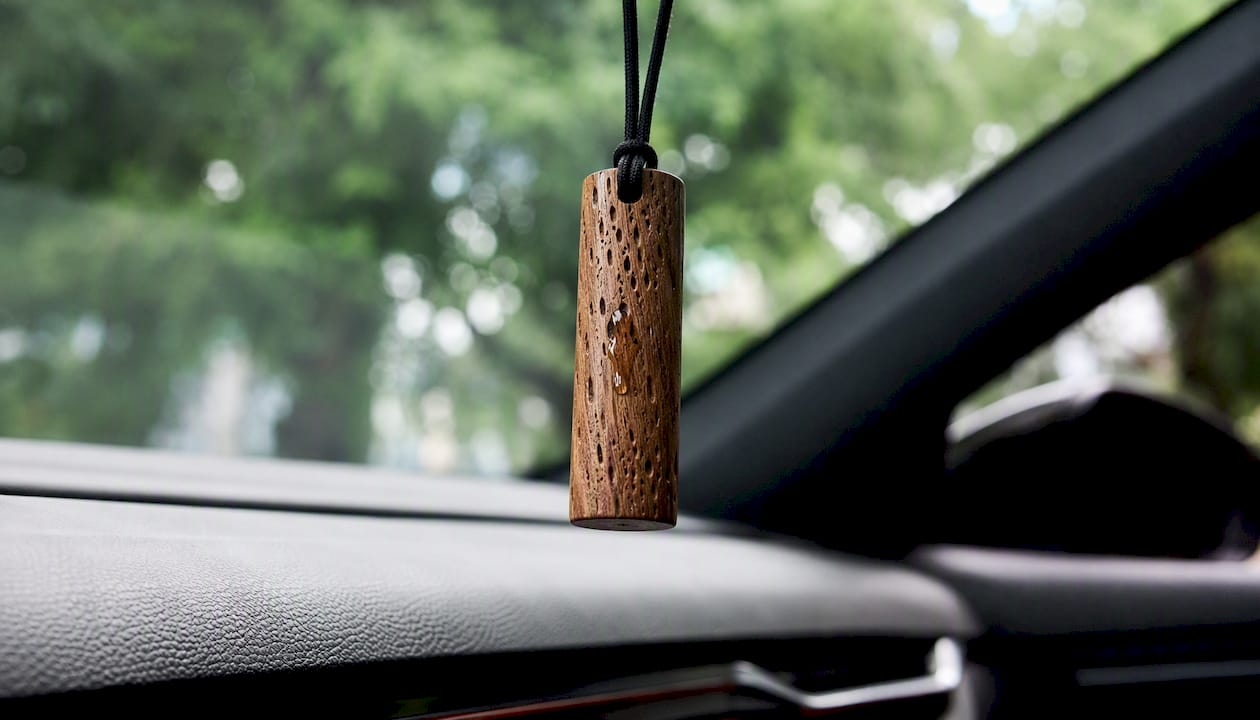
Slow-release scent hangers are the most popular format for good reason. A porous material, usually wood or felt, absorbs botanical fragrance oil and releases it gradually as cabin air moves through it. Lifespan runs several weeks when kept out of direct sunlight. Voidescent’s scent hangers use this format with fully disclosed, plant-derived oils and a minimalist design that fits modern interiors without looking like a novelty item.
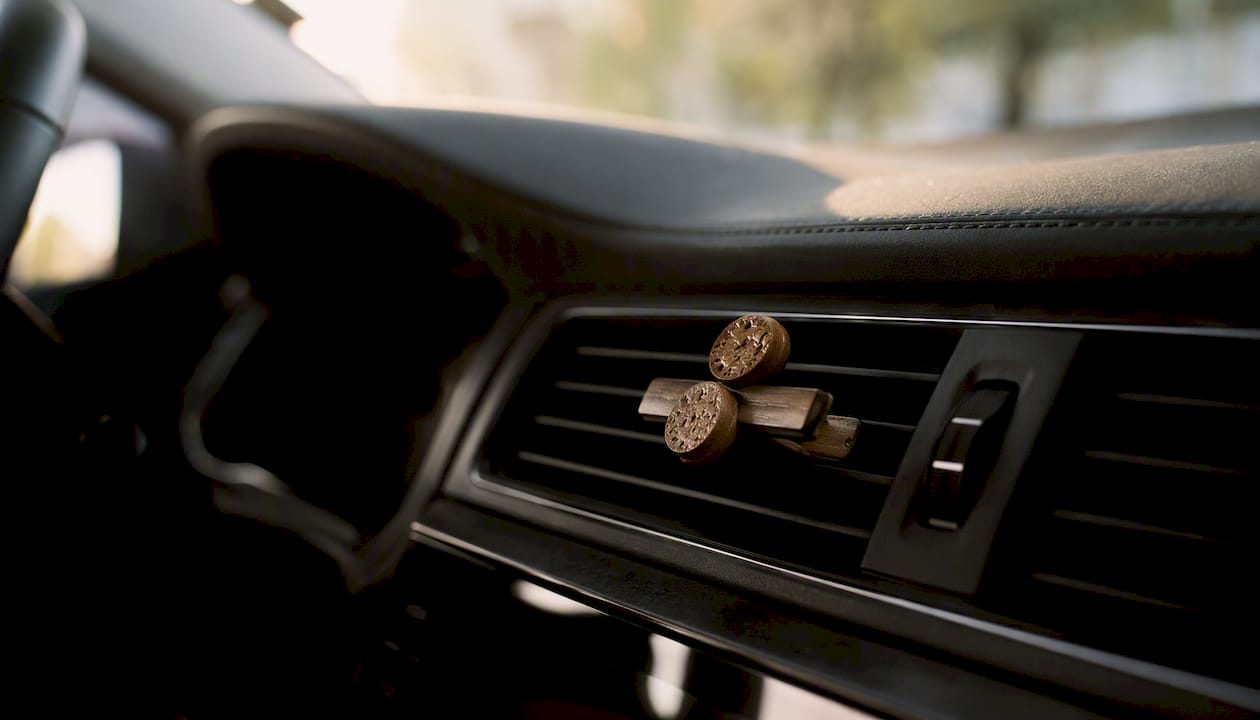
Vent-clip diffusers attach directly to an air vent blade. Active airflow does the work, which means scent disperses quickly and evenly. The trade-off: the fan has to be running, and strong oils can feel overpowering on high fan settings. Lifespan is typically a few weeks.
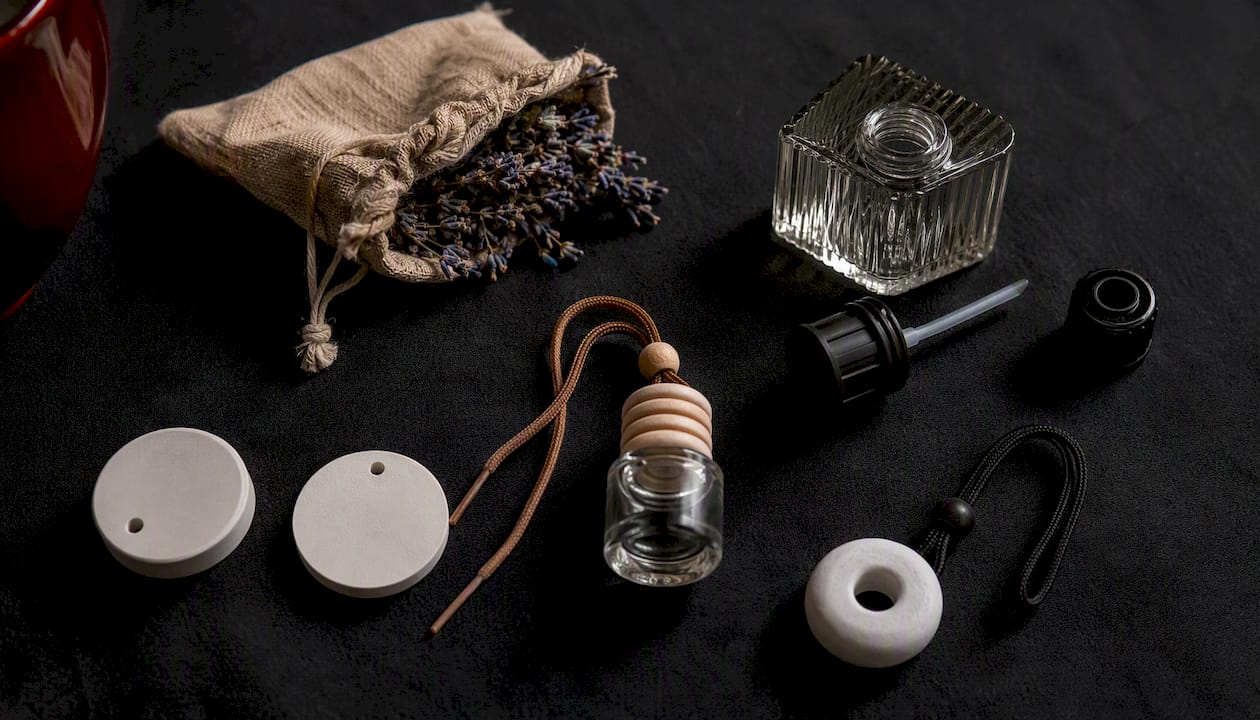
Wooden or clay discs are passive diffusers you load yourself with a few drops of essential oil. They’re refillable indefinitely and cost almost nothing to maintain. Scent output is subtle, which suits drivers who want a background note rather than a statement.
Activated charcoal bags don’t add fragrance at all. They pull odor molecules out of the air through adsorption, making them the right call for a car that smells musty or smoky. Activated charcoal bags are best paired with a scented option if you also want a pleasant aroma.
Cup-holder diffusers use water and a few drops of essential oil, sometimes with a USB-powered ultrasonic element. They’re refillable and adjustable, but spill risk is real and the water reservoir needs cleaning every week or two.
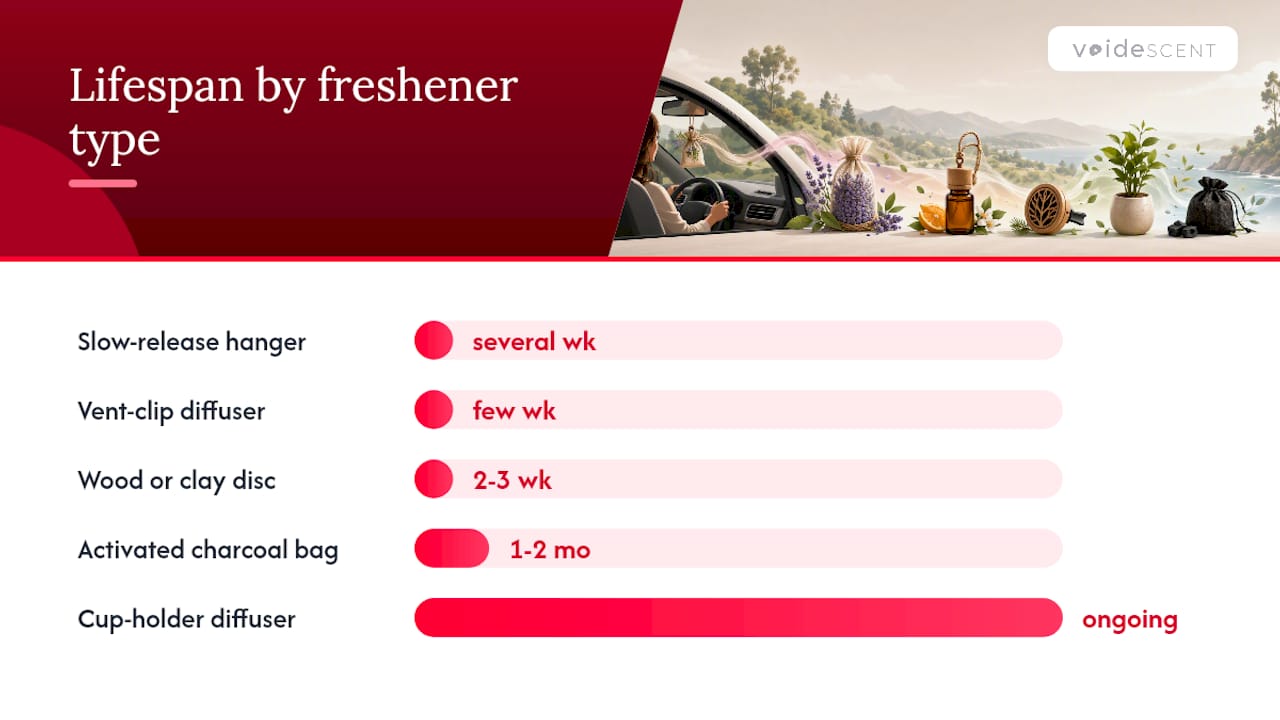
| Category | Typical lifespan | Refillable | Maintenance |
|---|---|---|---|
| Slow-release scent hanger | several weeks | Yes (add drops) | Minimal |
| Vent-clip diffuser | a few weeks | Some models | Low |
| Wooden or clay disc | 2–3 weeks per load | Yes | Low |
| Activated charcoal bag | about one to two months | Refresh in sun | Very low |
| Cup-holder diffuser | Ongoing | Yes | Weekly cleaning |
Pro Tip: Charcoal bags recharge in direct sunlight for about an hour. Set them on your dashboard on a sunny day once a month instead of replacing them.
Three DIY natural car fresheners you can make today
Safety first: Always dilute essential oils in a carrier oil or porous material before placing them in your car. Undiluted oils can damage certain plastics and irritate skin on contact. Mix in glass or ceramic, never plastic, because essential oils can degrade plastic containers and leach unwanted compounds into your blend.
Recipe 1: Clothespin vent-clip diffuser
Materials: Wooden clothespin, 5–8 drops of essential oil (lavender, eucalyptus, or cedarwood work well), small glass dish for mixing.
- Drop the essential oil onto the wooden clothespin and let it absorb for 2 minutes.
- Clip the clothespin onto an air vent blade.
- Turn on the fan to low or medium for even distribution.
Scent life: about one to two weeks. Refresh by adding 3–5 more drops directly to the wood. Clipping porous diffusers onto vents uses active airflow for subtle, continuous scent rather than an initial blast.
Safety note: Keep the clothespin away from the driver’s face. Avoid citrus oils on fan settings above medium, as concentrated citrus can cause eye irritation.
Recipe 2: Baking-soda odor absorber jar
Materials: Small glass jar with a perforated lid (or a lid you’ve poked holes in), 4 tablespoons of baking soda, 15–20 drops of essential oil.
- Pour baking soda into the jar.
- Add essential oil drops and stir gently with a wooden skewer.
- Secure the perforated lid and place the jar in a cup holder or under a seat.
Refresh monthly by stirring the mixture and adding more drops of oil. Baking soda neutralizes odors rather than masking them, so this recipe handles musty smells better than a scented hanger alone.
Safety note: Keep the jar upright. A tipped jar will spill baking soda into upholstery, which is difficult to vacuum out of tight spaces.
Recipe 3: Wooden ornament or clay disc diffuser
Materials: Unfinished wooden ornament or air-dry clay disc, 8–10 drops of essential oil, ribbon or twine for hanging.
- Place the disc in a small glass dish and apply essential oil drops evenly across the surface.
- Let it absorb for 5 minutes before hanging.
- Clip or hang from the rearview mirror, or clip to a vent blade for stronger diffusion.
Scent life: 2–3 weeks. Reload with 5–6 drops when the scent fades. For specialty fragrance oils and concentrated natural materials to load your disc, niche fragrance sources can offer more unusual botanical options than standard craft stores.
Safety note: Wooden discs loaded with flammable oils should not rest against hot surfaces like a dashboard in direct summer sun.
Are natural car fresheners safe for kids, pets, and sensitive passengers?
Natural does not automatically mean safe. Concentration, placement, and species-specific toxicity all matter.
Dos and don’ts:
- Do dilute all essential oils before use (1–3% dilution in a carrier is a reasonable starting point for enclosed spaces)
- Do use glass or ceramic for mixing and storage
- Do ventilate the car for a few minutes before passengers with asthma or fragrance sensitivities get in
- Don’t apply undiluted oils directly to vent blades or dashboard plastics
- Don’t use strong oils (peppermint, eucalyptus, tea tree) in a car regularly occupied by cats or dogs without veterinary guidance
- Don’t hang a heavily loaded diffuser directly in front of the driver’s face
Certain essential oils, including tea tree, eucalyptus, and many citrus oils, are documented as potentially toxic to cats and dogs at sufficient exposure levels. If pets ride in your car regularly, choose milder botanicals like lavender (with caution for cats) or cedarwood, keep concentrations low, and crack a window. For chronic or daily exposure, consult a veterinarian before committing to any essential-oil-based freshener.
The University of California reports that driving is one of the largest sources of daily air-pollutant exposure for most people, which means what you put in your car’s air matters more than most drivers realize. Swapping synthetic fragrance chemicals for plant-derived alternatives is a meaningful step, but only if the plant-derived option is used at safe concentrations.
Pro Tip: If a passenger reports a headache within 10 minutes of getting in, the concentration is too high. Remove the freshener, air out the car, and reload with half the oil next time.
How to choose the right freshener and keep it working
Start with these four questions before buying or making anything:
- How strong do you want the scent? Vent clips deliver the most intensity; passive hangers and clay discs are subtler.
- Do you want to refill or replace? Refillable formats (wood, clay, charcoal) cost less over time and generate less waste.
- Are pets or young children regular passengers? If yes, prioritize low-concentration, mild botanicals and avoid eucalyptus and tea tree entirely.
- Is there an existing odor problem? Deal with the source first. Remove trash, dry out damp mats, and wipe down surfaces before adding any freshener.
Placement and refresh cadence
Placement matters as much as the product. Vent clips use the HVAC fan to push scent through the cabin continuously. Mirror hangers release passively and work best in smaller cars or when you want a lighter background note. Cup-holder diffusers sit low, so scent pools near the floor rather than spreading evenly.
Refresh cadence by format:
- Slow-release hanger: add 3–5 drops of oil every 2–3 weeks, replace the base material every 6–8 weeks
- Baking-soda jar: stir and add 10 drops monthly
- Wooden or clay disc: reload every 2–3 weeks
- Charcoal bag: sun-recharge monthly, replace after about one to two years
Troubleshooting common problems
- Scent fades within days: The material is saturated or the oil has evaporated. Let it dry fully, then reload with fresh oil.
- Scent is too strong on startup: Move the diffuser away from the vent or reduce the number of drops by half.
- Odor returns suddenly: The underlying source was not removed. Check under seats and in door pockets.
- Scent fatigue (you stop noticing it): Rotate between two different scent families, or go unscented for a day to reset your nose.
What most natural-freshener guides get wrong
Most guides treat “natural” as a binary: either a product has essential oils or it doesn’t, and that’s the whole story. The real variable is delivery format. A wooden disc loaded with 20 drops of undiluted peppermint oil is not safer than a well-formulated synthetic freshener. Concentration and carrier matter more than the “natural” label.
The second thing guides miss: passive fresheners placed on a mirror do almost nothing in a large SUV or truck. The cabin volume is too big for passive diffusion to reach the back seats. Vent placement, as the DIY community has figured out through trial and error, is the practical answer for full-cabin coverage.
My honest recommendation for drivers who want zero guesswork: start with a quality slow-release hanger from a brand that publishes its full ingredient list, then add a charcoal bag under the seat if odor control is also a concern. That combination covers both scent and neutralization without stacking multiple synthetic chemicals in a small enclosed space.
Voidescent: a plant-derived option built for the long haul
Synthetic fresheners fade in a week and leave you guessing what’s actually in them. Voidescent takes the opposite approach: fully disclosed, plant-derived fragrance oils in a slow-release hanger format that lasts 4–6 weeks per load, with a money-back guarantee if it doesn’t perform.

Key reasons eco-conscious drivers choose it:
- Ingredient transparency: No “fragrance” catch-all; botanical sources are named
- Refillable format: Load with Voidescent’s botanical fragrance oils instead of tossing the whole unit
- Design: Minimalist, fits modern interiors without looking out of place
- Guarantee: Full money-back if you’re not satisfied
For maximum longevity, the Scent Maxxing product is the high-priority pick, designed specifically to extend scent life and intensity. Browse the full range at Voidescent and find the scent profile that fits your car.
Sources
- DIY Car Freshener | How to Make A Car Smell Good Naturally - Lemons, Lavender, & Laundry
- How To Make 3 Naturally-Scented Air Fresheners For Cars