

12 Minimalist Car Interior Ideas for Design-Conscious Drivers
A minimalist car interior is one where every object earns its place, surfaces stay unbroken, and nothing competes for your eye. You do not need a new car to get there. Six changes, most of them under an hour of work, move almost any cabin toward that look: clear out the console and door pockets, mount your phone on a slim magnetic dock instead of a bulky cradle, route charging cables through the seat gap so nothing dangles, drop in one low-profile organizer instead of three mismatched ones, throw on a set of neutral seat covers, and add a single, restrained scent instead of a rack of competing air fresheners.
Here is the six-item checklist to work through this weekend.
- Declutter first, buy second. Pull everything out of the cabin, then only put back what you use weekly.
- Swap your phone cradle for a slim magnetic or vent mount that disappears when the phone is off it.
- Route cables under the console edge or through seat-gap clips so nothing crosses open space.
- Replace multiple bins and caddies with one low-profile organizer sized to your actual daily items.
- Add neutral seat covers or a folded throw in a single tone to quiet down a busy factory interior.
- Introduce one tasteful scent source rather than several competing fresheners clipped to vents and mirrors.
None of this sticks without upkeep. A minimalist cabin is a maintenance habit as much as a design choice, and the sections below cover both: what to change, and how to keep it that way.
Key Takeaways
A minimalist car interior works when essential items get concealed homes, surfaces stay limited to one or two materials and tones, and daily habits keep the system from drifting back into clutter.
| Point | Details |
|---|---|
| Declutter before buying | Empty every storage point first, then only add organizers for what is actually left. |
| Pick one architecture, one palette | Commit to a single focal line and one or two neutral tones instead of mixing textures and colors. |
| Conceal daily-use items | Route cables, chargers, and small objects into hidden or under-seat storage rather than open trays. |
| Keep a few physical controls | Consolidate most functions into one screen, but leave hazard lights and volume as physical buttons. |
| Finish with restraint, not more stuff | One tasteful, slow-release scent like Voidescent’s Heavens or Descent replaces a rack of fading fresheners. |
Table of Contents
- Minimalist Car Interior Ideas Inspired by Production Models
- What “Minimalist” Actually Means in a Car Cabin
- Decluttering and Smart Storage That Actually Sticks
- Materials and Color Palettes for a Calm Cabin
- Lighting and Tech Choices That Cut Visual Noise
- Keeping a Minimalist Interior Looking That Way
- Accessories Worth Adding (and What to Skip)
- Ergonomic Layout Choices That Support Comfort, Not Just Looks
- Personalizing a Minimalist Cabin Without Wrecking the Look
- Storage That Stays Minimalist Without Sacrificing Daily Use
- Why a Quiet Cabin Changes How You Drive
- A Tasteful Finishing Touch for a Minimalist Cabin
- Sources
Minimalist Car Interior Ideas Inspired by Production Models
You do not have to guess at what works. A handful of production and concept interiors have already done the hard design work, and you can borrow their logic without buying the car.
Jaguar’s Type 01 concept is the clearest recent example of radical reduction. Instead of a conventional dashboard, it runs a full-length central spine down the cabin, with concealed compartments and a digital layer that only shows up where it is needed. The effect is closer to furniture than automotive trim.
The spine reorients the entire cabin front to back instead of side to side, creating individual zones for each occupant rather than one shared dashboard plane. Screens surface only where necessary, and long, uninterrupted material runs replace the usual scatter of buttons and seams.
That single design move, reported in designboom’s coverage of the Type 01 interior, tells you something practical: a longitudinal focal line (a strip of trim, a single console spine, even a contrasting stitch line running the length of the dash) reads as more intentional than symmetry alone. CAR Magazine’s early look at the Type 01 frames this as a shift from horizontal dashboard architecture to a spine-led layout, and it is worth noting because most factory interiors still default to the old horizontal habit.
A few more to study:
- Tesla Model 3: near-total removal of physical switchgear in favor of one central screen. The lesson to copy is restraint, not the touchscreen itself. Most owners do not need to remove every button; they need to stop adding more.
- Hyundai Ioniq 5: a flat floor and a movable center console that reads as open rather than empty. Copy the idea of negative space around the console instead of packing it with add-ons.
- Jaguar I-PACE: rounded, unbroken trim panels with hidden vents. Copy the principle of concealment, not the exact vent design.
- Volvo XC40: muted, tonal color blocking rather than contrasting trim pieces. Copy the restraint in palette, which costs nothing to replicate with seat covers and mats.
The point of studying these cars is architecture, not shopping lists. You cannot buy Jaguar’s spine console for your hatchback, but you can apply the same logic: pick one visual line, one material, one zone of concealment, and commit to it rather than layering on five different aftermarket fixes.
What “Minimalist” Actually Means in a Car Cabin
Essentialism is the design principle underneath all of this: every visible element has to justify its presence, or it gets consolidated, hidden, or removed. In practice, that shows up as a short list of recurring moves designers use again and again.
- Consolidate infotainment and climate controls into one central touchscreen instead of scattering buttons across three zones.
- Use hidden-until-lit interfaces, so a panel looks like plain trim until it is switched on.
- Favor unbroken horizontal or longitudinal lines over multi-seam panel layouts.
- Reduce visible branding and redundant switches so the cabin reads as architecture, not a control panel.
Jaguar’s approach to the Type 01 leans on large swaths of a single material rather than the busy, multi-texture layouts common in mainstream interiors. That is a detail you can steal cheaply: one seat cover fabric, one dash trim finish, one accent color, applied consistently, beats five coordinated-but-different textures every time.
Architecture matters as much as material. A horizontal layout (the traditional dashboard-across-the-width approach) tends to visually widen a cabin but can feel flat. A longitudinal or spine-led layout, the kind CAR Magazine describes in the Type 01, divides the cabin into zones and draws the eye front to back, which reads as more considered in a smaller space.
Technology on demand is the phrase design teams keep returning to: the eye is drawn to texture and form, and the screen only asserts itself when you actually need it.
There is a real trade-off here worth naming. Hiding controls behind glass or software can make an interior distraction-free, but reporting on the 2026 minimalist trend also flags the risk of burying safety-critical functions behind menus. The hybrid approach, keeping a handful of physical controls for hazard lights, volume, and climate while consolidating everything else, is becoming the accepted middle ground, and it is one you should apply at home too: hide the phone charger cable, but do not hide your parking brake release under a fold-down panel you forget about.
Decluttering and Smart Storage That Actually Sticks
Most cluttered interiors are not a design problem. They are an unassigned-homes problem: items without a fixed spot end up wherever they land, and that is what wrecks a clean cabin faster than bad trim ever could.
Work through this in order:
- Empty every storage point (glovebox, door pockets, console, seatbacks, trunk) onto a table.
- Purge anything you have not touched in a month — old parking stubs, spare chargers, loose coins.
- Assign one home per daily item: sunglasses, garage remote, phone cable, hand sanitizer.
- Install one concealed or under-seat organizer sized to what is left, not to what you wish you needed.
- Fill remaining gaps (console seams, seat gaps) with slim gap fillers so loose items stop sliding out of sight and reappearing later.
On products, prioritize spending in this order: a slim under-seat tray first, a console divider second, dedicated cable clips third, and a low-profile trash can last, since most drivers overestimate how much trash storage they actually need. Car and Driver’s accessory recommendations lean the same direction: compact, single-purpose tools beat bulky multi-compartment organizers that end up half empty and visually busy anyway. If you want a deeper look at concealment-forward storage design, FS9 Tactical’s guide to vehicle storage organizers covers the category well.
Pro Tip: The single highest-impact upgrade is usually the cheapest one: a $10 seat-gap organizer. It closes the exact spot where phones, pens, and receipts vanish and then resurface a week later, scattered across the passenger footwell.
Materials and Color Palettes for a Calm Cabin
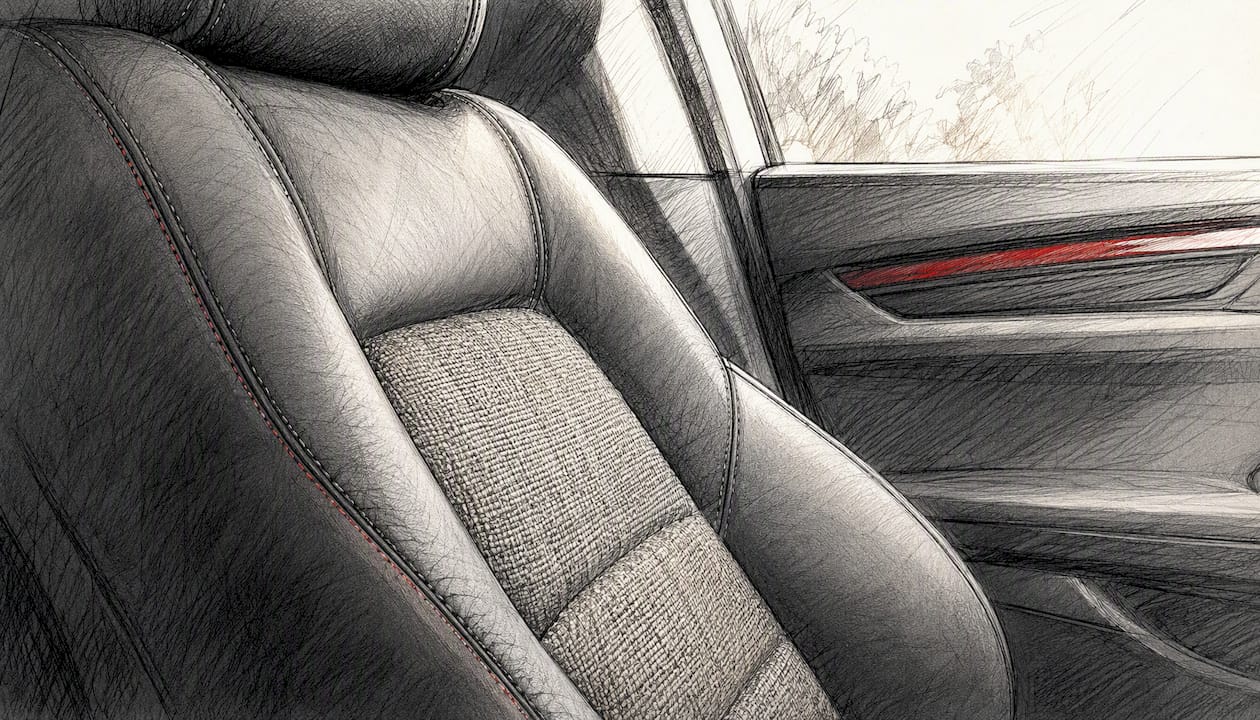
Neutral, tonal palettes read as calm; busy multi-tone interiors read as cluttered even when they are technically clean. Stick to one or two base tones (stone, graphite, warm sand) with a single accent, rather than the black-plus-three-accent-colors combination most factory trims default to.
- Choose one dominant neutral and repeat it across seats, mats, and any add-on covers.
- Use tonal contrast (a slightly darker or lighter shade of the same color family) instead of a clashing accent hue.
- Favor matte finishes over gloss almost everywhere.
- Reserve any metallic accent for a single trim line, not multiple surfaces.
On material choice, Ferrari’s Luce concept makes a useful case that minimalism does not have to feel cheap or thin. It leans on glass and metal components that add real tactile weight without adding visual clutter, proof that “minimalist” and “substantial” are not opposites. Open-pore wood, brushed metal, and matte fabrics all carry that same honest, tactile quality. Piano black, on the other hand, is worth avoiding for anything you will touch daily: it shows fingerprints and dust within hours and photographs beautifully only in a showroom, never in daily use.
Sustainability and minimalism increasingly overlap, too. Coverage of the 2026 minimalist interior trend points to a growing supply of vegan leathers, recycled textiles, and natural-fiber options that read as premium rather than as a compromise. If you are shopping for seat covers or mats, these materials often deliver the matte, tonal look you want anyway, so there is no real trade-off between eco-conscious sourcing and the aesthetic. Danish design principles push the same direction: SVAL CPH’s breakdown of what minimalist Danish design gets right makes the case that restraint in materials, not the absence of materials, is what signals quality.
Lighting and Tech Choices That Cut Visual Noise
Ambient LED strips, centralized touchscreens, and wireless charging pads all reduce visual clutter when they are used with restraint. The same tools, overused, create their own kind of mess.
Do this:
- Centralize infotainment and climate into one screen rather than adding a second aftermarket display.
- Use a single low-glow ambient LED strip along the door or console line, not multiple colored zones.
- Add a wireless charging pad flush with the console surface instead of a cradle that sticks up.
- Keep steering-wheel shortcuts and voice control active so you rarely need to touch the screen at all.
Don’t do this:
- Don’t stack multiple phone mounts, charging cables, and dash cams in the same sightline.
- Don’t run ambient lighting in more than one or two colors; it starts to look like a dashboard rather than a cabin.
- Don’t hide hazard lights, defrost, or volume behind a touchscreen menu.
Trend analysis on 2026 minimalist interiors is direct about the safety trade-off here: consolidating controls reduces distraction, but burying anything safety-critical behind two or three menu taps is a real risk, not a theoretical one. Keep physical buttons for the handful of functions you might need in a hurry, and let voice commands and steering-wheel shortcuts absorb everything else.
Keeping a Minimalist Interior Looking That Way
The look does not survive on its own. It survives on a short, repeatable routine.
- Weekly: wipe the touchscreen and glossy surfaces with a microfiber cloth, vacuum the console and seat gaps, and rehome any stray items back to their assigned spot.
- Monthly: reset infotainment presets and remove apps or shortcuts you have stopped using, do a full interior vacuum including under the seats, and check that organizers have not quietly filled up with clutter again.
- As needed: apply a non-abrasive interior cleaner to fabric and matte trim, never a glossy or oil-based dressing that attracts dust.
Keep three things on hand: a microfiber cloth, a non-abrasive interior cleaner, and a small portable vacuum.
- Set your climate and seat presets once and leave them; re-adjusting settings every drive is a habit that quietly re-clutters your attention even if the cabin looks clean.
- Give receipts, parking permits, and toll transponders one dedicated slot so they never end up loose on the passenger seat.
- Do a 30-second scan before you leave the car each time, the same way you’d check a room before leaving a hotel.
Accessories Worth Adding (and What to Skip)
A short list of accessory categories does most of the work here, and the operative word is “low-profile.” Anything bulky undoes the effect immediately, no matter how useful it is.
- Slim magnetic or vent phone mounts that disappear when the phone is removed.
- Flush wireless chargers built into or mounted level with the console.
- A single low-profile organizer, sized to daily essentials rather than every possible item.
- One subtle ambient LED strip along a door or console line, kept to a single low-glow tone.
- A premium, slow-release scent hanger rather than a stack of clip-on air fresheners competing for the same vent.
That last category matters more than it looks. Most air fresheners fade within a week or two, which pushes owners toward adding a second or third one, and that stacking is exactly the kind of visual and olfactory clutter a minimalist cabin is supposed to avoid. Voidescent’s scent hangers are built around a slow-release botanical formula designed to last four to six weeks, which means one discreet, well-designed hanger does the job a cluttered rack of synthetic fresheners usually fails at.
Pro Tip: Scale every accessory to the cabin, not to the showroom photo. A wireless charger that looks sleek in a full-size SUV can look oversized in a compact hatchback; hold the item in place before you commit to mounting it.
Ergonomic Layout Choices That Support Comfort, Not Just Looks
Minimalism and comfort are not competing goals, but they can pull against each other if you strip things down without thinking about reach and posture. The fix is to design around your actual driving position, not around what looks cleanest in a photo.
Keep your three most-used touchpoints (phone mount, charging pad, and drink holder) within a natural arm’s reach from the steering wheel, so you are never leaning or twisting for something you use every drive. Seat covers and cushions should follow your seat’s factory contours rather than adding thickness that changes your seating height, since raising your hip point even slightly can throw off mirror angles and knee clearance. Armrest and console height matter too: a console organizer that sits higher than the factory armrest will force your elbow up and create fatigue on long drives, even if it looks tidy.
The general rule is that anything you touch more than once a drive should be reachable without looking away from the road, and anything you touch less than once a week should be out of sight entirely. That single filter solves most ergonomic and aesthetic conflicts at once.
Personalizing a Minimalist Cabin Without Wrecking the Look
Personalization and minimalism can coexist, but only if you personalize through restraint rather than addition. The instinct with most car customization is to add: a sticker, a hanging charm, a second phone mount for a tablet. Minimalist personalization works the opposite way, through curated substitution rather than accumulation.
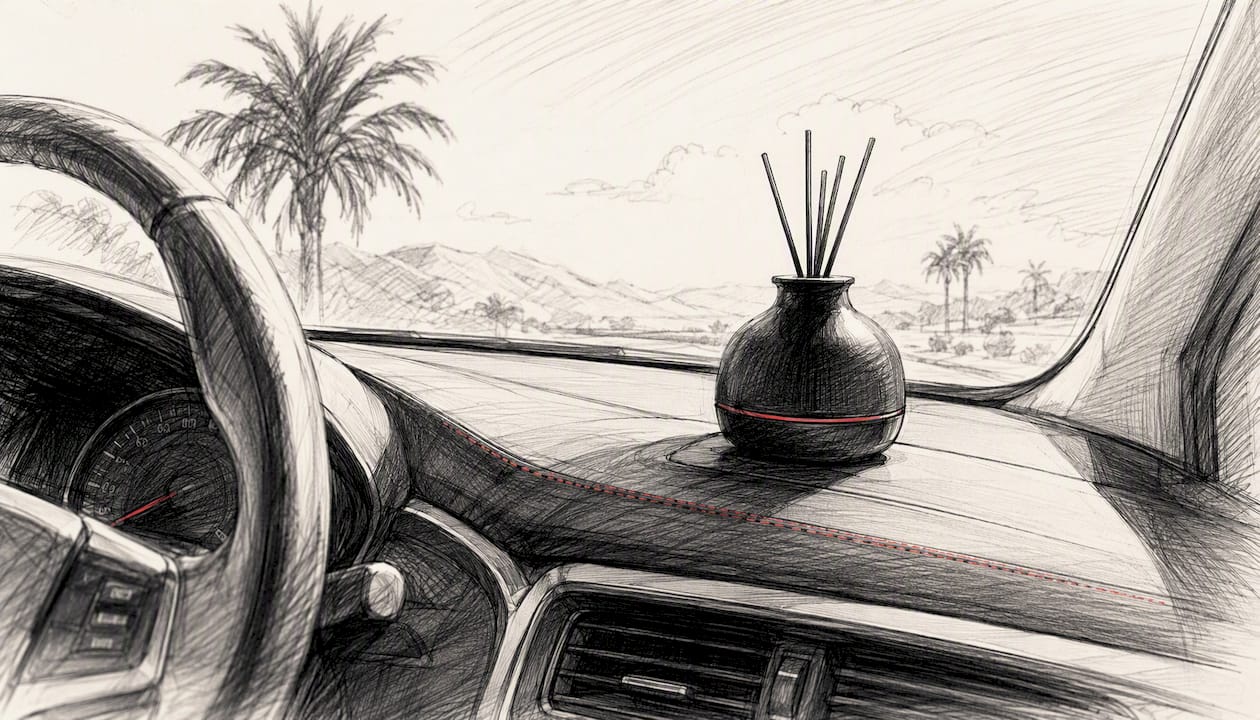
Pick one or two signature choices and let them carry all the personality. That might be a single accent color repeated across stitching and trim, one meaningful object (a small dashboard photo, a single keychain) kept in its own dedicated spot, or a distinct scent that becomes part of how the car feels like yours every time you get in. The goal is that a stranger sitting in your car would notice one or two intentional details, not a dozen small ones competing for attention.
Swappable elements make this easier to maintain over time. Seat covers, mats, and scent hangers can be changed seasonally without touching the car’s actual trim, which means you can refresh the personality of the cabin every few months without ever risking the underlying minimalist architecture.
Storage That Stays Minimalist Without Sacrificing Daily Use
The hardest part of minimalist storage is that real life does not stop generating small objects: parking tickets, hand sanitizer, a spare charging cable, sunglasses. The goal is not to eliminate storage but to make it invisible until you need it.
Concealed storage beats visible storage every time it is available. A console with a closing lid or a lidded armrest compartment holds the exact same items as an open cupholder tray, but only one of them shows up in your sightline while you drive. Where concealment is not possible, uniformity is the next best option: one organizer style, one color, used consistently, reads as far more intentional than three different mismatched trays from three different shopping trips.
Prioritize storage upgrades by frequency of use. Daily items (phone, sunglasses, garage remote) deserve the most accessible concealed spot. Weekly items (a phone charger you do not always need, hand sanitizer) can go one layer deeper. Anything used less than monthly does not belong in the cabin at all; it belongs in the trunk, or not in the car.
Why a Quiet Cabin Changes How You Drive
Visual clutter and mental clutter are more connected than most drivers give them credit for. A dashboard with six things competing for your attention, a dangling cable, a half-full cupholder, a phone cradle blocking part of your sightline, adds up to a low hum of distraction you stop noticing consciously but never fully tune out. Strip that away and the drive itself gets quieter, even before you turn the key.
There is a discipline cost to this, and it is worth being honest about it. A minimalist interior does not stay that way through one weekend of decluttering; it stays that way because you put the receipt back in its slot instead of the cupholder, because you resist the urge to add a second organizer “just in case.” That small, repeated discipline is the actual product here, more than any single accessory. The payoff is a cabin that feels less like storage and more like a space you actually chose, every time you get in.
A Tasteful Finishing Touch for a Minimalist Cabin
Once the clutter is gone and the palette is settled, scent is the last sense most owners forget to design for. A synthetic clip-on freshener fades within days and then gets replaced by a second, stronger one, which is exactly the kind of visual and olfactory pile-up a minimalist cabin is meant to avoid.
Voidescent’s Heavens scent hanger is built for that gap: a slow-release botanical fragrance oil designed to hold a consistent, evolving aroma for four to six weeks, so you are not swapping it out every week or layering a second scent on top of a fading one. The design itself follows the same minimalist logic as the rest of this list, a single clean silhouette rather than a plastic clip shaped like a tree or a bottle.
Placement matters more than intensity. Hang it from the rearview mirror mount or a rear vent, away from direct airflow from the main climate vents, so the scent releases evenly instead of blasting in short bursts every time the fan kicks on. One hanger is enough for most cabins; resist the instinct to add a second for a stronger effect, since that undoes the entire point. If you want a different fragrance profile with the same slow-release approach, Descent is worth a look for a cooler, more subdued character. Either one finishes a minimalist cabin the way a single well-chosen accent piece finishes a room.
Sources
- Jaguar reveals Type 01 interior with full-length ‘spine’ and travertine tones | designboom
- Electric Ferrari Luce’s Interior Revealed: When Apple Meets Ferrari | The Drive
- Jaguar Type 01 interior teaser | CAR Magazine
- The luxury of simplicity: exploring the rise of minimalistic car interiors in 2026 | CarGuruNews