

Fragrance Oil vs Essential Oil for Car Scent Hangers
Botanical fragrance oils win for slow-release automotive scent hangers. They are formulated for carrier absorption, heat stability, and a consistent scent arc over several weeks to a month or more — three things single essential oils were never designed to deliver in a hot, enclosed cabin.
The three reasons that matter most:
- Carrier compatibility: Botanical fragrance oils absorb into EVA and porous resin matrices the way they were designed to. Essential oils, being pure volatile distillates, often evaporate too quickly or fail to bond with the carrier at the right rate.
- Controlled volatility: A formulated blend releases at a designed pace. Essential oils front-load their throw and fade fast, especially under dashboard heat.
- Scent complexity: Botanical blends are curated for olfactory arcs — the opening note, the dry-down, the lasting base. A single essential oil gives you one note and that’s it.
TL;DR: For a premium slow-release hanger that holds its scent for 4–6 weeks, botanical fragrance oils are the clear choice. Voidescent backs that claim with a money-back guarantee — try a single refill and see.
Table of Contents
- What do “botanical fragrance oil” and “essential oil” actually mean here?
- How slow-release car scent hangers actually work
- Which should you choose as a design-conscious driver?
- How to use botanical fragrance oils in a car scent hanger
- Safety, allergens, and ventilation in your vehicle cabin
- What lifespan should you expect, and how do you troubleshoot it?
- Why the guidance here is reliable
- Key Takeaways
- The design intent behind slow-release botanical scents
- Voidescent: botanical slow-release hangers worth trying
- Sources and further reading
What do “botanical fragrance oil” and “essential oil” actually mean here?
These terms get conflated constantly, so here is exactly how they are used in this guide.
Botanical fragrance oil (as defined here) is a plant-forward, formulated blend engineered for slow release in solid or porous carriers. It draws on botanical-derived aroma compounds and is built for performance consistency, heat stability, and carrier absorption. This is not synthetic perfumery made entirely from lab-created aroma chemicals. The distinction matters: formulated botanical blends are designed for stability and repeatability, while single essential oils carry the variability of a living plant.
Essential oil is a single-plant extract produced by steam distillation or cold pressing. It contains the plant’s volatile terpene profile — which is exactly what makes it aromatic, and exactly what makes it unpredictable under heat. Batch variability is real: the same lavender oil from two harvests can smell noticeably different and evaporate at different rates.
Key practical implications:
- Botanical fragrance oils offer labeled, consistent botanical content across every refill.
- Essential oils carry natural batch variation and a faster, less predictable volatility curve.
- Heat stability favors formulated blends; essential oils can degrade or shift character above 100°F, a temperature a parked car exceeds routinely.
How slow-release car scent hangers actually work
Slow release depends on two things: how well the carrier absorbs the oil, and how steadily it lets that oil off-gas into the cabin air.
The most common carrier in automotive hangers is partially melt-bonded EVA (ethylene-vinyl acetate) powder. According to US patent US5019434A, EVA porous molded products rapidly absorb liquid fragrance, can expand up to nearly twice their original volume, and maintain continuous gas-permeable pores for controlled release. The vinyl acetate (VA) content is the key formulation variable: VA content in the low twenties to low thirties suits standard air freshener use, while lower VA content is recommended when the carrier needs to withstand higher temperatures.
Molded resin generators take a different approach. US patent 5,865,372 describes spherical and vaned resin shapes mounted on vehicle HVAC vents, where heat and airflow induce rotation, spreading scent more evenly through the cabin without any electronics.
Solid-state matrices go further still. US patent 10493177 covers fragrance oil loaded into a polyolefin elastomer and polyether block amide matrix at moderate fragrance oil proportions by weight, producing a no-spill solid that releases scent gradually and won’t mar plastic surfaces.
Key stat: Studies cited by Elyvora’s 2026 natural car freshener guide indicate parked cars can concentrate VOC emissions multiple times above ambient air levels — which is why carrier design and ingredient transparency matter more in a car than in any other diffusion context.
Temperature and airflow are the main variables you can’t control. A car parked in direct sun in summer can exceed 130°F inside. That heat accelerates volatilization; a vent-mounted hanger with active HVAC airflow releases scent faster than a mirror-hung hanger in still air. Both effects are manageable when the oil and carrier are matched correctly.
Which should you choose as a design-conscious driver?
The decision rule is simple: if you want reliable 4–6 week slow release, surface compatibility, and a designed olfactory arc, choose botanical fragrance oils made for slow-release hangers. Choose single essential oils only if plant identity is the priority and you’re prepared to manage dilution, volatility, and shorter effective life.
Three real scenarios:
- Daily commuter, 45+ minutes each way: — Botanical fragrance oil. You want consistent scent every morning without fussing with refills every week.
The best car scent is one you stop noticing after five minutes — not because it faded, but because it became part of the drive.
Pro Tip: Start with a low-strength refill on your first try. If the scent feels weak after 48 hours, move the hanger closer to a vent. If it’s too strong, pull it back or remove it for 24 hours to reset. Voidescent’s scent refill collection is backed by a money-back guarantee, so there’s no risk in testing.
How to use botanical fragrance oils in a car scent hanger
Follow carrier fill volumes exactly and test placement before committing to a permanent spot.
Troubleshooting:
- Weak scent after day 3: — Check that the refill is fully seated and the carrier surface isn’t blocked. Move closer to a vent.
Pro Tip: In summer, remove the hanger from a parked car or shade it under the seat. Sustained heat above 130°F can accelerate evaporation significantly and shorten the effective lifespan.
Store unused refills sealed in a cool, dark place. Heat and UV exposure before use will degrade the scent profile before the refill ever reaches your car.
Safety, allergens, and ventilation in your vehicle cabin
Both botanical fragrance oils and essential oils can trigger sensitivities. The enclosed car cabin makes concentration effects worse than almost any other diffusion setting.
Key risks:
- Phototoxic citrus compounds: Bergapten and related furanocoumarins in citrus oils can cause skin reactions on sun-exposed surfaces. Less relevant for car hangers, but relevant if oil contacts skin.
- Common allergenic terpenes: Linalool, limonene, and geraniol are natural constituents of many botanical blends and essential oils. They’re generally well-tolerated at low concentrations but can irritate at high doses in a sealed cabin.
- Hot parked cars: VOC concentrations in parked vehicles can reach 4–20 times ambient levels. Opening windows for two minutes before driving disperses the buildup.
Practical mitigations:
- Crack windows briefly after parking in heat before re-entering.
- Choose formulations with IFRA-compliant ingredient lists or EPA Safer Choice certification where available.
- Patch-test a small, hidden area of trim before full installation.
- Use lower fill levels in smaller cabins or with sensitive passengers.
Warning: For children, pregnant passengers, or anyone with asthma or respiratory sensitivities, use the lowest effective concentration and prioritize full ingredient transparency. When in doubt, skip vent-mounted placement and use a mirror-hung hanger in the rear cabin instead.
What lifespan should you expect, and how do you troubleshoot it?
A properly paired slow-release refill in a matched EVA or porous carrier lasts 4–6 weeks under normal driving conditions. That range assumes moderate ambient temperatures, typical daily use, and correct carrier loading.
Variables that shorten lifespan:
- High-volatility top-note-heavy scent profiles
Stat note: EVA refill carriers visibly shrink as fragrance evaporates — a design feature documented in automotive fragrance patents that gives you a built-in end-of-life signal without guessing.
Troubleshooting checklist:
Timeline for common fixes: immediate repositioning resolves most strength issues within hours; a 24–72 hour reset handles absorption problems; after one week with no improvement, the refill or carrier likely needs replacement.
Why the guidance here is reliable
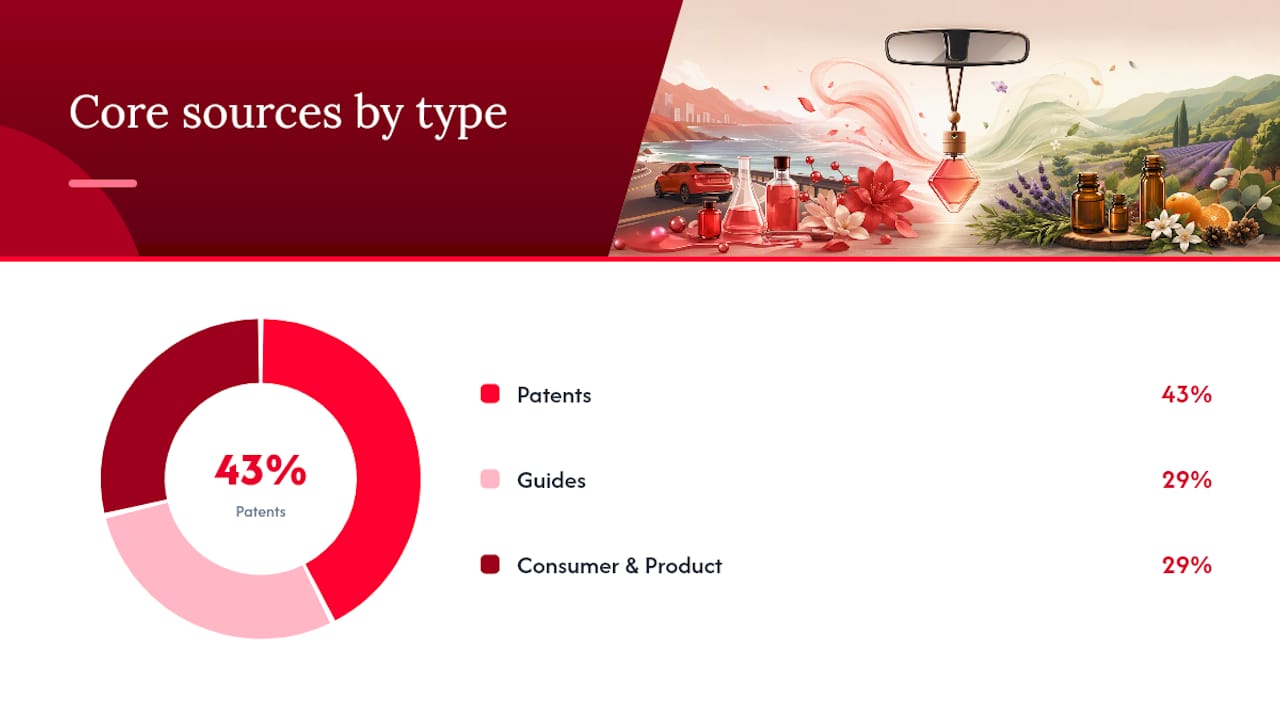
Recommendations in this guide draw on carrier chemistry patents, fragrance formulation practice, and documented product performance.
The core sources:
| Source type | What it supports |
|---|---|
| US5019434A EVA carrier patent | Carrier absorption mechanics, VA% guidance, heat resistance |
| US5865372 vehicle vent diffuser patent | Airflow and rotation effects on diffusion |
| US10493177 solid-state fragrancing patent | Polymer matrix formulations, surface safety |
| Naturalistico formulation guide | Essential oil vs fragrance oil functional differences |
| Elyvora VOC and safety guide | In-car VOC concentration data, EPA Safer Choice context |
| Polished Piston consumer guide | Practical residue, staining, and maintenance notes |
| Voidescent product claims | 4–6 week lifespan, money-back guarantee, botanical formulation |
This guide does not substitute for professional safety or medical advice. Readers with specific health concerns should consult a qualified professional and review current ingredient disclosures before use.
Author: Azanone. Sources: US patents on EVA and polymer carrier chemistry, peer-reviewed VOC literature summaries, industry formulation guides, and Voidescent product documentation.
Key Takeaways
Botanical fragrance oils outperform essential oils in slow-release car hangers because they are formulated for carrier absorption, heat stability, and a consistent 4–6 week scent arc that single-plant distillates cannot match.
| Point | Details |
|---|---|
| Botanical oils win for car hangers | Formulated for EVA carrier absorption and heat stability; essential oils evaporate too fast. |
| Expect 4–6 weeks of scent | Properly paired refills in matched carriers deliver consistent throw for 4–6 weeks under normal use. |
| Heat and placement matter | Vent mounting speeds release; summer heat shortens lifespan — shade or remove the hanger when parked. |
| Ingredient transparency protects you | In enclosed cabins, VOCs concentrate fast; choose formulations with full botanical ingredient disclosure. |
| Voidescent is the recommended option | Voidescent’s slow-release botanical hangers are backed by a money-back guarantee and designed for the 4–6 week performance window. |
The design intent behind slow-release botanical scents
Most car fresheners treat scent as an afterthought — a chemical blast that fades in a week and leaves a synthetic residue. The thinking behind Voidescent goes the other way: start with botanical blends that have something to say, build them into a carrier that releases slowly enough to evolve over weeks, and wrap it in a form that belongs in a well-designed interior.
The 4–6 week lifespan isn’t a marketing claim. It’s the result of matching the right fragrance oil chemistry to the right carrier matrix — the same principle the EVA carrier patents have described for decades, applied to a product that actually looks good hanging in your car.
Voidescent: botanical slow-release hangers worth trying
If this guide has convinced you that botanical fragrance oils are the right call for your car, Voidescent is where that recommendation lands in practice.

Voidescent’s automotive scent hangers use slow-release botanical fragrance oils in a minimalist, design-forward format built for the 4–6 week performance window described throughout this guide. No synthetic blast, no mystery ingredients, no weekly replacements. The money-back guarantee means your first order is risk-free.
Start with the Scent Maxxing refill for a high-impact botanical experience, or browse the full scent collection to find a profile that fits your cabin and driving style. Every how-to step in this guide applies directly to Voidescent refills and hangers.
Sources and further reading
The claims in this guide are grounded in the following sources.
| Source | What it covers |
|---|---|
| US5019434A — EVA porous carrier patent | Carrier absorption, VA% guidance, heat resistance tradeoffs |
| US5865372 — Vehicle vent air freshener patent | Vent-mounted diffusion, airflow and rotation mechanics |
| US10493177 — Solid-state fragrancing patent | Polymer matrix formulations, surface compatibility |
| Naturalistico: Essential Oils vs Fragrance Oils | Functional differences, formulation stability |
| Elyvora: Natural Car Air Fresheners 2026 | In-car VOC data, EPA Safer Choice guidance |
| Polished Piston: Essential Oils vs Air Fresheners | Consumer maintenance notes, residue and staining risks |
| Voidescent — The ever lingering scent | Product lifespan claims, botanical formulation, money-back guarantee |
For deeper technical reading, the three US patents above are publicly accessible via Google Patents and FreePatentsOnline. The Elyvora and Polished Piston guides offer practical consumer-level context on in-car safety and maintenance.