

80 Allergens, New EU Rules and Eco Labels for Air Fresheners
Trust third-party certification and published Allergen Declarations, not the word “eco” or “natural” printed on a box. A logo on a can of car spray means nothing unless a certifier stands behind it. Ironically, an essential-oil blend often carries more declared allergens than a synthetic one, so “natural” is a marketing word, not a safety guarantee.
TL;DR:
- Only third-party certifications with verifiable registry entries, like Cradle to Cradle or Ecogarantie, ensure genuine sustainable and safe labeling; vague claims lack credibility.
- EU Regulation 2023/1545 mandates listing roughly 80 fragrance allergens by name once thresholds are exceeded, with stricter disclosure required for products after July 31, 2026.
- Checking labels by requesting allergen declarations and certification documents quickly identifies brands that genuinely disclose ingredient safety versus superficial marketing claims.
- Natural essential oils often contain more declarable allergens than synthetic fragrances, making “natural” an unreliable indicator of lower allergen exposure.
- Refillable, slow-release formats like oil hangers produce less waste and often contain fewer allergens, making them a sustainable and health-conscious choice over aerosols.
Table of Contents
- What Legitimate Eco Labels and Certifications for Air Fresheners Actually Cover
- Why EU Regulation 2023/1545 Changes What “Fragranced” Means
- How to Evaluate an Air Freshener Label Before You Buy
- Natural Alternatives and Format Trade-Offs Worth Knowing
- How Voidescent Handles Ingredient Transparency
- Do Eco-Labeled Air Fresheners Actually Improve Indoor Air Quality?
- The Full Lifecycle: What Happens Before and After the Scent Fades
- The Major Eco Labels You’ll Actually See on Air Fresheners
- Why Transparency Beats “Natural” as a Buying Signal
- Where Voidescent Fits Into This Checklist
- Sources
- FAQ
What Legitimate Eco Labels and Certifications for Air Fresheners Actually Cover
Air freshener packaging borrows credibility from four separate label categories, and mixing them up is how greenwashing survives. Each one checks a different thing, and none of them alone proves a product is safe or sustainable.
- Material health labels, like Cradle to Cradle, grade a product on chemical safety of ingredients, material reuse potential, renewable energy use in manufacturing, water stewardship, and social fairness across tiered levels from Bronze to Platinum.
- Organic and raw-material claims focus narrowly on where the fragrance ingredients came from, not on packaging, emissions, or worker conditions.
- Management-system ecolabels, such as Ecogarantie, set product-specific rules for air fresheners covering ingredient sourcing, a ban on GMOs, biodegradability targets, and which packaging materials qualify, according to the Ecogarantie standard for air fresheners.
- Packaging and recyclability marks only speak to the container, saying nothing about what’s inside it.
Why EU Regulation 2023/1545 Changes What “Fragranced” Means
Fragrance allergen labeling just got dramatically more specific, and most shoppers haven’t caught up. Commission Regulation (EU) 2023/1545 expanded the declarable allergen list under Annex III to roughly 80 individual substances, up from the old list of 26. Any new product placed on the EU market after July 31, 2026, must list these allergens by name whenever they exceed set thresholds, and existing stock may continue to be sold for a limited time thereafter.
Quick stat: The threshold for declaring an allergen is 0.001% in leave-on products and 0.01% in rinse-off products, according to the expanded Annex III rules.
The math behind that threshold trips up a lot of people. You multiply the percentage of an allergen inside the fragrance compound by the percentage of that compound used in the finished product, then check the result against the threshold, as explained in this allergen declaration tutorial.
This is where a lot of confident-sounding paperwork falls short:
- An IFRA certificate confirms the fragrance is formulated within safe-use limits, but it does not list per-allergen concentrations.
- An Allergen Declaration is the document that actually lists each Annex III allergen by name and percentage, which is what label compliance requires, per this comparison of IFRA compliance and allergen declarations.
- If a brand only offers an IFRA certificate when you ask about allergens, you’re getting half the picture.
Before buying a diffuser or spray, ask which document backs the label. If the answer is “IFRA certified,” follow up and ask for the Allergen Declaration specifically. You can also read more on how IFRA-compliant car fragrance claims relate to actual allergen disclosure.
How to Evaluate an Air Freshener Label Before You Buy
Checking a product properly takes about two minutes once you know the sequence. Work through it in order rather than jumping around, since each step either confirms or eliminates the need for the next.
- Look for a named third-party certification with a certificate number, not just a logo. Search the certifying body’s public registry to confirm it’s current.
- Read the ingredient list for INCI names. Parfum or fragrance blends should list any Annex III allergens present above threshold by name, not hide them inside a generic “fragrance” line.
- Ask for the Allergen Declaration and IFRA certificate on request. A brand that can’t produce either fast is worth avoiding, especially for anyone with fragrance sensitivities.
- Check packaging for recyclability marks and material. Glass and aluminum recycle more reliably than mixed plastics.
- Confirm there’s a real supplier contact, not just a generic web form. Legitimate manufacturers answer allergen questions directly.
Pro Tip: Email the brand’s support address and ask specifically for “the Annex III Allergen Declaration for this product.” Vague marketing claims fall apart fast when you ask for the actual document.
Red flags include ingredient lists that say only “fragrance oil” with no breakdown, certifications with no verifiable registry entry, and customer service that dodges direct questions about allergens. Format matters too: sprays carry CLP hazard pictograms when flammable or under pressure, oil hangers and wax melts typically show fewer hazard warnings but still need allergen disclosure if fragrance is present above threshold, and plug-in diffusers should list voltage and fragrance concentration together.
Natural Alternatives and Format Trade-Offs Worth Knowing
Format changes both waste output and allergen exposure, and the two don’t always move together. Sachets create minimal packaging waste but fade fast and often use synthetic fixatives to hold scent. Aerosol sprays deliver fast fragrance and fast waste, going straight from can to landfill within weeks. Wax melts and reed diffusers sit in the middle, moderate waste, moderate exposure. Oil-based car hangers, when refillable and slow-release, tend to produce the least packaging waste per week of use.
Here’s the part that surprises people: essential oils frequently contain more Annex III allergens than a synthetic fragrance oil built to avoid them. Lavender, citrus, and clove oils commonly contain linalool, limonene, geraniol, and citral, all declarable allergens, according to EU fragrance allergen labeling guidance. Choosing “natural” over “synthetic” is not automatically the lower-exposure choice for someone with sensitivities.
For low-waste, low-allergen-risk shopping: favor refillable formats, ventilate the space rather than layering more fragrance, and buy only from brands that publish their Allergen Declaration rather than making you ask twice. You can compare fragrance oil versus essential oil profiles for a closer look at how these trade-offs play out in car scent products specifically.
How Voidescent Handles Ingredient Transparency
Any brand claiming eco credibility should be able to produce documentation on request, and buyers should expect it as standard practice. Voidescent builds its car hanger fragrances around pure essential oils and a slow-release format designed to avoid the harsh synthetic load found in typical aerosol fresheners, engineered to last four to six weeks per hanger.
What to request from any brand before buying, Voidescent included:
- The Allergen Declaration listing Annex III substances and concentrations.
- The IFRA Certificate of Conformity for safe-use levels.
- The Safety Data Sheet (SDS) for handling and storage guidance.
- Packaging and CLP information confirming what hazard labeling, if any, applies.
Asking for these four documents takes one email and separates brands that back their claims from ones that just print them.
Do Eco-Labeled Air Fresheners Actually Improve Indoor Air Quality?
Eco certification and indoor air quality are related, but not the same thing, and conflating them is a common mistake. A Cradle to Cradle or Ecogarantie label tells you about material sourcing and supply chain practices. It does not, by itself, tell you how much volatile organic compound the product releases into your car or living room air.
Conventional aerosol air fresheners frequently rely on high fragrance-oil concentrations pushed through a propellant, releasing a burst of VOCs each spray. Slow-release formats like oil hangers or wax melts disperse fragrance gradually, which generally means lower peak concentration in enclosed spaces like a car cabin. That distinction matters more in a vehicle than in a house, simply because the air volume is smaller and windows are often closed.
The practical health-relevant factors aren’t about the eco label itself but about three separate things: total fragrance load, ventilation, and whether declared allergens are present above threshold. A certified-eco product using a high fragrance concentration in a poorly ventilated car can still trigger a reaction in a sensitive person. A non-certified product using a lighter, well-disclosed formula might cause fewer issues. This is exactly why the Allergen Declaration matters more than the certification logo for anyone managing allergies. For background on what conventional products expose you to, see this rundown of air freshener health risks.
The Full Lifecycle: What Happens Before and After the Scent Fades
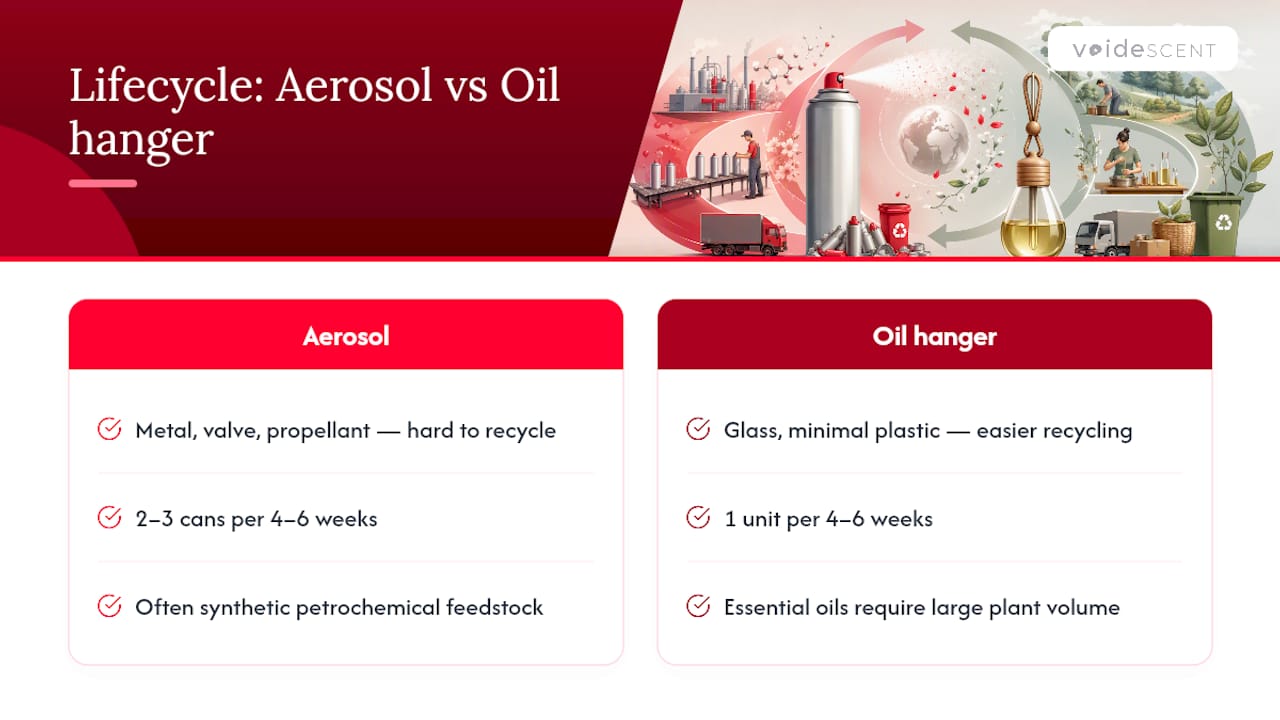
An eco label rarely accounts for the entire journey from raw material to landfill, and that gap is worth understanding before you assume “certified” means “low impact end to end.” Production starts with sourcing, whether that’s petrochemical feedstock for synthetic fragrance compounds or agricultural crops for essential oils. Essential oil extraction is resource-intensive per unit of scent. Producing a small amount of rose or sandalwood oil requires a large volume of plant material, water, and energy, which is part of why genuinely sustainable natural fragrance brands are more expensive, not less.
Packaging is the second lifecycle stage where impact diverges sharply between formats. Aerosol cans combine metal, plastic valve components, and propellant gas, all of which complicate recycling even when the can itself is technically recyclable. Reed diffusers and oil hangers use glass or minimal plastic, which recycles more cleanly and in far smaller volumes overall.
Disposal is where slow-release formats pull ahead most clearly. A single oil hanger lasting four to six weeks generates one unit of waste over that period. A typical aerosol can, used at a similar rate, might be replaced two or three times in the same window, each replacement adding a full can, valve, and residual propellant to the waste stream. For a closer look at cutting that waste specifically, this guide on reducing air freshener waste covers refill strategies most people overlook.
The Major Eco Labels You’ll Actually See on Air Fresheners
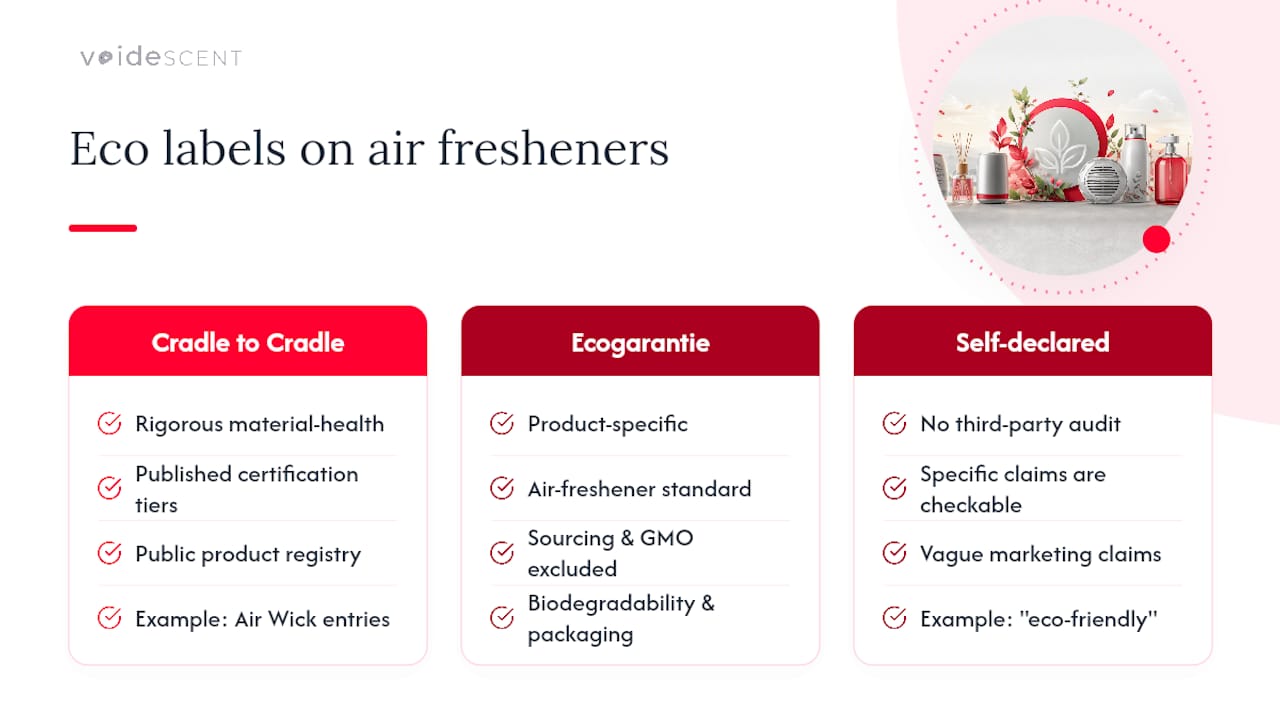
Not every label carrying “eco” in its name deserves equal weight, and knowing which ones actually audit air fresheners specifically saves you from chasing decoration. Cradle to Cradle remains the most rigorous general-purpose material-health certification available to this category, with published tiers and a public product registry you can check directly, as the C2C registry demonstrates with its Air Wick entries.
Ecogarantie occupies a narrower but more product-specific role. Its standard was written with air fresheners in mind, covering ingredient sourcing, GMO exclusion, biodegradability, and permitted packaging materials directly, rather than applying a generic sustainability framework borrowed from other product categories.
Beyond these two, most “eco” or “green” claims on air freshener packaging are self-declared, meaning the brand makes the claim without third-party audit. That’s not automatically false, but it carries none of the verification weight of an audited certification. A brand stating “no synthetic phthalates” is making a checkable, specific claim; a brand stating “eco-friendly formula” with no further detail is making a marketing statement with nothing behind it. For a deeper look at one ingredient category worth watching, this piece on phthalates in air fresheners explains why that particular claim needs scrutiny.
Credibility, in short, tracks with specificity. The more precisely a claim can be checked against a public registry or a named standard, the more it’s worth trusting.
Why Transparency Beats “Natural” as a Buying Signal
The honest recommendation is to choose brands willing to hand over documents, not just adjectives. Ask for the Allergen Declaration before you ask about anything else. Natural formulations often mean more declared allergens, not fewer, so “natural” is a starting point for a conversation, not the end of one. The brands worth your money are the ones that answer that email fast.
— Azanone
Where Voidescent Fits Into This Checklist
If you’ve made it through the checklist above, Voidescent is built around exactly what it asks for: essential-oil formulas without synthetic filler chemicals, minimalist packaging that skips the aerosol-and-plastic-valve waste stream, and a slow-release design meant to last four to six weeks per hanger instead of fading in days. The Heavens and Descent fragrances both use that same oil-based, long-duration format, while Nebula rounds out the current lineup for drivers who want a different scent profile without switching formats.
If you’re allergy-prone, request the Allergen Declaration before you buy, from Voidescent or any other brand. Trying a hanger carries no real risk if the scent or format doesn’t suit your car. Browse the full car hanger fragrance lineup to compare scents, or check with support directly for allergen documentation before checkout.
For anyone whose car odor problem is beyond what fragrance can fix, a professional option like ozone treatment addresses embedded smoke or mildew odors at the source rather than masking them, which is worth knowing before you assume a stronger scent is the answer.
Sources
- Commission Regulation (EU) 2023/1545 (fragrance allergen labelling)
- Sustainability product labels: Cradle to Cradle overview (Mitchell Center/UMaine)
- Tutorial: Declaring fragrance allergens on cosmetic labels (OEMHallmark)
FAQ
What are some eco-friendly air freshener brands?
Look for brands that publish Allergen Declarations and hold verifiable third-party certifications like Cradle to Cradle or Ecogarantie rather than ones that just print “eco” on the label. Voidescent’s essential-oil car hangers follow this transparency approach, avoiding synthetic aerosol propellants entirely.
What are the healthiest air fresheners?
The healthiest options are typically slow-release, low-VOC formats such as oil hangers or wax melts used in well-ventilated spaces, rather than high-concentration aerosol sprays. Even natural essential-oil products can trigger reactions in sensitive people, so checking the Allergen Declaration matters more than checking whether the formula is labeled “natural.”
What are some eco-friendly air fresheners available in the UK?
UK shoppers can look for products carrying Cradle to Cradle material-health certification, confirmed on the C2C public registry, or Ecogarantie-certified formulations built to that standard’s air-freshener-specific rules. Refillable oil-hanger formats also tend to generate less packaging waste over time than single-use aerosol cans.
What three ingredients make your house smell good naturally?
Citrus peel, cinnamon, and vanilla are commonly used for natural home scenting, though citrus oils in particular can still contain declarable allergens like limonene above certain concentrations. If you’re sensitive to fragrance, patch-test any natural ingredient the same way you’d check a commercial product’s allergen list.
How much does a Voidescent car hanger fragrance cost?
Current pricing for Voidescent’s car hanger fragrances, including Heavens, Descent, and Nebula, is listed directly on the Voidescent product pages.