

Match Scents to Your Drive: Peppermint vs Bergamot for Driving Anxiety
Try a calming blend of lavender and bergamot in a vent-mounted, slow-release hanger, and test it in a parked car before your first real drive. If you need alertness instead of calm, peppermint is the better pick for long, monotonous stretches. Either way, patch-test for allergies first and check with anyone who rides with you regularly, since a scent that soothes you might overwhelm a passenger.
TL;DR:
- Peppermint improves alertness and reduces aggressive driving, especially during monotonous highway stretches, but bergamot better stabilizes responses in urban traffic.
- Blended essential oils provide stronger stress recovery signals in the brain compared to single notes like lavender, but individual scent associations can affect relaxation.
- Slow-release car scent hangers, personal inhalers, and testing in parked cars first are safest methods to incorporate aromatherapy while driving.
- Scent use should be part of a broader anxiety management toolkit, including route planning and breathing exercises, with regular replacement every four to six weeks.
- Context matters: stimulating scents help understimulated drivers, while calming or balancing oils are better for complex traffic or high-anxiety days.
Table of Contents
- What Essential Oils Work Best for Driving Anxiety?
- How Do You Safely Use Aromatherapy While Driving?
- Building a Driving-Anxiety Toolkit That Actually Works
- What Does the Research Say About Scent and Driving Stress?
- A Realistic Take on Scent and Driving Anxiety
- Which Voidescent Scent Fits Your Driving Toolkit?
- Sources
What Essential Oils Work Best for Driving Anxiety?
Not every calming oil belongs in a car, and not every car oil belongs on a stressful commute. The oils worth trusting fall into three functional camps, and knowing which one you need matters more than knowing which one smells nicest.
- Calming: Lavender, bergamot, and rose. These are the go-to choices for pre-drive nerves, test anxiety, or bumper-to-bumper traffic where your heart rate is climbing for no good reason.
- Alerting: Peppermint and lemon. Best for long highway stretches where boredom, not panic, is the risk.
- Mood-lift: Orange and neroli. Useful for the “I just need this drive to feel less gray” days rather than acute anxiety spikes.
The research backs a context-based approach rather than a single best oil. A driving simulator study on peppermint found it significantly reduced aggressive driving behaviors, with a medium effect size on alertness (p=0.033). Meanwhile, research on olfactory intervention in driver assistance contexts found peppermint sustains vigilance on monotonous highway drives, but bergamot does a better job stabilizing response rhythms in dense, complex urban traffic. That’s the core insight: match the oil to the demand of the drive, not just to your mood.
Blends often outperform single notes for anxiety specifically. A lab study using EEG measurements found blended essential oils produced stronger stress-recovery signatures than lavender alone, with better theta-band brain connectivity. Your own scent history counts too. If lavender reminds you of a dentist’s office, it won’t relax you no matter what the studies say.
How Do You Safely Use Aromatherapy While Driving?
Delivery method changes everything about how safe and effective a scent is behind the wheel. Vent clips diffuse fast but flood the cabin, which is risky if you’re sensitive to strong smells or driving with passengers. Hanging slow-release options, like a scent hanger, give you a steady, low background presence without any hands-on interaction while moving. Personal inhalers offer the most control since you choose exactly when to use them, but they require taking a hand off the wheel briefly. Dab-on pads sit in a middle ground: strong and portable, but harder to dose precisely.
Test any new scent before it ever rides along on a real trip:
- Check the dilution. Pre-diluted car products are safer than neat essential oils near your face.
- Do a home test. Smell it in your living room first and wait 20 minutes to check for headache or irritation.
- Sit in a parked car with the product placed where you’ll actually use it, engine off, for 5 to 10 minutes.
- Take a short, low-traffic drive using only a light dose before trusting it on your regular commute.
Never apply oils to your skin while driving, keep at least one window cracked for ventilation, and ask passengers about sensitivities before you commit to a scent for a shared ride. Qualitative research on how people manage driving anxiety found that in-vehicle coping strategies, including aromatherapy, can backfire if they add distraction instead of reducing it. That’s the whole reason for testing first.
Pro Tip: Use scent as a breathing anchor. Take two slow inhales through your nose timed to a four-count box-breathing pattern (inhale four, hold four, exhale four, hold four) each time you catch the fragrance. Your brain starts associating the smell with the calming breath pattern within a few drives, so eventually the scent alone helps trigger the exhale.

Building a Driving-Anxiety Toolkit That Actually Works
Aromatherapy works best as one tool among several, not a standalone fix. A compact kit takes five minutes to assemble and covers most anxious-driving scenarios you’ll actually face.
- A slow-release scent hanger or sample vial for ambient calm on every drive.
- A personal inhaler stick for acute spikes, like merging onto a highway or sitting in gridlock.
- A pre-built playlist or audio anchor for drives where scent alone isn’t enough.
- A written route checklist (parking plan, rest stops, exit numbers) to cut down on the unknowns that fuel anxiety in the first place.
Use the kit across the trip’s timeline rather than all at once. Before you leave, do a two-minute breathing check paired with your calming scent. Mid-drive, if tension builds, reach for the personal inhaler rather than adjusting the ambient diffuser, since it gives you a controlled, deliberate dose. If anxiety spikes hard, pull over somewhere safe, cut the engine, and use the inhaler with box breathing until your heart rate settles.
Maintenance keeps the whole system working. Most slow-release hangers hold their scent for four to six weeks before needing replacement; write the start date somewhere you’ll see it. Store inhalers and vials away from direct sunlight and heat, since both degrade essential oils faster.
| Kit Item | Best Used When | Replace/Maintain |
|---|---|---|
| Scent hanger | Every drive, ambient calm | Every 4 to 6 weeks |
| Personal inhaler | Acute anxiety spikes | Refill as scent fades |
| Playlist/audio anchor | Long or monotonous drives | Update monthly |
| Route checklist | Before unfamiliar trips | Rewrite per destination |
What Does the Research Say About Scent and Driving Stress?
The strongest evidence points to context, not a single miracle oil. Peppermint’s benefits show up clearly in monotony: a driving simulator trial found it reduced aggressive driving behavior with statistically significant results. But dense urban driving is a different demand entirely, and that’s where bergamot does more of the work by stabilizing response rhythms in complex traffic rather than simply boosting alertness.
This tracks with a well-established idea in performance psychology, the Yerkes-Dodson principle, which holds that arousal helps performance up to a point and then hurts it. A stimulating scent like peppermint is great for a driver who’s understimulated on a flat, empty highway. That same scent could push an already-anxious driver stuck in traffic further into overstimulation.
Blended essential oils showed stronger neural markers of stress recovery than single-note lavender, with enhanced theta-band connectivity suggesting deeper physiological calming.
That finding, from a controlled EEG study on olfactory stress recovery, lines up with clinical guidance from Johns Hopkins Medicine, which notes that scent molecules reach the limbic system fast enough to shift mood within seconds. The practical takeaway: test any new scent in a calm, stationary setting first, favor low-dose slow-release delivery over strong bursts, and skip stimulating oils entirely on days when your anxiety is already running high.
A Realistic Take on Scent and Driving Anxiety
Aromatherapy is not a cure for driving anxiety, and treating it that way sets people up to feel like a failure when a bad drive still happens. What it actually does is lower the baseline tension enough that your other coping tools, breathing, route planning, a familiar playlist, get a fair chance to work. Voidescent builds its scent hangers for four to six weeks of consistent, evolving fragrance because a scent that fades in three days can’t build the kind of association your nervous system needs to calm down on cue, and every order carries a money-back guarantee if it doesn’t work for your car. If your anxiety is severe or worsening, talk to a doctor or therapist. Scent supports the work; it doesn’t replace it.
— Azanone
Which Voidescent Scent Fits Your Driving Toolkit?
Voidescent is built specifically for the slow-release, low-dose approach this article recommends, not the flood-the-cabin blast of a synthetic clip-on. For the calming role, Heavens works as your lavender-and-bergamot equivalent for daily commutes and pre-drive nerves. For urban stress and stop-and-go traffic, Descent leans into the balanced, grounding profile that bergamot blends perform well in simulator studies. If you want a long, steady presence for road trips or daily highway driving without constant swapping, Nebula is built for low-dose, extended release. And if you already know you respond well to stronger fragrance and want more intensity once you’ve tested a lighter option first, Voidegrail is the scent-maxxing pick.
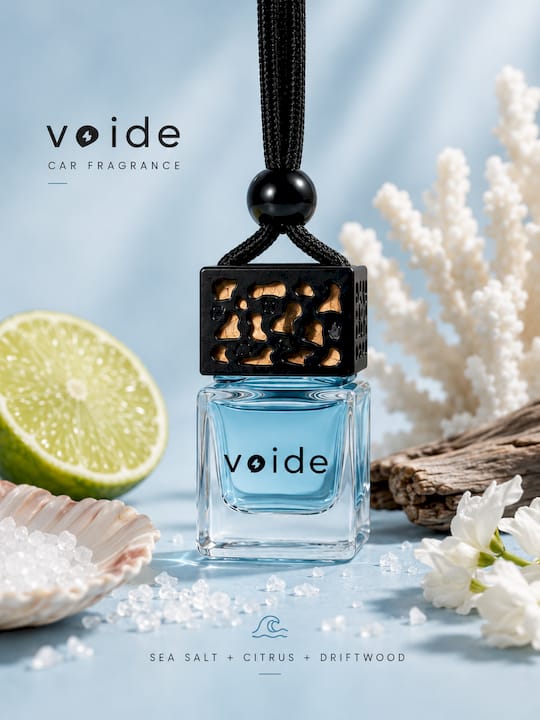
Hang any of these from the vent or mirror, never on the skin, and expect four to six weeks of consistent scent life before a swap. Browse the full scent collection or start at the Voidescent homepage if you’re not sure which one fits your drive. Every order comes backed by a money-back guarantee, so testing your first blend costs you nothing but the drive itself.
Sources
- Aroma of the essential oil of peppermint reduces aggressive driving behaviour in healthy adults
- Cognitive activation and emotional regulation effects of olfactory intervention in the context of advanced driver assistance systems
- Aroma olfactory intervention: enhancing stress recovery via brain neural activity modulation
- Determining how individuals manage their driving anxiety